

56
T. Okino and K. Yamanouchi
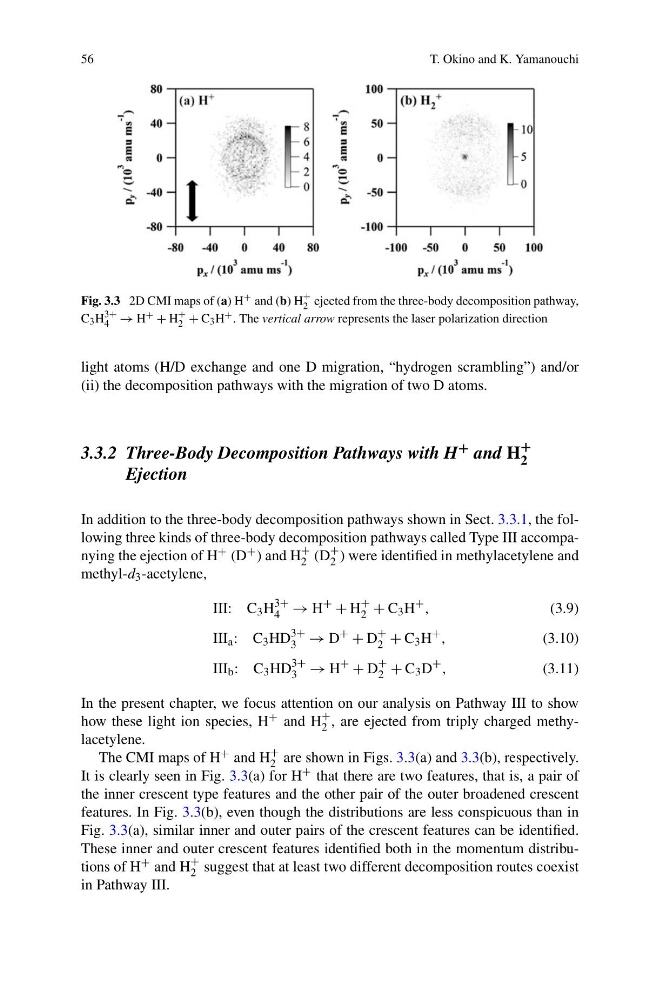
Fig. 3.3 2D CMI maps of (a) H + and (b) H
+
2 ejected from the three-body decomposition pathway,
C 3 H
3+
4 → H + + H
+
2 + C 3 H + . The vertical arrow represents the laser polarization direction
light atoms (H/D exchange and one D migration, “hydrogen scrambling”) and/or
(ii) the decomposition pathways with the migration of two D atoms.
3.3.2 Three-Body Decomposition Pathways with H + and H
+
2
Ejection
In addition to the three-body decomposition pathways shown in Sect. 3.3.1, the following three kinds of three-body decomposition pathways called Type III accompanying the ejection of H + (D + ) and H
+
2 (D
+
2 ) were identified in methylacetylene and
methyl-d 3 -acetylene,
III: C 3 H
3+
4 → H
+
+ H
+
2 + C 3 H
+ ,
(3.9)
III a : C 3 HD
3+
3 → D
+
+ D
+
2 + C 3 H
+ ,
(3.10)
III b : C 3 HD
3+
3 → H
+
+ D
+
2 + C 3 D
+ ,
(3.11)
In the present chapter, we focus attention on our analysis on Pathway III to show
how these light ion species, H + and H
+
2 , are ejected from triply charged methylacetylene.
The CMI maps of H + and H
+
2 are shown in Figs. 3.3(a) and 3.3(b), respectively.
It is clearly seen in Fig. 3.3(a) for H + that there are two features, that is, a pair of
the inner crescent type features and the other pair of the outer broadened crescent
features. In Fig. 3.3(b), even though the distributions are less conspicuous than in
Fig. 3.3(a), similar inner and outer pairs of the crescent features can be identified.
These inner and outer crescent features identified both in the momentum distributions of H + and H
+
2 suggest that at least two different decomposition routes coexist
in Pathway III.
T. Okino and K. Yamanouchi
Fig. 3.3 2D CMI maps of (a) H + and (b) H
+
2 ejected from the three-body decomposition pathway,
C 3 H
3+
4 → H + + H
+
2 + C 3 H + . The vertical arrow represents the laser polarization direction
light atoms (H/D exchange and one D migration, “hydrogen scrambling”) and/or
(ii) the decomposition pathways with the migration of two D atoms.
3.3.2 Three-Body Decomposition Pathways with H + and H
+
2
Ejection
In addition to the three-body decomposition pathways shown in Sect. 3.3.1, the following three kinds of three-body decomposition pathways called Type III accompanying the ejection of H + (D + ) and H
+
2 (D
+
2 ) were identified in methylacetylene and
methyl-d 3 -acetylene,
III: C 3 H
3+
4 → H
+
+ H
+
2 + C 3 H
+ ,
(3.9)
III a : C 3 HD
3+
3 → D
+
+ D
+
2 + C 3 H
+ ,
(3.10)
III b : C 3 HD
3+
3 → H
+
+ D
+
2 + C 3 D
+ ,
(3.11)
In the present chapter, we focus attention on our analysis on Pathway III to show
how these light ion species, H + and H
+
2 , are ejected from triply charged methylacetylene.
The CMI maps of H + and H
+
2 are shown in Figs. 3.3(a) and 3.3(b), respectively.
It is clearly seen in Fig. 3.3(a) for H + that there are two features, that is, a pair of
the inner crescent type features and the other pair of the outer broadened crescent
features. In Fig. 3.3(b), even though the distributions are less conspicuous than in
Fig. 3.3(a), similar inner and outer pairs of the crescent features can be identified.
These inner and outer crescent features identified both in the momentum distributions of H + and H
+
2 suggest that at least two different decomposition routes coexist
in Pathway III.