

34
A. Palacios et al.
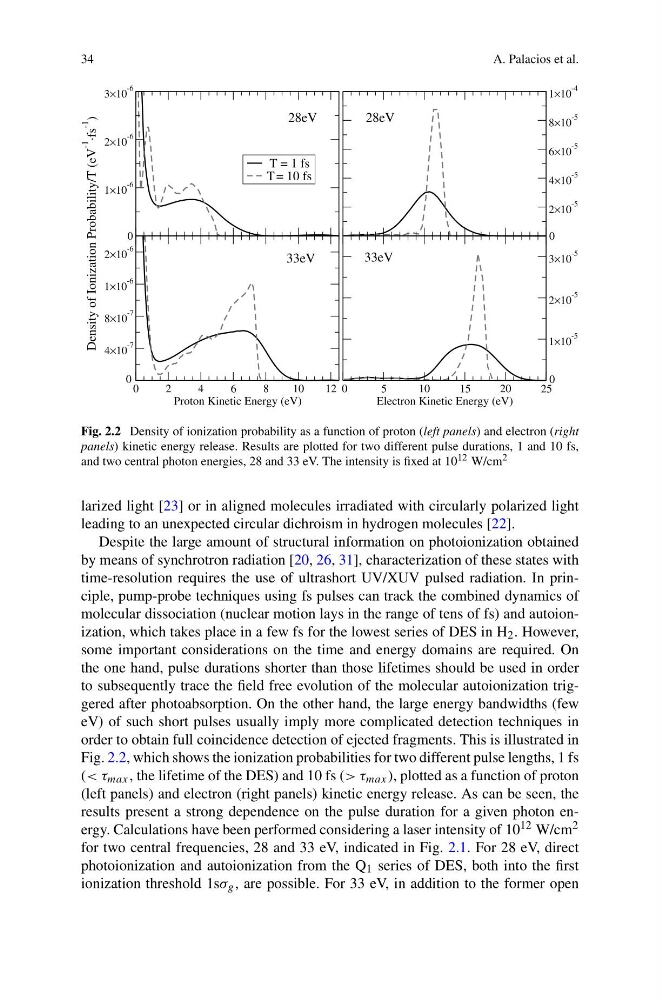
Fig. 2.2 Density of ionization probability as a function of proton (left panels) and electron (right
panels) kinetic energy release. Results are plotted for two different pulse durations, 1 and 10 fs,
and two central photon energies, 28 and 33 eV. The intensity is fixed at 10 12 W/cm 2
larized light [23] or in aligned molecules irradiated with circularly polarized light
leading to an unexpected circular dichroism in hydrogen molecules [22].
Despite the large amount of structural information on photoionization obtained
by means of synchrotron radiation [20, 26, 31], characterization of these states with
time-resolution requires the use of ultrashort UV/XUV pulsed radiation. In principle, pump-probe techniques using fs pulses can track the combined dynamics of
molecular dissociation (nuclear motion lays in the range of tens of fs) and autoionization, which takes place in a few fs for the lowest series of DES in H 2 . However,
some important considerations on the time and energy domains are required. On
the one hand, pulse durations shorter than those lifetimes should be used in order
to subsequently trace the field free evolution of the molecular autoionization triggered after photoabsorption. On the other hand, the large energy bandwidths (few
eV) of such short pulses usually imply more complicated detection techniques in
order to obtain full coincidence detection of ejected fragments. This is illustrated in
Fig. 2.2, which shows the ionization probabilities for two different pulse lengths, 1 fs
(< τ max , the lifetime of the DES) and 10 fs (> τ max ), plotted as a function of proton
(left panels) and electron (right panels) kinetic energy release. As can be seen, the
results present a strong dependence on the pulse duration for a given photon energy. Calculations have been performed considering a laser intensity of 10 12 W/cm 2
for two central frequencies, 28 and 33 eV, indicated in Fig. 2.1. For 28 eV, direct
photoionization and autoionization from the Q 1 series of DES, both into the first
ionization threshold 1sσ g , are possible. For 33 eV, in addition to the former open
A. Palacios et al.
Fig. 2.2 Density of ionization probability as a function of proton (left panels) and electron (right
panels) kinetic energy release. Results are plotted for two different pulse durations, 1 and 10 fs,
and two central photon energies, 28 and 33 eV. The intensity is fixed at 10 12 W/cm 2
larized light [23] or in aligned molecules irradiated with circularly polarized light
leading to an unexpected circular dichroism in hydrogen molecules [22].
Despite the large amount of structural information on photoionization obtained
by means of synchrotron radiation [20, 26, 31], characterization of these states with
time-resolution requires the use of ultrashort UV/XUV pulsed radiation. In principle, pump-probe techniques using fs pulses can track the combined dynamics of
molecular dissociation (nuclear motion lays in the range of tens of fs) and autoionization, which takes place in a few fs for the lowest series of DES in H 2 . However,
some important considerations on the time and energy domains are required. On
the one hand, pulse durations shorter than those lifetimes should be used in order
to subsequently trace the field free evolution of the molecular autoionization triggered after photoabsorption. On the other hand, the large energy bandwidths (few
eV) of such short pulses usually imply more complicated detection techniques in
order to obtain full coincidence detection of ejected fragments. This is illustrated in
Fig. 2.2, which shows the ionization probabilities for two different pulse lengths, 1 fs
(< τ max , the lifetime of the DES) and 10 fs (> τ max ), plotted as a function of proton
(left panels) and electron (right panels) kinetic energy release. As can be seen, the
results present a strong dependence on the pulse duration for a given photon energy. Calculations have been performed considering a laser intensity of 10 12 W/cm 2
for two central frequencies, 28 and 33 eV, indicated in Fig. 2.1. For 28 eV, direct
photoionization and autoionization from the Q 1 series of DES, both into the first
ionization threshold 1sσ g , are possible. For 33 eV, in addition to the former open