

2 XUV Lasers for Ultrafast Electronic Control in H 2
33
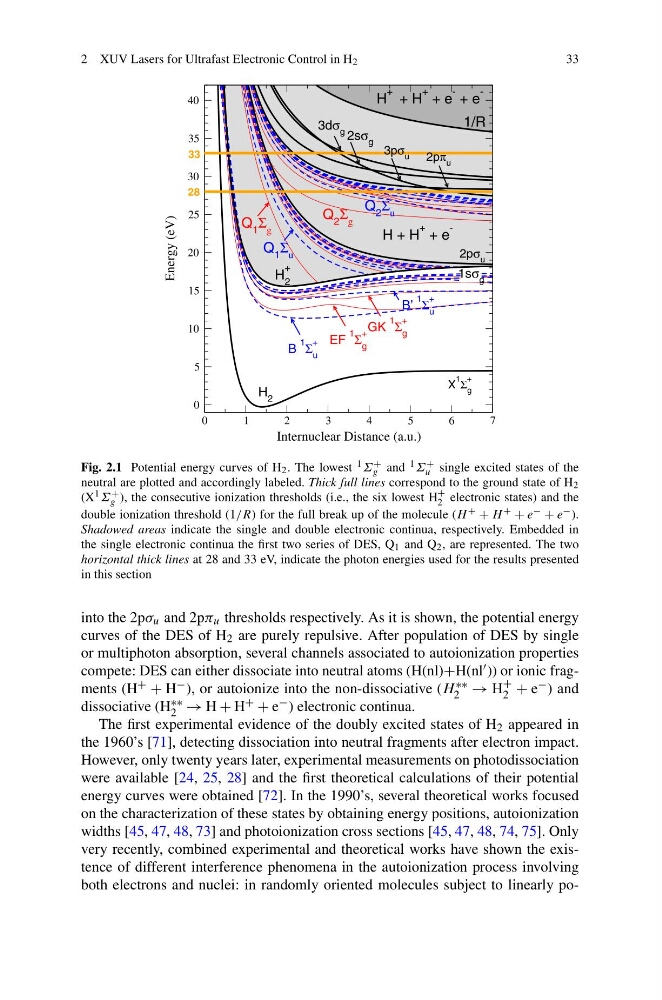
Fig. 2.1 Potential energy curves of H 2 . The lowest 1 Σ +
g and 1 Σ +
u single excited states of the
neutral are plotted and accordingly labeled. Thick full lines correspond to the ground state of H 2
(X 1 Σ +
g ), the consecutive ionization thresholds (i.e., the six lowest H
+
2 electronic states) and the
double ionization threshold (1/R) for the full break up of the molecule (H + + H + + e − + e − ).
Shadowed areas indicate the single and double electronic continua, respectively. Embedded in
the single electronic continua the first two series of DES, Q 1 and Q 2 , are represented. The two
horizontal thick lines at 28 and 33 eV, indicate the photon energies used for the results presented
in this section
into the 2pσ u and 2pπ u thresholds respectively. As it is shown, the potential energy
curves of the DES of H 2 are purely repulsive. After population of DES by single
or multiphoton absorption, several channels associated to autoionization properties
compete: DES can either dissociate into neutral atoms (H(nl)+H(nl )) or ionic fragments (H + + H − ), or autoionize into the non-dissociative (H ∗∗
2 → H
+
2 + e − ) and
dissociative (H ∗∗
2 → H + H + + e − ) electronic continua.
The first experimental evidence of the doubly excited states of H 2 appeared in
the 1960’s [71], detecting dissociation into neutral fragments after electron impact.
However, only twenty years later, experimental measurements on photodissociation
were available [24, 25, 28] and the first theoretical calculations of their potential
energy curves were obtained [72]. In the 1990’s, several theoretical works focused
on the characterization of these states by obtaining energy positions, autoionization
widths [45, 47, 48, 73] and photoionization cross sections [45, 47, 48, 74, 75]. Only
very recently, combined experimental and theoretical works have shown the existence of different interference phenomena in the autoionization process involving
both electrons and nuclei: in randomly oriented molecules subject to linearly po-
33
Fig. 2.1 Potential energy curves of H 2 . The lowest 1 Σ +
g and 1 Σ +
u single excited states of the
neutral are plotted and accordingly labeled. Thick full lines correspond to the ground state of H 2
(X 1 Σ +
g ), the consecutive ionization thresholds (i.e., the six lowest H
+
2 electronic states) and the
double ionization threshold (1/R) for the full break up of the molecule (H + + H + + e − + e − ).
Shadowed areas indicate the single and double electronic continua, respectively. Embedded in
the single electronic continua the first two series of DES, Q 1 and Q 2 , are represented. The two
horizontal thick lines at 28 and 33 eV, indicate the photon energies used for the results presented
in this section
into the 2pσ u and 2pπ u thresholds respectively. As it is shown, the potential energy
curves of the DES of H 2 are purely repulsive. After population of DES by single
or multiphoton absorption, several channels associated to autoionization properties
compete: DES can either dissociate into neutral atoms (H(nl)+H(nl )) or ionic fragments (H + + H − ), or autoionize into the non-dissociative (H ∗∗
2 → H
+
2 + e − ) and
dissociative (H ∗∗
2 → H + H + + e − ) electronic continua.
The first experimental evidence of the doubly excited states of H 2 appeared in
the 1960’s [71], detecting dissociation into neutral fragments after electron impact.
However, only twenty years later, experimental measurements on photodissociation
were available [24, 25, 28] and the first theoretical calculations of their potential
energy curves were obtained [72]. In the 1990’s, several theoretical works focused
on the characterization of these states by obtaining energy positions, autoionization
widths [45, 47, 48, 73] and photoionization cross sections [45, 47, 48, 74, 75]. Only
very recently, combined experimental and theoretical works have shown the existence of different interference phenomena in the autoionization process involving
both electrons and nuclei: in randomly oriented molecules subject to linearly po-