

276
F. Chaussard et al.
11.3.1.1 Theoretical Description: Liouville-von Neumann Equation
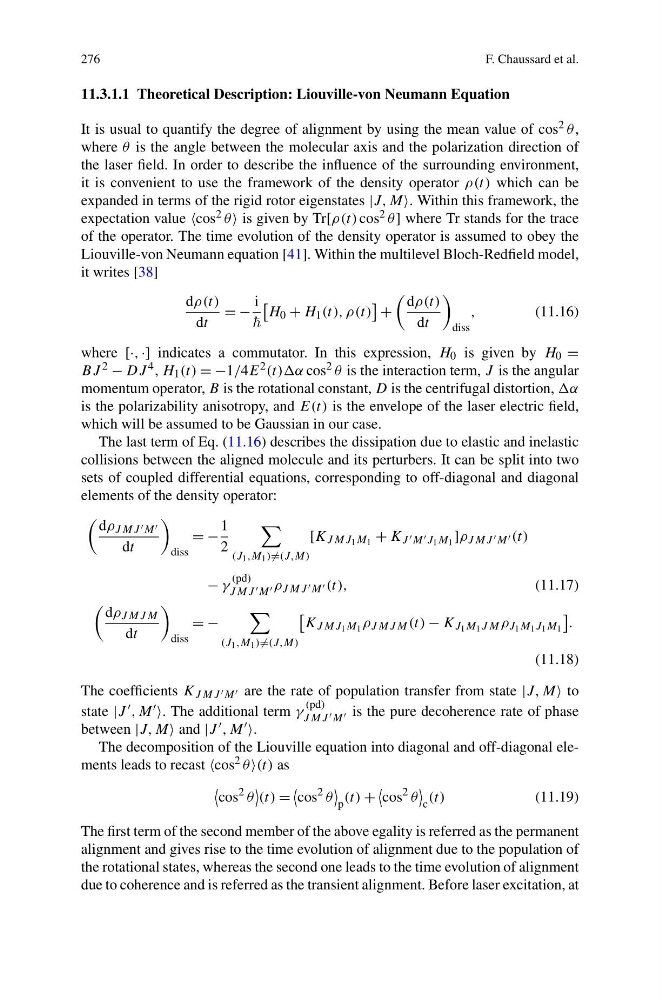
It is usual to quantify the degree of alignment by using the mean value of cos 2 θ ,
where θ is the angle between the molecular axis and the polarization direction of
the laser field. In order to describe the influence of the surrounding environment,
it is convenient to use the framework of the density operator ρ(t) which can be
expanded in terms of the rigid rotor eigenstates |J, M. Within this framework, the
expectation value cos 2 θ is given by Tr[ρ(t) cos 2 θ ] where Tr stands for the trace
of the operator. The time evolution of the density operator is assumed to obey the
Liouville-von Neumann equation [41]. Within the multilevel Bloch-Redfield model,
it writes [38]
dρ(t)
dt
= −
i
H 0 + H 1 (t), ρ(t)
+
dρ(t)
dt
diss
,
(11.16)
where [·, ·] indicates a commutator. In this expression, H 0 is given by H 0 =
BJ 2 − DJ 4 , H 1 (t) = −1/4E 2 (t))α cos 2 θ is the interaction term, J is the angular
momentum operator, B is the rotational constant, D is the centrifugal distortion, α
is the polarizability anisotropy, and E(t) is the envelope of the laser electric field,
which will be assumed to be Gaussian in our case.
The last term of Eq. (11.16) describes the dissipation due to elastic and inelastic
collisions between the aligned molecule and its perturbers. It can be split into two
sets of coupled differential equations, corresponding to off-diagonal and diagonal
elements of the density operator:
dρ J MJ M
dt
diss
= −
1
2
(J 1 ,M 1 ) =(J,M)
[K J MJ 1 M 1 + K J M J 1 M 1 ]ρ J MJ M (t)
− γ
(pd)
J MJ M ρ J MJ M (t),
(11.17)
dρ J MJ M
dt
diss
= −
(J 1 ,M 1 ) =(J,M)
K J MJ 1 M 1 ρ J MJ M (t) − K J 1 M 1 J M ρ J 1 M 1 J 1 M 1
.
(11.18)
The coefficients K J MJ M are the rate of population transfer from state |J, M to
state |J , M . The additional term γ
(pd)
J MJ M is the pure decoherence rate of phase
between |J, M and |J , M .
The decomposition of the Liouville equation into diagonal and off-diagonal elements leads to recast cos 2 θ (t) as
cos
2 θ
(t) =
cos
2 θ
p
(t) +
cos
2 θ
c
(t)
(11.19)
The first term of the second member of the above egality is referred as the permanent
alignment and gives rise to the time evolution of alignment due to the population of
the rotational states, whereas the second one leads to the time evolution of alignment
due to coherence and is referred as the transient alignment. Before laser excitation, at
F. Chaussard et al.
11.3.1.1 Theoretical Description: Liouville-von Neumann Equation
It is usual to quantify the degree of alignment by using the mean value of cos 2 θ ,
where θ is the angle between the molecular axis and the polarization direction of
the laser field. In order to describe the influence of the surrounding environment,
it is convenient to use the framework of the density operator ρ(t) which can be
expanded in terms of the rigid rotor eigenstates |J, M. Within this framework, the
expectation value cos 2 θ is given by Tr[ρ(t) cos 2 θ ] where Tr stands for the trace
of the operator. The time evolution of the density operator is assumed to obey the
Liouville-von Neumann equation [41]. Within the multilevel Bloch-Redfield model,
it writes [38]
dρ(t)
dt
= −
i
H 0 + H 1 (t), ρ(t)
+
dρ(t)
dt
diss
,
(11.16)
where [·, ·] indicates a commutator. In this expression, H 0 is given by H 0 =
BJ 2 − DJ 4 , H 1 (t) = −1/4E 2 (t))α cos 2 θ is the interaction term, J is the angular
momentum operator, B is the rotational constant, D is the centrifugal distortion, α
is the polarizability anisotropy, and E(t) is the envelope of the laser electric field,
which will be assumed to be Gaussian in our case.
The last term of Eq. (11.16) describes the dissipation due to elastic and inelastic
collisions between the aligned molecule and its perturbers. It can be split into two
sets of coupled differential equations, corresponding to off-diagonal and diagonal
elements of the density operator:
dρ J MJ M
dt
diss
= −
1
2
(J 1 ,M 1 ) =(J,M)
[K J MJ 1 M 1 + K J M J 1 M 1 ]ρ J MJ M (t)
− γ
(pd)
J MJ M ρ J MJ M (t),
(11.17)
dρ J MJ M
dt
diss
= −
(J 1 ,M 1 ) =(J,M)
K J MJ 1 M 1 ρ J MJ M (t) − K J 1 M 1 J M ρ J 1 M 1 J 1 M 1
.
(11.18)
The coefficients K J MJ M are the rate of population transfer from state |J, M to
state |J , M . The additional term γ
(pd)
J MJ M is the pure decoherence rate of phase
between |J, M and |J , M .
The decomposition of the Liouville equation into diagonal and off-diagonal elements leads to recast cos 2 θ (t) as
cos
2 θ
(t) =
cos
2 θ
p
(t) +
cos
2 θ
c
(t)
(11.19)
The first term of the second member of the above egality is referred as the permanent
alignment and gives rise to the time evolution of alignment due to the population of
the rotational states, whereas the second one leads to the time evolution of alignment
due to coherence and is referred as the transient alignment. Before laser excitation, at