

11 Optical Diagnostics with Ultrafast and Strong Field Raman Techniques
275
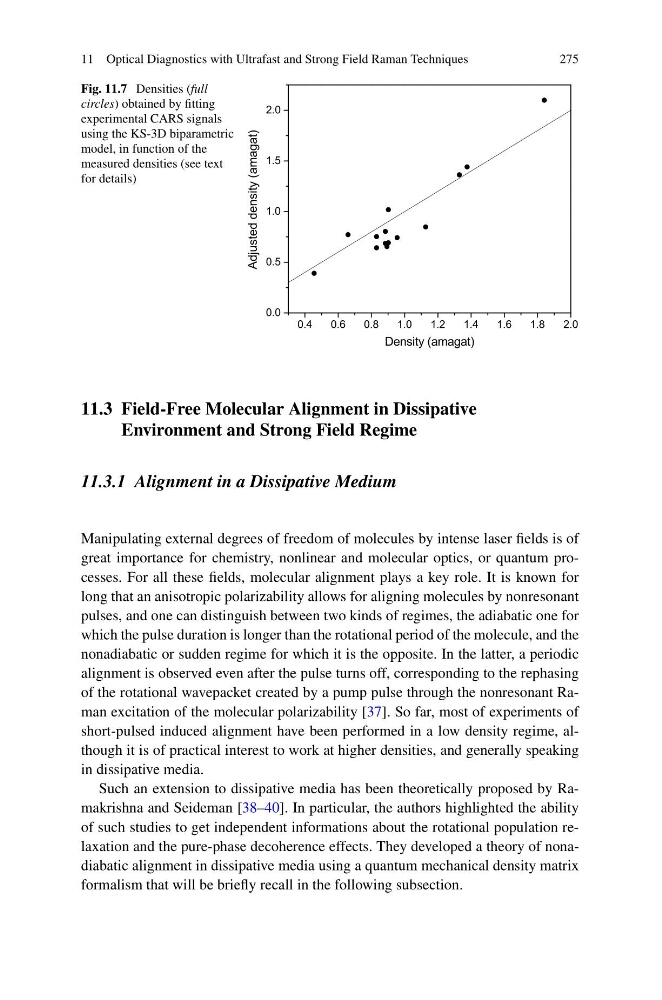
Fig. 11.7 Densities (full
circles) obtained by fitting
experimental CARS signals
using the KS-3D biparametric
model, in function of the
measured densities (see text
for details)
11.3 Field-Free Molecular Alignment in Dissipative
Environment and Strong Field Regime
11.3.1 Alignment in a Dissipative Medium
Manipulating external degrees of freedom of molecules by intense laser fields is of
great importance for chemistry, nonlinear and molecular optics, or quantum processes. For all these fields, molecular alignment plays a key role. It is known for
long that an anisotropic polarizability allows for aligning molecules by nonresonant
pulses, and one can distinguish between two kinds of regimes, the adiabatic one for
which the pulse duration is longer than the rotational period of the molecule, and the
nonadiabatic or sudden regime for which it is the opposite. In the latter, a periodic
alignment is observed even after the pulse turns off, corresponding to the rephasing
of the rotational wavepacket created by a pump pulse through the nonresonant Raman excitation of the molecular polarizability [37]. So far, most of experiments of
short-pulsed induced alignment have been performed in a low density regime, although it is of practical interest to work at higher densities, and generally speaking
in dissipative media.
Such an extension to dissipative media has been theoretically proposed by Ramakrishna and Seideman [38–40]. In particular, the authors highlighted the ability
of such studies to get independent informations about the rotational population relaxation and the pure-phase decoherence effects. They developed a theory of nonadiabatic alignment in dissipative media using a quantum mechanical density matrix
formalism that will be briefly recall in the following subsection.
275
Fig. 11.7 Densities (full
circles) obtained by fitting
experimental CARS signals
using the KS-3D biparametric
model, in function of the
measured densities (see text
for details)
11.3 Field-Free Molecular Alignment in Dissipative
Environment and Strong Field Regime
11.3.1 Alignment in a Dissipative Medium
Manipulating external degrees of freedom of molecules by intense laser fields is of
great importance for chemistry, nonlinear and molecular optics, or quantum processes. For all these fields, molecular alignment plays a key role. It is known for
long that an anisotropic polarizability allows for aligning molecules by nonresonant
pulses, and one can distinguish between two kinds of regimes, the adiabatic one for
which the pulse duration is longer than the rotational period of the molecule, and the
nonadiabatic or sudden regime for which it is the opposite. In the latter, a periodic
alignment is observed even after the pulse turns off, corresponding to the rephasing
of the rotational wavepacket created by a pump pulse through the nonresonant Raman excitation of the molecular polarizability [37]. So far, most of experiments of
short-pulsed induced alignment have been performed in a low density regime, although it is of practical interest to work at higher densities, and generally speaking
in dissipative media.
Such an extension to dissipative media has been theoretically proposed by Ramakrishna and Seideman [38–40]. In particular, the authors highlighted the ability
of such studies to get independent informations about the rotational population relaxation and the pure-phase decoherence effects. They developed a theory of nonadiabatic alignment in dissipative media using a quantum mechanical density matrix
formalism that will be briefly recall in the following subsection.