

272
F. Chaussard et al.
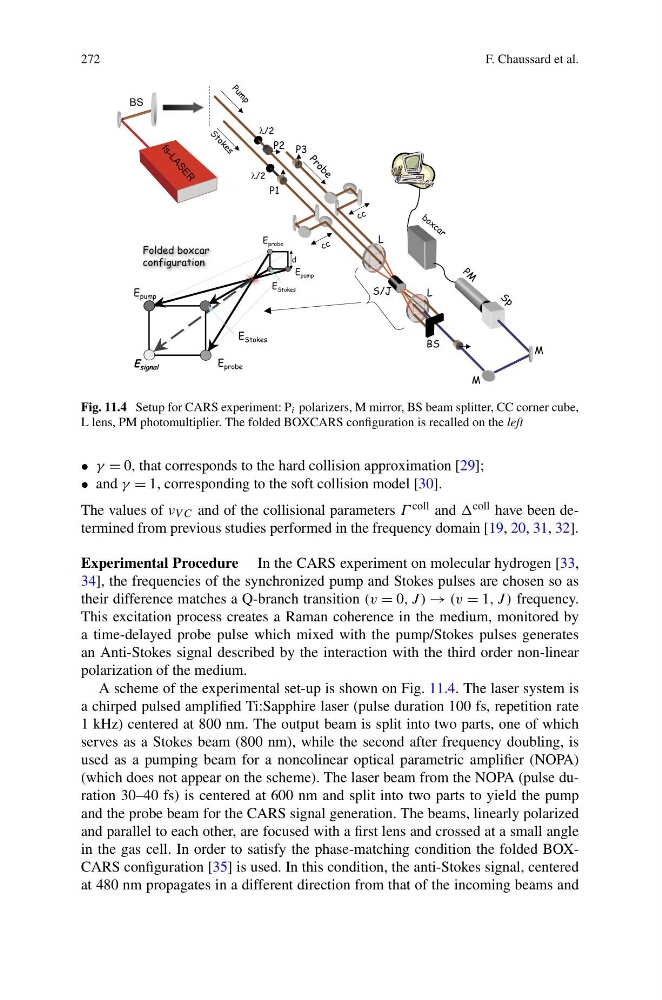
Fig. 11.4 Setup for CARS experiment: P i polarizers, M mirror, BS beam splitter, CC corner cube,
L lens, PM photomultiplier. The folded BOXCARS configuration is recalled on the left
• γ = 0, that corresponds to the hard collision approximation [29];
• and γ = 1, corresponding to the soft collision model [30].
The values of ν V C and of the collisional parameters Γ coll and coll have been determined from previous studies performed in the frequency domain [19, 20, 31, 32].
Experimental Procedure In the CARS experiment on molecular hydrogen [33,
34], the frequencies of the synchronized pump and Stokes pulses are chosen so as
their difference matches a Q-branch transition (v = 0, J ) → (v = 1, J ) frequency.
This excitation process creates a Raman coherence in the medium, monitored by
a time-delayed probe pulse which mixed with the pump/Stokes pulses generates
an Anti-Stokes signal described by the interaction with the third order non-linear
polarization of the medium.
A scheme of the experimental set-up is shown on Fig. 11.4. The laser system is
a chirped pulsed amplified Ti:Sapphire laser (pulse duration 100 fs, repetition rate
1 kHz) centered at 800 nm. The output beam is split into two parts, one of which
serves as a Stokes beam (800 nm), while the second after frequency doubling, is
used as a pumping beam for a noncolinear optical parametric amplifier (NOPA)
(which does not appear on the scheme). The laser beam from the NOPA (pulse duration 30–40 fs) is centered at 600 nm and split into two parts to yield the pump
and the probe beam for the CARS signal generation. The beams, linearly polarized
and parallel to each other, are focused with a first lens and crossed at a small angle
in the gas cell. In order to satisfy the phase-matching condition the folded BOXCARS configuration [35] is used. In this condition, the anti-Stokes signal, centered
at 480 nm propagates in a different direction from that of the incoming beams and
F. Chaussard et al.
Fig. 11.4 Setup for CARS experiment: P i polarizers, M mirror, BS beam splitter, CC corner cube,
L lens, PM photomultiplier. The folded BOXCARS configuration is recalled on the left
• γ = 0, that corresponds to the hard collision approximation [29];
• and γ = 1, corresponding to the soft collision model [30].
The values of ν V C and of the collisional parameters Γ coll and coll have been determined from previous studies performed in the frequency domain [19, 20, 31, 32].
Experimental Procedure In the CARS experiment on molecular hydrogen [33,
34], the frequencies of the synchronized pump and Stokes pulses are chosen so as
their difference matches a Q-branch transition (v = 0, J ) → (v = 1, J ) frequency.
This excitation process creates a Raman coherence in the medium, monitored by
a time-delayed probe pulse which mixed with the pump/Stokes pulses generates
an Anti-Stokes signal described by the interaction with the third order non-linear
polarization of the medium.
A scheme of the experimental set-up is shown on Fig. 11.4. The laser system is
a chirped pulsed amplified Ti:Sapphire laser (pulse duration 100 fs, repetition rate
1 kHz) centered at 800 nm. The output beam is split into two parts, one of which
serves as a Stokes beam (800 nm), while the second after frequency doubling, is
used as a pumping beam for a noncolinear optical parametric amplifier (NOPA)
(which does not appear on the scheme). The laser beam from the NOPA (pulse duration 30–40 fs) is centered at 600 nm and split into two parts to yield the pump
and the probe beam for the CARS signal generation. The beams, linearly polarized
and parallel to each other, are focused with a first lens and crossed at a small angle
in the gas cell. In order to satisfy the phase-matching condition the folded BOXCARS configuration [35] is used. In this condition, the anti-Stokes signal, centered
at 480 nm propagates in a different direction from that of the incoming beams and