

11 Optical Diagnostics with Ultrafast and Strong Field Raman Techniques
271
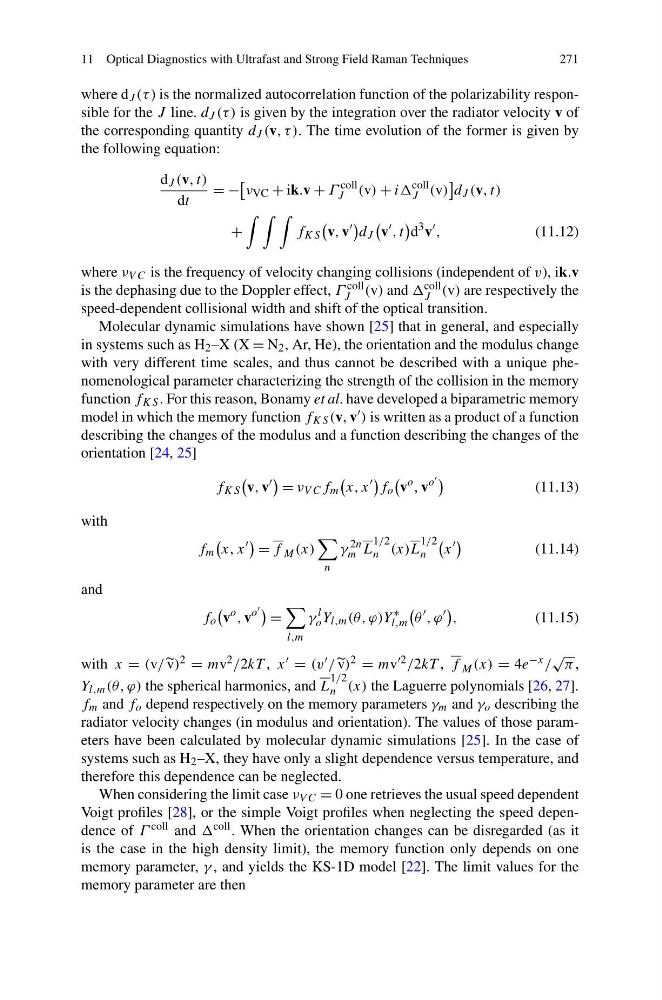
where d J (τ ) is the normalized autocorrelation function of the polarizability responsible for the J line. d J (τ ) is given by the integration over the radiator velocity v of
the corresponding quantity d J (v, τ ). The time evolution of the former is given by
the following equation:
d J (v, t)
dt
= −
ν VC + ik.v + Γ
coll
J (v) + ii
coll
J (v)
d J (v, t)
+
f KS
v, v
d J
v
, t
d
3 v
,
(11.12)
where ν V C is the frequency of velocity changing collisions (independent of v), ik.v
is the dephasing due to the Doppler effect, Γ coll
J (v) and coll
J (v) are respectively the
speed-dependent collisional width and shift of the optical transition.
Molecular dynamic simulations have shown [25] that in general, and especially
in systems such as H 2 –X (X = N 2 , Ar, He), the orientation and the modulus change
with very different time scales, and thus cannot be described with a unique phenomenological parameter characterizing the strength of the collision in the memory
function f KS . For this reason, Bonamy et al. have developed a biparametric memory
model in which the memory function f KS (v, v ) is written as a product of a function
describing the changes of the modulus and a function describing the changes of the
orientation [24, 25]
f KS
v, v
= ν V C f m
x, x
f o
v
o , v
o
(11.13)
with
f m
x, x
= f M (x)
n
γ
2n
m L
1/2
n (x)L
1/2
n
x
(11.14)
and
f o
v
o , v
o =
l,m
γ
l
o Y l,m (θ, ϕ)Y
∗
l,m
θ
, ϕ
,
(11.15)
with x = (v/ v) 2 = mv 2 /2kT , x = (v / v) 2 = mv 2 /2kT , f M (x) = 4e −x /
√
π ,
Y l,m (θ, ϕ) the spherical harmonics, and L
1/2
n (x) the Laguerre polynomials [26, 27].
f m and f o depend respectively on the memory parameters γ m and γ o describing the
radiator velocity changes (in modulus and orientation). The values of those parameters have been calculated by molecular dynamic simulations [25]. In the case of
systems such as H 2 –X, they have only a slight dependence versus temperature, and
therefore this dependence can be neglected.
When considering the limit case ν V C = 0 one retrieves the usual speed dependent
Voigt profiles [28], or the simple Voigt profiles when neglecting the speed dependence of Γ coll and coll . When the orientation changes can be disregarded (as it
is the case in the high density limit), the memory function only depends on one
memory parameter, γ , and yields the KS-1D model [22]. The limit values for the
memory parameter are then
271
where d J (τ ) is the normalized autocorrelation function of the polarizability responsible for the J line. d J (τ ) is given by the integration over the radiator velocity v of
the corresponding quantity d J (v, τ ). The time evolution of the former is given by
the following equation:
d J (v, t)
dt
= −
ν VC + ik.v + Γ
coll
J (v) + ii
coll
J (v)
d J (v, t)
+
f KS
v, v
d J
v
, t
d
3 v
,
(11.12)
where ν V C is the frequency of velocity changing collisions (independent of v), ik.v
is the dephasing due to the Doppler effect, Γ coll
J (v) and coll
J (v) are respectively the
speed-dependent collisional width and shift of the optical transition.
Molecular dynamic simulations have shown [25] that in general, and especially
in systems such as H 2 –X (X = N 2 , Ar, He), the orientation and the modulus change
with very different time scales, and thus cannot be described with a unique phenomenological parameter characterizing the strength of the collision in the memory
function f KS . For this reason, Bonamy et al. have developed a biparametric memory
model in which the memory function f KS (v, v ) is written as a product of a function
describing the changes of the modulus and a function describing the changes of the
orientation [24, 25]
f KS
v, v
= ν V C f m
x, x
f o
v
o , v
o
(11.13)
with
f m
x, x
= f M (x)
n
γ
2n
m L
1/2
n (x)L
1/2
n
x
(11.14)
and
f o
v
o , v
o =
l,m
γ
l
o Y l,m (θ, ϕ)Y
∗
l,m
θ
, ϕ
,
(11.15)
with x = (v/ v) 2 = mv 2 /2kT , x = (v / v) 2 = mv 2 /2kT , f M (x) = 4e −x /
√
π ,
Y l,m (θ, ϕ) the spherical harmonics, and L
1/2
n (x) the Laguerre polynomials [26, 27].
f m and f o depend respectively on the memory parameters γ m and γ o describing the
radiator velocity changes (in modulus and orientation). The values of those parameters have been calculated by molecular dynamic simulations [25]. In the case of
systems such as H 2 –X, they have only a slight dependence versus temperature, and
therefore this dependence can be neglected.
When considering the limit case ν V C = 0 one retrieves the usual speed dependent
Voigt profiles [28], or the simple Voigt profiles when neglecting the speed dependence of Γ coll and coll . When the orientation changes can be disregarded (as it
is the case in the high density limit), the memory function only depends on one
memory parameter, γ , and yields the KS-1D model [22]. The limit values for the
memory parameter are then