

270
F. Chaussard et al.
Some experimental results will be presented in the next section, in which we will
focus our attention on the case of molecular hydrogen.
11.2.2 Hydrogen Rovibrational Femtosecond CARS
Over the past decades, a lot of frequency-resolved spectroscopic studies have been
performed to determine the vibrational line profiles of pure or foreign gas broadened H 2 , because of its particular interest in combustion diagnostic, especially in
thermometry in H 2 /air flames. Moreover, H 2 is a particular molecule that exhibits
unusual spectral features. The origin of these spectral signatures has unambiguously
been found in the radiator speed dependence of the collisional parameters, coupled
to the velocity and speed (velocity modulus) changes due to collisions [18–20].
Though these effects also exist in other molecules, the lightness of H 2 enhances
them and makes this molecule an ideal candidate for a detailed study of such collisional processes. For example, the collisional shifting value is particularly important
(more than two times the broadening) and strongly depends on the relative speed.
As a consequence, the spectral lines become asymmetric for weak concentration of
H 2 in mixtures, and the broadening coefficients are no longer linear functions of
the perturber mole fraction. None of the usual profiles such as the weighted sum of
Lorentzian or Voigt profiles can correctly model the frequency response and would
lead to important errors if used for temperature diagnostic, these effects being enhanced when the temperature increases. Several lineshape models have been developed in the frequency domain to describe these effects [18, 19, 21, 22], and a
particularly interesting approach to derive such lineshapes relies on the use of a
kinetic model based on the time evolution of the autocorrelation function, which
uses the so-called Keilson-Storer function [23] and the concept of speed-memory
to model the velocity and speed changes due to collisions. Corresponding extended
approaches have been developed to model the CARS time response in the whole
density range, running from the low density or Doppler regime, to the high density or collisional regime [22, 24]. They will be briefly recalled in the following
subsection.
11.2.2.1 Modelization of Collisional Effects: KS-3D Biparametric Model
Following the works of Keilson et al. [23] and Robert et al. [22, 24], the modelization of the time response uses the so-called memory function f (v|v ) = f KS which
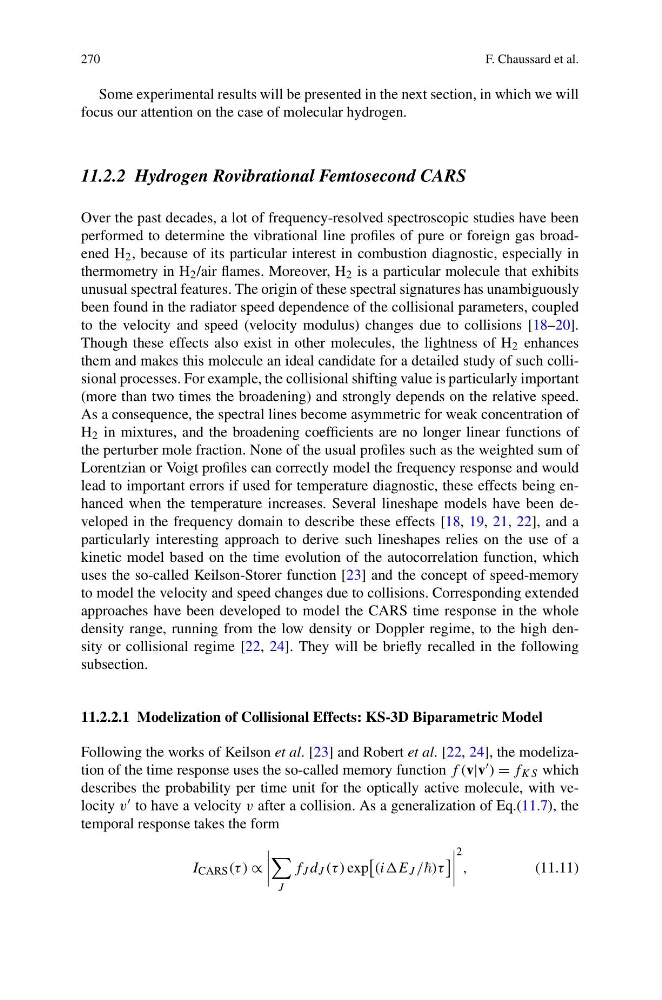
describes the probability per time unit for the optically active molecule, with velocity v to have a velocity v after a collision. As a generalization of Eq.(11.7), the
temporal response takes the form
I CARS (τ ) ∝
J
f J d J (τ ) exp
(iiE J /)τ
2
,
(11.11)
F. Chaussard et al.
Some experimental results will be presented in the next section, in which we will
focus our attention on the case of molecular hydrogen.
11.2.2 Hydrogen Rovibrational Femtosecond CARS
Over the past decades, a lot of frequency-resolved spectroscopic studies have been
performed to determine the vibrational line profiles of pure or foreign gas broadened H 2 , because of its particular interest in combustion diagnostic, especially in
thermometry in H 2 /air flames. Moreover, H 2 is a particular molecule that exhibits
unusual spectral features. The origin of these spectral signatures has unambiguously
been found in the radiator speed dependence of the collisional parameters, coupled
to the velocity and speed (velocity modulus) changes due to collisions [18–20].
Though these effects also exist in other molecules, the lightness of H 2 enhances
them and makes this molecule an ideal candidate for a detailed study of such collisional processes. For example, the collisional shifting value is particularly important
(more than two times the broadening) and strongly depends on the relative speed.
As a consequence, the spectral lines become asymmetric for weak concentration of
H 2 in mixtures, and the broadening coefficients are no longer linear functions of
the perturber mole fraction. None of the usual profiles such as the weighted sum of
Lorentzian or Voigt profiles can correctly model the frequency response and would
lead to important errors if used for temperature diagnostic, these effects being enhanced when the temperature increases. Several lineshape models have been developed in the frequency domain to describe these effects [18, 19, 21, 22], and a
particularly interesting approach to derive such lineshapes relies on the use of a
kinetic model based on the time evolution of the autocorrelation function, which
uses the so-called Keilson-Storer function [23] and the concept of speed-memory
to model the velocity and speed changes due to collisions. Corresponding extended
approaches have been developed to model the CARS time response in the whole
density range, running from the low density or Doppler regime, to the high density or collisional regime [22, 24]. They will be briefly recalled in the following
subsection.
11.2.2.1 Modelization of Collisional Effects: KS-3D Biparametric Model
Following the works of Keilson et al. [23] and Robert et al. [22, 24], the modelization of the time response uses the so-called memory function f (v|v ) = f KS which
describes the probability per time unit for the optically active molecule, with velocity v to have a velocity v after a collision. As a generalization of Eq.(11.7), the
temporal response takes the form
I CARS (τ ) ∝
J
f J d J (τ ) exp
(iiE J /)τ
2
,
(11.11)