

11 Optical Diagnostics with Ultrafast and Strong Field Raman Techniques
269
11.2.1.2 Coherent Anti-Stokes Raman Spectroscopy (CARS)
Principles In femtosecond Coherent Anti-Stokes Raman Spectroscopy, synchronized pump and Stokes pulses create a coherent superposition of Q-branch transitions (J = 0) between the ground and the first vibrational state (v = 1) of H 2 .
Each transition oscillates with a frequency ω J = E J /, with E J the energy of
the Raman transition. The time evolution of the coherent excitation is probed by
a time-delayed third pulse, which under phase matching conditions completes the
CARS scheme and leads to the anti-Stokes signal.
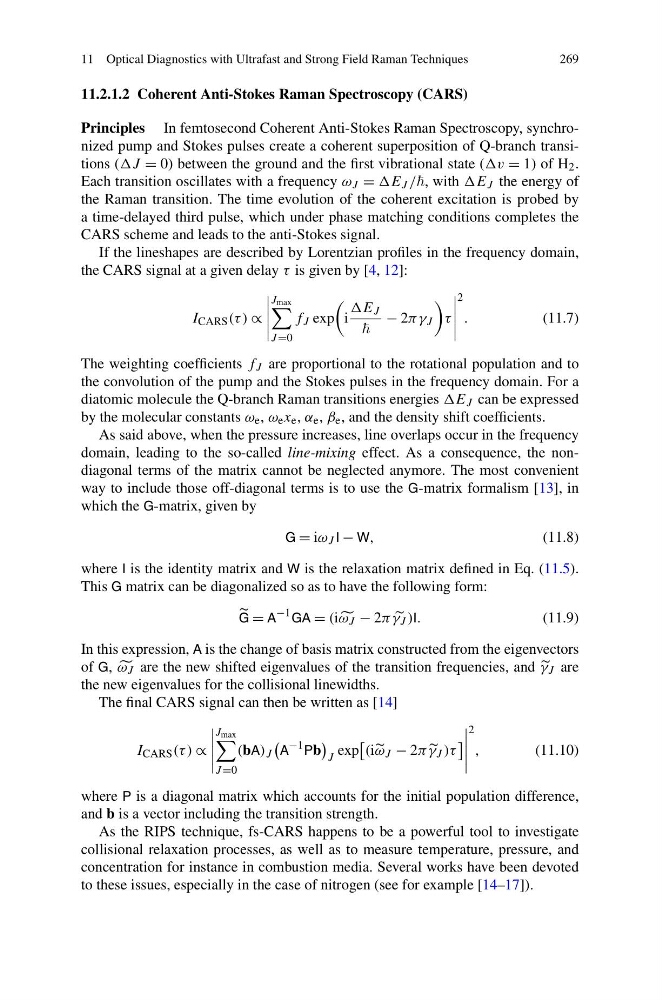
If the lineshapes are described by Lorentzian profiles in the frequency domain,
the CARS signal at a given delay τ is given by [4, 12]:
I CARS (τ ) ∝
J max
J =0
f J exp
i
E J
− 2πγ J
τ
2
.
(11.7)
The weighting coefficients f J are proportional to the rotational population and to
the convolution of the pump and the Stokes pulses in the frequency domain. For a
diatomic molecule the Q-branch Raman transitions energies E J can be expressed
by the molecular constants ω e , ω e x e , α e , β e , and the density shift coefficients.
As said above, when the pressure increases, line overlaps occur in the frequency
domain, leading to the so-called line-mixing effect. As a consequence, the nondiagonal terms of the matrix cannot be neglected anymore. The most convenient
way to include those off-diagonal terms is to use the G-matrix formalism [13], in
which the G-matrix, given by
G = iω J I − W,
(11.8)
where I is the identity matrix and W is the relaxation matrix defined in Eq. (11.5).
This G matrix can be diagonalized so as to have the following form:
G = A
−1 GA = (i ω J − 2π
γ J )I.
(11.9)
In this expression, A is the change of basis matrix constructed from the eigenvectors
of G,
ω J are the new shifted eigenvalues of the transition frequencies, and γ J are
the new eigenvalues for the collisional linewidths.
The final CARS signal can then be written as [14]
I CARS (τ ) ∝
J max
J =0
(bA) J
A
−1 Pb
J
exp
(i ω J − 2π γ J )τ
2
,
(11.10)
where P is a diagonal matrix which accounts for the initial population difference,
and b is a vector including the transition strength.
As the RIPS technique, fs-CARS happens to be a powerful tool to investigate
collisional relaxation processes, as well as to measure temperature, pressure, and
concentration for instance in combustion media. Several works have been devoted
to these issues, especially in the case of nitrogen (see for example [14–17]).
269
11.2.1.2 Coherent Anti-Stokes Raman Spectroscopy (CARS)
Principles In femtosecond Coherent Anti-Stokes Raman Spectroscopy, synchronized pump and Stokes pulses create a coherent superposition of Q-branch transitions (J = 0) between the ground and the first vibrational state (v = 1) of H 2 .
Each transition oscillates with a frequency ω J = E J /, with E J the energy of
the Raman transition. The time evolution of the coherent excitation is probed by
a time-delayed third pulse, which under phase matching conditions completes the
CARS scheme and leads to the anti-Stokes signal.
If the lineshapes are described by Lorentzian profiles in the frequency domain,
the CARS signal at a given delay τ is given by [4, 12]:
I CARS (τ ) ∝
J max
J =0
f J exp
i
E J
− 2πγ J
τ
2
.
(11.7)
The weighting coefficients f J are proportional to the rotational population and to
the convolution of the pump and the Stokes pulses in the frequency domain. For a
diatomic molecule the Q-branch Raman transitions energies E J can be expressed
by the molecular constants ω e , ω e x e , α e , β e , and the density shift coefficients.
As said above, when the pressure increases, line overlaps occur in the frequency
domain, leading to the so-called line-mixing effect. As a consequence, the nondiagonal terms of the matrix cannot be neglected anymore. The most convenient
way to include those off-diagonal terms is to use the G-matrix formalism [13], in
which the G-matrix, given by
G = iω J I − W,
(11.8)
where I is the identity matrix and W is the relaxation matrix defined in Eq. (11.5).
This G matrix can be diagonalized so as to have the following form:
G = A
−1 GA = (i ω J − 2π
γ J )I.
(11.9)
In this expression, A is the change of basis matrix constructed from the eigenvectors
of G,
ω J are the new shifted eigenvalues of the transition frequencies, and γ J are
the new eigenvalues for the collisional linewidths.
The final CARS signal can then be written as [14]
I CARS (τ ) ∝
J max
J =0
(bA) J
A
−1 Pb
J
exp
(i ω J − 2π γ J )τ
2
,
(11.10)
where P is a diagonal matrix which accounts for the initial population difference,
and b is a vector including the transition strength.
As the RIPS technique, fs-CARS happens to be a powerful tool to investigate
collisional relaxation processes, as well as to measure temperature, pressure, and
concentration for instance in combustion media. Several works have been devoted
to these issues, especially in the case of nitrogen (see for example [14–17]).