

9 On the Investigation of Excited State Dynamics with (Pump-)Degenerate
225
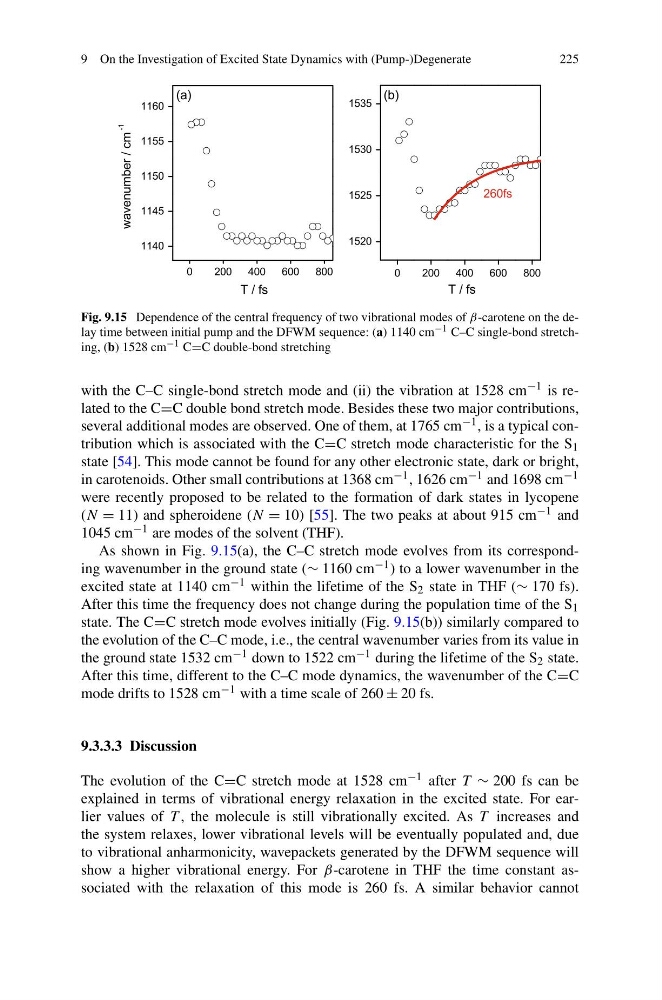
Fig. 9.15 Dependence of the central frequency of two vibrational modes of β-carotene on the delay time between initial pump and the DFWM sequence: (a) 1140 cm −1 C–C single-bond stretching, (b) 1528 cm −1 C=C double-bond stretching
with the C–C single-bond stretch mode and (ii) the vibration at 1528 cm −1 is related to the C=C double bond stretch mode. Besides these two major contributions,
several additional modes are observed. One of them, at 1765 cm −1 , is a typical contribution which is associated with the C=C stretch mode characteristic for the S 1
state [54]. This mode cannot be found for any other electronic state, dark or bright,
in carotenoids. Other small contributions at 1368 cm −1 , 1626 cm −1 and 1698 cm −1
were recently proposed to be related to the formation of dark states in lycopene
(N = 11) and spheroidene (N = 10) [55]. The two peaks at about 915 cm −1 and
1045 cm −1 are modes of the solvent (THF).
As shown in Fig. 9.15(a), the C–C stretch mode evolves from its corresponding wavenumber in the ground state (∼ 1160 cm −1 ) to a lower wavenumber in the
excited state at 1140 cm −1 within the lifetime of the S 2 state in THF (∼ 170 fs).
After this time the frequency does not change during the population time of the S 1
state. The C=C stretch mode evolves initially (Fig. 9.15(b)) similarly compared to
the evolution of the C–C mode, i.e., the central wavenumber varies from its value in
the ground state 1532 cm −1 down to 1522 cm −1 during the lifetime of the S 2 state.
After this time, different to the C–C mode dynamics, the wavenumber of the C=C
mode drifts to 1528 cm −1 with a time scale of 260 ± 20 fs.
9.3.3.3 Discussion
The evolution of the C=C stretch mode at 1528 cm −1 after T ∼ 200 fs can be
explained in terms of vibrational energy relaxation in the excited state. For earlier values of T , the molecule is still vibrationally excited. As T increases and
the system relaxes, lower vibrational levels will be eventually populated and, due
to vibrational anharmonicity, wavepackets generated by the DFWM sequence will
show a higher vibrational energy. For β-carotene in THF the time constant associated with the relaxation of this mode is 260 fs. A similar behavior cannot
225
Fig. 9.15 Dependence of the central frequency of two vibrational modes of β-carotene on the delay time between initial pump and the DFWM sequence: (a) 1140 cm −1 C–C single-bond stretching, (b) 1528 cm −1 C=C double-bond stretching
with the C–C single-bond stretch mode and (ii) the vibration at 1528 cm −1 is related to the C=C double bond stretch mode. Besides these two major contributions,
several additional modes are observed. One of them, at 1765 cm −1 , is a typical contribution which is associated with the C=C stretch mode characteristic for the S 1
state [54]. This mode cannot be found for any other electronic state, dark or bright,
in carotenoids. Other small contributions at 1368 cm −1 , 1626 cm −1 and 1698 cm −1
were recently proposed to be related to the formation of dark states in lycopene
(N = 11) and spheroidene (N = 10) [55]. The two peaks at about 915 cm −1 and
1045 cm −1 are modes of the solvent (THF).
As shown in Fig. 9.15(a), the C–C stretch mode evolves from its corresponding wavenumber in the ground state (∼ 1160 cm −1 ) to a lower wavenumber in the
excited state at 1140 cm −1 within the lifetime of the S 2 state in THF (∼ 170 fs).
After this time the frequency does not change during the population time of the S 1
state. The C=C stretch mode evolves initially (Fig. 9.15(b)) similarly compared to
the evolution of the C–C mode, i.e., the central wavenumber varies from its value in
the ground state 1532 cm −1 down to 1522 cm −1 during the lifetime of the S 2 state.
After this time, different to the C–C mode dynamics, the wavenumber of the C=C
mode drifts to 1528 cm −1 with a time scale of 260 ± 20 fs.
9.3.3.3 Discussion
The evolution of the C=C stretch mode at 1528 cm −1 after T ∼ 200 fs can be
explained in terms of vibrational energy relaxation in the excited state. For earlier values of T , the molecule is still vibrationally excited. As T increases and
the system relaxes, lower vibrational levels will be eventually populated and, due
to vibrational anharmonicity, wavepackets generated by the DFWM sequence will
show a higher vibrational energy. For β-carotene in THF the time constant associated with the relaxation of this mode is 260 fs. A similar behavior cannot