

224
T. Buckup et al.
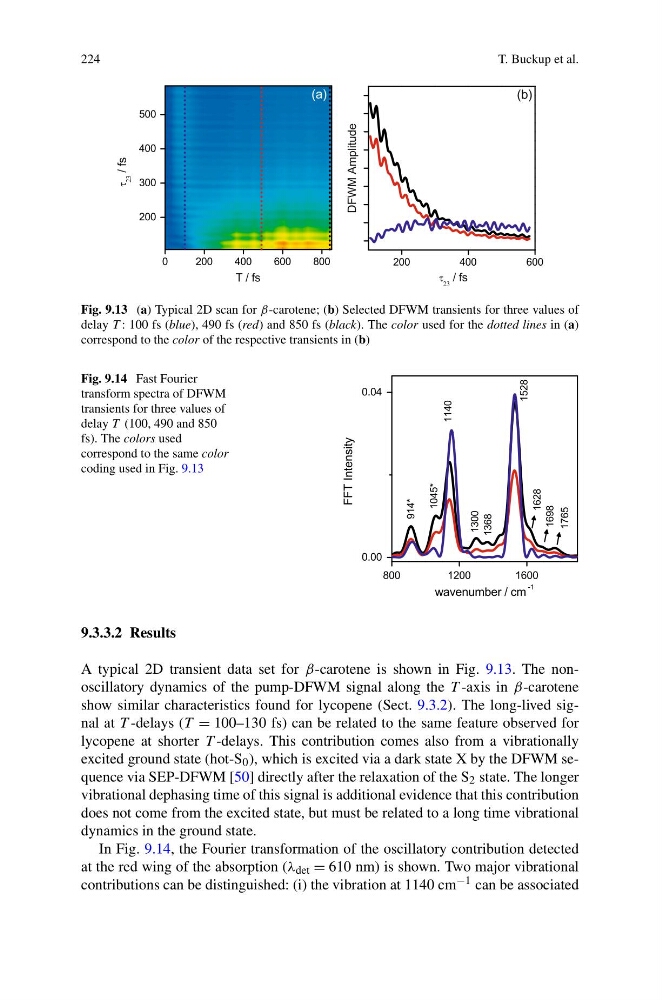
Fig. 9.13 (a) Typical 2D scan for β-carotene; (b) Selected DFWM transients for three values of
delay T : 100 fs (blue), 490 fs (red) and 850 fs (black). The color used for the dotted lines in (a)
correspond to the color of the respective transients in (b)
Fig. 9.14 Fast Fourier
transform spectra of DFWM
transients for three values of
delay T (100, 490 and 850
fs). The colors used
correspond to the same color
coding used in Fig. 9.13
9.3.3.2 Results
A typical 2D transient data set for β-carotene is shown in Fig. 9.13. The nonoscillatory dynamics of the pump-DFWM signal along the T -axis in β-carotene
show similar characteristics found for lycopene (Sect. 9.3.2). The long-lived signal at T -delays (T = 100–130 fs) can be related to the same feature observed for
lycopene at shorter T -delays. This contribution comes also from a vibrationally
excited ground state (hot-S 0 ), which is excited via a dark state X by the DFWM sequence via SEP-DFWM [50] directly after the relaxation of the S 2 state. The longer
vibrational dephasing time of this signal is additional evidence that this contribution
does not come from the excited state, but must be related to a long time vibrational
dynamics in the ground state.
In Fig. 9.14, the Fourier transformation of the oscillatory contribution detected
at the red wing of the absorption (λ det = 610 nm) is shown. Two major vibrational
contributions can be distinguished: (i) the vibration at 1140 cm −1 can be associated
T. Buckup et al.
Fig. 9.13 (a) Typical 2D scan for β-carotene; (b) Selected DFWM transients for three values of
delay T : 100 fs (blue), 490 fs (red) and 850 fs (black). The color used for the dotted lines in (a)
correspond to the color of the respective transients in (b)
Fig. 9.14 Fast Fourier
transform spectra of DFWM
transients for three values of
delay T (100, 490 and 850
fs). The colors used
correspond to the same color
coding used in Fig. 9.13
9.3.3.2 Results
A typical 2D transient data set for β-carotene is shown in Fig. 9.13. The nonoscillatory dynamics of the pump-DFWM signal along the T -axis in β-carotene
show similar characteristics found for lycopene (Sect. 9.3.2). The long-lived signal at T -delays (T = 100–130 fs) can be related to the same feature observed for
lycopene at shorter T -delays. This contribution comes also from a vibrationally
excited ground state (hot-S 0 ), which is excited via a dark state X by the DFWM sequence via SEP-DFWM [50] directly after the relaxation of the S 2 state. The longer
vibrational dephasing time of this signal is additional evidence that this contribution
does not come from the excited state, but must be related to a long time vibrational
dynamics in the ground state.
In Fig. 9.14, the Fourier transformation of the oscillatory contribution detected
at the red wing of the absorption (λ det = 610 nm) is shown. Two major vibrational
contributions can be distinguished: (i) the vibration at 1140 cm −1 can be associated