

9 On the Investigation of Excited State Dynamics with (Pump-)Degenerate
221
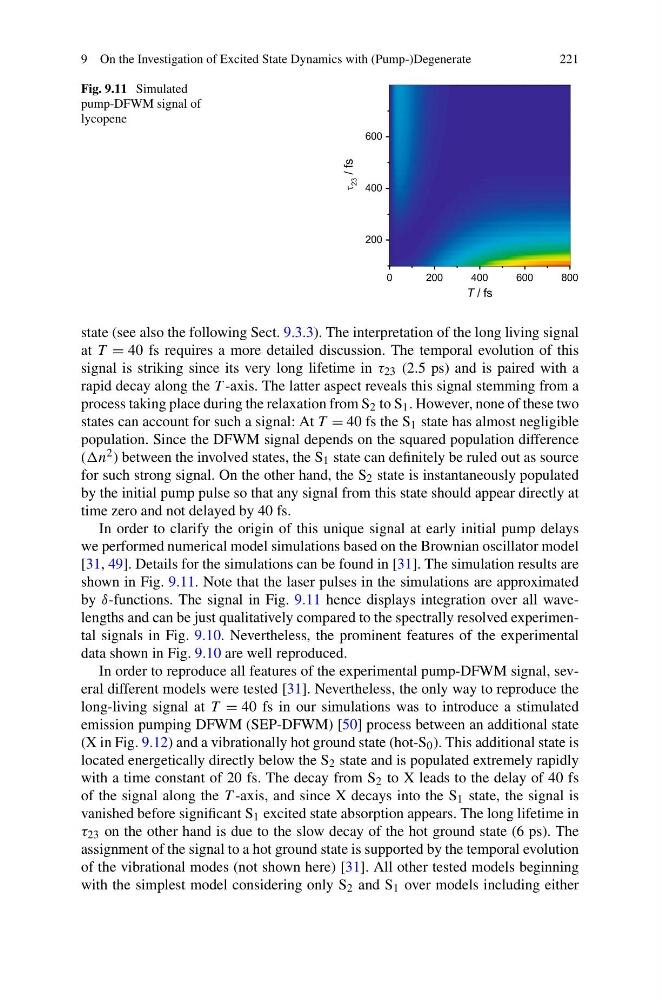
Fig. 9.11 Simulated
pump-DFWM signal of
lycopene
state (see also the following Sect. 9.3.3). The interpretation of the long living signal
at T = 40 fs requires a more detailed discussion. The temporal evolution of this
signal is striking since its very long lifetime in τ 23 (2.5 ps) and is paired with a
rapid decay along the T -axis. The latter aspect reveals this signal stemming from a
process taking place during the relaxation from S 2 to S 1 . However, none of these two
states can account for such a signal: At T = 40 fs the S 1 state has almost negligible
population. Since the DFWM signal depends on the squared population difference
(n 2 ) between the involved states, the S 1 state can definitely be ruled out as source
for such strong signal. On the other hand, the S 2 state is instantaneously populated
by the initial pump pulse so that any signal from this state should appear directly at
time zero and not delayed by 40 fs.
In order to clarify the origin of this unique signal at early initial pump delays
we performed numerical model simulations based on the Brownian oscillator model
[31, 49]. Details for the simulations can be found in [31]. The simulation results are
shown in Fig. 9.11. Note that the laser pulses in the simulations are approximated
by δ-functions. The signal in Fig. 9.11 hence displays integration over all wavelengths and can be just qualitatively compared to the spectrally resolved experimental signals in Fig. 9.10. Nevertheless, the prominent features of the experimental
data shown in Fig. 9.10 are well reproduced.
In order to reproduce all features of the experimental pump-DFWM signal, several different models were tested [31]. Nevertheless, the only way to reproduce the
long-living signal at T = 40 fs in our simulations was to introduce a stimulated
emission pumping DFWM (SEP-DFWM) [50] process between an additional state
(X in Fig. 9.12) and a vibrationally hot ground state (hot-S 0 ). This additional state is
located energetically directly below the S 2 state and is populated extremely rapidly
with a time constant of 20 fs. The decay from S 2 to X leads to the delay of 40 fs
of the signal along the T -axis, and since X decays into the S 1 state, the signal is
vanished before significant S 1 excited state absorption appears. The long lifetime in
τ 23 on the other hand is due to the slow decay of the hot ground state (6 ps). The
assignment of the signal to a hot ground state is supported by the temporal evolution
of the vibrational modes (not shown here) [31]. All other tested models beginning
with the simplest model considering only S 2 and S 1 over models including either
221
Fig. 9.11 Simulated
pump-DFWM signal of
lycopene
state (see also the following Sect. 9.3.3). The interpretation of the long living signal
at T = 40 fs requires a more detailed discussion. The temporal evolution of this
signal is striking since its very long lifetime in τ 23 (2.5 ps) and is paired with a
rapid decay along the T -axis. The latter aspect reveals this signal stemming from a
process taking place during the relaxation from S 2 to S 1 . However, none of these two
states can account for such a signal: At T = 40 fs the S 1 state has almost negligible
population. Since the DFWM signal depends on the squared population difference
(n 2 ) between the involved states, the S 1 state can definitely be ruled out as source
for such strong signal. On the other hand, the S 2 state is instantaneously populated
by the initial pump pulse so that any signal from this state should appear directly at
time zero and not delayed by 40 fs.
In order to clarify the origin of this unique signal at early initial pump delays
we performed numerical model simulations based on the Brownian oscillator model
[31, 49]. Details for the simulations can be found in [31]. The simulation results are
shown in Fig. 9.11. Note that the laser pulses in the simulations are approximated
by δ-functions. The signal in Fig. 9.11 hence displays integration over all wavelengths and can be just qualitatively compared to the spectrally resolved experimental signals in Fig. 9.10. Nevertheless, the prominent features of the experimental
data shown in Fig. 9.10 are well reproduced.
In order to reproduce all features of the experimental pump-DFWM signal, several different models were tested [31]. Nevertheless, the only way to reproduce the
long-living signal at T = 40 fs in our simulations was to introduce a stimulated
emission pumping DFWM (SEP-DFWM) [50] process between an additional state
(X in Fig. 9.12) and a vibrationally hot ground state (hot-S 0 ). This additional state is
located energetically directly below the S 2 state and is populated extremely rapidly
with a time constant of 20 fs. The decay from S 2 to X leads to the delay of 40 fs
of the signal along the T -axis, and since X decays into the S 1 state, the signal is
vanished before significant S 1 excited state absorption appears. The long lifetime in
τ 23 on the other hand is due to the slow decay of the hot ground state (6 ps). The
assignment of the signal to a hot ground state is supported by the temporal evolution
of the vibrational modes (not shown here) [31]. All other tested models beginning
with the simplest model considering only S 2 and S 1 over models including either