

222
T. Buckup et al.
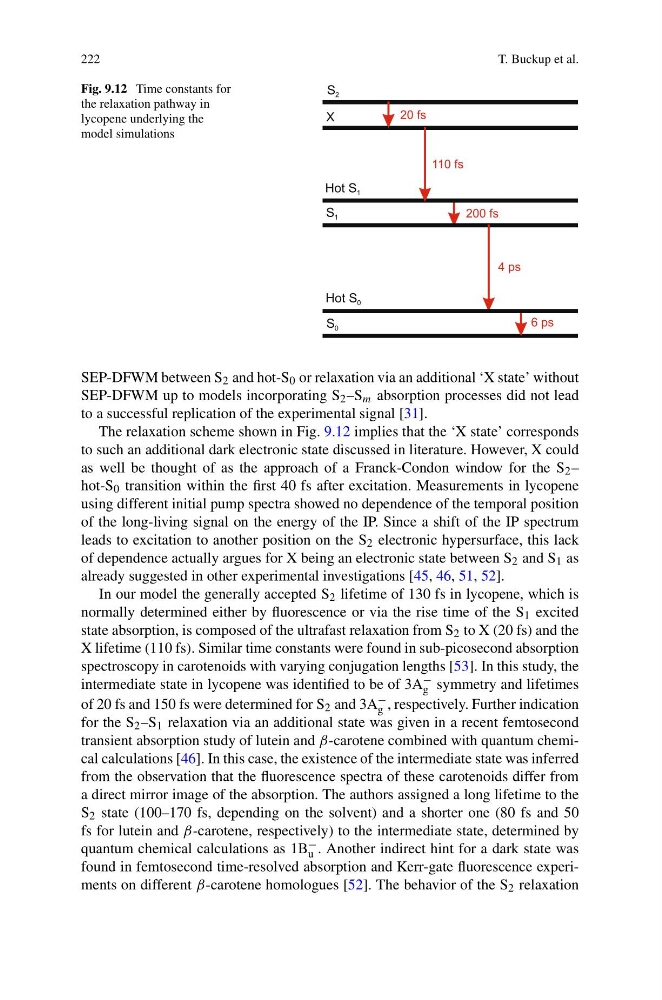
Fig. 9.12 Time constants for
the relaxation pathway in
lycopene underlying the
model simulations
SEP-DFWM between S 2 and hot-S 0 or relaxation via an additional ‘X state’ without
SEP-DFWM up to models incorporating S 2 –S m absorption processes did not lead
to a successful replication of the experimental signal [31].
The relaxation scheme shown in Fig. 9.12 implies that the ‘X state’ corresponds
to such an additional dark electronic state discussed in literature. However, X could
as well be thought of as the approach of a Franck-Condon window for the S 2 –
hot-S 0 transition within the first 40 fs after excitation. Measurements in lycopene
using different initial pump spectra showed no dependence of the temporal position
of the long-living signal on the energy of the IP. Since a shift of the IP spectrum
leads to excitation to another position on the S 2 electronic hypersurface, this lack
of dependence actually argues for X being an electronic state between S 2 and S 1 as
already suggested in other experimental investigations [45, 46, 51, 52].
In our model the generally accepted S 2 lifetime of 130 fs in lycopene, which is
normally determined either by fluorescence or via the rise time of the S 1 excited
state absorption, is composed of the ultrafast relaxation from S 2 to X (20 fs) and the
X lifetime (110 fs). Similar time constants were found in sub-picosecond absorption
spectroscopy in carotenoids with varying conjugation lengths [53]. In this study, the
intermediate state in lycopene was identified to be of 3A −
g symmetry and lifetimes
of 20 fs and 150 fs were determined for S 2 and 3A −
g , respectively. Further indication
for the S 2 –S 1 relaxation via an additional state was given in a recent femtosecond
transient absorption study of lutein and β-carotene combined with quantum chemical calculations [46]. In this case, the existence of the intermediate state was inferred
from the observation that the fluorescence spectra of these carotenoids differ from
a direct mirror image of the absorption. The authors assigned a long lifetime to the
S 2 state (100–170 fs, depending on the solvent) and a shorter one (80 fs and 50
fs for lutein and β-carotene, respectively) to the intermediate state, determined by
quantum chemical calculations as 1B −
u . Another indirect hint for a dark state was
found in femtosecond time-resolved absorption and Kerr-gate fluorescence experiments on different β-carotene homologues [52]. The behavior of the S 2 relaxation
T. Buckup et al.
Fig. 9.12 Time constants for
the relaxation pathway in
lycopene underlying the
model simulations
SEP-DFWM between S 2 and hot-S 0 or relaxation via an additional ‘X state’ without
SEP-DFWM up to models incorporating S 2 –S m absorption processes did not lead
to a successful replication of the experimental signal [31].
The relaxation scheme shown in Fig. 9.12 implies that the ‘X state’ corresponds
to such an additional dark electronic state discussed in literature. However, X could
as well be thought of as the approach of a Franck-Condon window for the S 2 –
hot-S 0 transition within the first 40 fs after excitation. Measurements in lycopene
using different initial pump spectra showed no dependence of the temporal position
of the long-living signal on the energy of the IP. Since a shift of the IP spectrum
leads to excitation to another position on the S 2 electronic hypersurface, this lack
of dependence actually argues for X being an electronic state between S 2 and S 1 as
already suggested in other experimental investigations [45, 46, 51, 52].
In our model the generally accepted S 2 lifetime of 130 fs in lycopene, which is
normally determined either by fluorescence or via the rise time of the S 1 excited
state absorption, is composed of the ultrafast relaxation from S 2 to X (20 fs) and the
X lifetime (110 fs). Similar time constants were found in sub-picosecond absorption
spectroscopy in carotenoids with varying conjugation lengths [53]. In this study, the
intermediate state in lycopene was identified to be of 3A −
g symmetry and lifetimes
of 20 fs and 150 fs were determined for S 2 and 3A −
g , respectively. Further indication
for the S 2 –S 1 relaxation via an additional state was given in a recent femtosecond
transient absorption study of lutein and β-carotene combined with quantum chemical calculations [46]. In this case, the existence of the intermediate state was inferred
from the observation that the fluorescence spectra of these carotenoids differ from
a direct mirror image of the absorption. The authors assigned a long lifetime to the
S 2 state (100–170 fs, depending on the solvent) and a shorter one (80 fs and 50
fs for lutein and β-carotene, respectively) to the intermediate state, determined by
quantum chemical calculations as 1B −
u . Another indirect hint for a dark state was
found in femtosecond time-resolved absorption and Kerr-gate fluorescence experiments on different β-carotene homologues [52]. The behavior of the S 2 relaxation