

192
M. Dantus and C.L. Kalcic
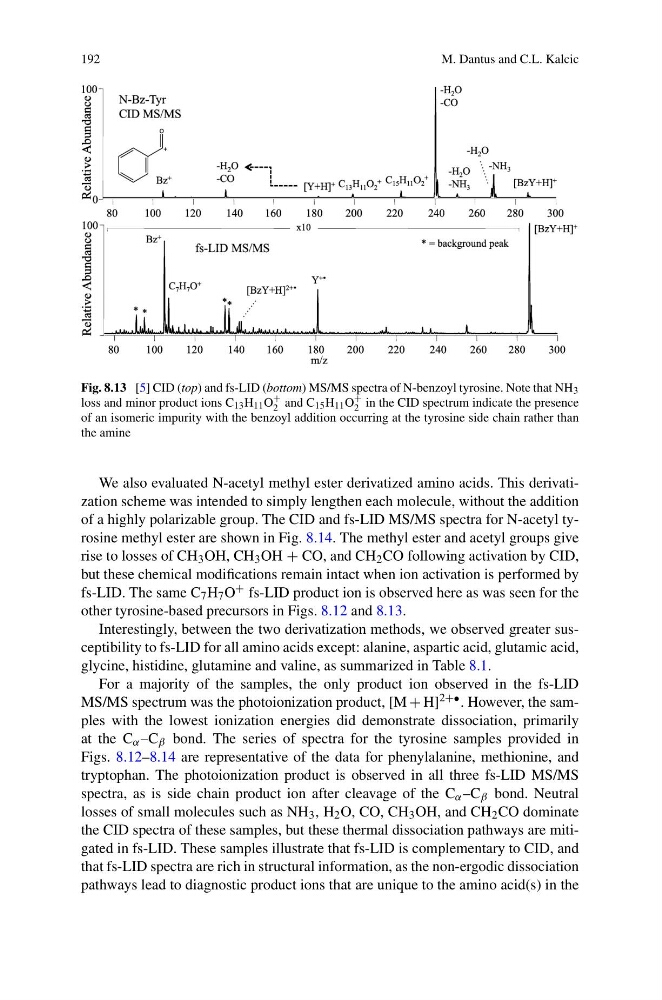
Fig. 8.13 [5] CID (top) and fs-LID (bottom) MS/MS spectra of N-benzoyl tyrosine. Note that NH 3
loss and minor product ions C 13 H 11 O
+
2 and C 15 H 11 O
+
2 in the CID spectrum indicate the presence
of an isomeric impurity with the benzoyl addition occurring at the tyrosine side chain rather than
the amine
We also evaluated N-acetyl methyl ester derivatized amino acids. This derivatization scheme was intended to simply lengthen each molecule, without the addition
of a highly polarizable group. The CID and fs-LID MS/MS spectra for N-acetyl tyrosine methyl ester are shown in Fig. 8.14. The methyl ester and acetyl groups give
rise to losses of CH 3 OH, CH 3 OH + CO, and CH 2 CO following activation by CID,
but these chemical modifications remain intact when ion activation is performed by
fs-LID. The same C 7 H 7 O + fs-LID product ion is observed here as was seen for the
other tyrosine-based precursors in Figs. 8.12 and 8.13.
Interestingly, between the two derivatization methods, we observed greater susceptibility to fs-LID for all amino acids except: alanine, aspartic acid, glutamic acid,
glycine, histidine, glutamine and valine, as summarized in Table 8.1.
For a majority of the samples, the only product ion observed in the fs-LID
MS/MS spectrum was the photoionization product, [M + H] 2+• . However, the samples with the lowest ionization energies did demonstrate dissociation, primarily
at the C α –C β bond. The series of spectra for the tyrosine samples provided in
Figs. 8.12–8.14 are representative of the data for phenylalanine, methionine, and
tryptophan. The photoionization product is observed in all three fs-LID MS/MS
spectra, as is side chain product ion after cleavage of the C α –C β bond. Neutral
losses of small molecules such as NH 3 , H 2 O, CO, CH 3 OH, and CH 2 CO dominate
the CID spectra of these samples, but these thermal dissociation pathways are mitigated in fs-LID. These samples illustrate that fs-LID is complementary to CID, and
that fs-LID spectra are rich in structural information, as the non-ergodic dissociation
pathways lead to diagnostic product ions that are unique to the amino acid(s) in the
M. Dantus and C.L. Kalcic
Fig. 8.13 [5] CID (top) and fs-LID (bottom) MS/MS spectra of N-benzoyl tyrosine. Note that NH 3
loss and minor product ions C 13 H 11 O
+
2 and C 15 H 11 O
+
2 in the CID spectrum indicate the presence
of an isomeric impurity with the benzoyl addition occurring at the tyrosine side chain rather than
the amine
We also evaluated N-acetyl methyl ester derivatized amino acids. This derivatization scheme was intended to simply lengthen each molecule, without the addition
of a highly polarizable group. The CID and fs-LID MS/MS spectra for N-acetyl tyrosine methyl ester are shown in Fig. 8.14. The methyl ester and acetyl groups give
rise to losses of CH 3 OH, CH 3 OH + CO, and CH 2 CO following activation by CID,
but these chemical modifications remain intact when ion activation is performed by
fs-LID. The same C 7 H 7 O + fs-LID product ion is observed here as was seen for the
other tyrosine-based precursors in Figs. 8.12 and 8.13.
Interestingly, between the two derivatization methods, we observed greater susceptibility to fs-LID for all amino acids except: alanine, aspartic acid, glutamic acid,
glycine, histidine, glutamine and valine, as summarized in Table 8.1.
For a majority of the samples, the only product ion observed in the fs-LID
MS/MS spectrum was the photoionization product, [M + H] 2+• . However, the samples with the lowest ionization energies did demonstrate dissociation, primarily
at the C α –C β bond. The series of spectra for the tyrosine samples provided in
Figs. 8.12–8.14 are representative of the data for phenylalanine, methionine, and
tryptophan. The photoionization product is observed in all three fs-LID MS/MS
spectra, as is side chain product ion after cleavage of the C α –C β bond. Neutral
losses of small molecules such as NH 3 , H 2 O, CO, CH 3 OH, and CH 2 CO dominate
the CID spectra of these samples, but these thermal dissociation pathways are mitigated in fs-LID. These samples illustrate that fs-LID is complementary to CID, and
that fs-LID spectra are rich in structural information, as the non-ergodic dissociation
pathways lead to diagnostic product ions that are unique to the amino acid(s) in the