

8 Ultrafast Ionization and Fragmentation: From Small Molecules
193
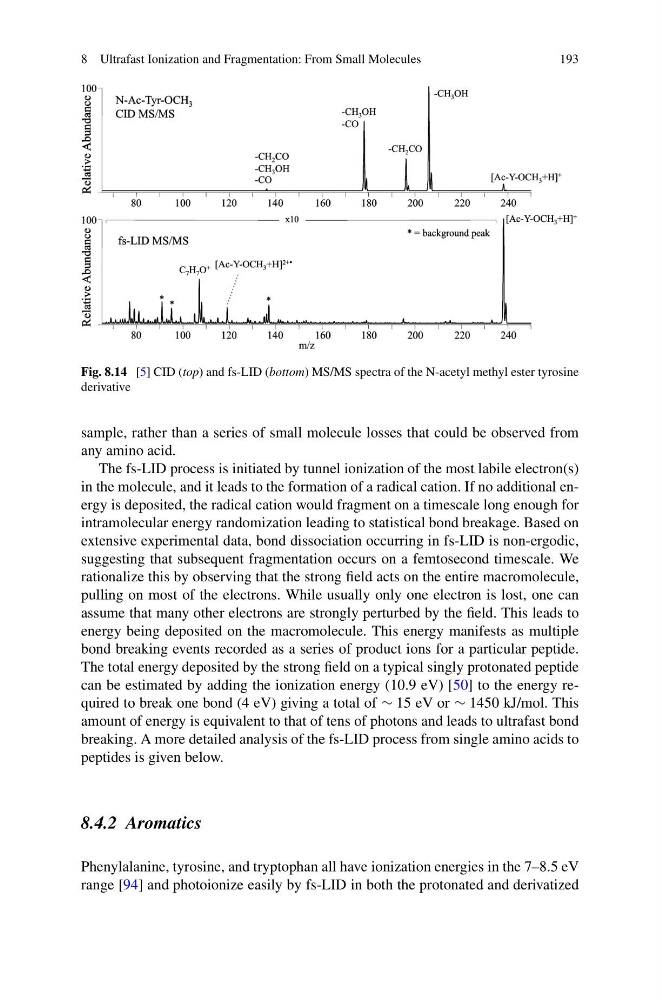
Fig. 8.14 [5] CID (top) and fs-LID (bottom) MS/MS spectra of the N-acetyl methyl ester tyrosine
derivative
sample, rather than a series of small molecule losses that could be observed from
any amino acid.
The fs-LID process is initiated by tunnel ionization of the most labile electron(s)
in the molecule, and it leads to the formation of a radical cation. If no additional energy is deposited, the radical cation would fragment on a timescale long enough for
intramolecular energy randomization leading to statistical bond breakage. Based on
extensive experimental data, bond dissociation occurring in fs-LID is non-ergodic,
suggesting that subsequent fragmentation occurs on a femtosecond timescale. We
rationalize this by observing that the strong field acts on the entire macromolecule,
pulling on most of the electrons. While usually only one electron is lost, one can
assume that many other electrons are strongly perturbed by the field. This leads to
energy being deposited on the macromolecule. This energy manifests as multiple
bond breaking events recorded as a series of product ions for a particular peptide.
The total energy deposited by the strong field on a typical singly protonated peptide
can be estimated by adding the ionization energy (10.9 eV) [50] to the energy required to break one bond (4 eV) giving a total of ∼ 15 eV or ∼ 1450 kJ/mol. This
amount of energy is equivalent to that of tens of photons and leads to ultrafast bond
breaking. A more detailed analysis of the fs-LID process from single amino acids to
peptides is given below.
8.4.2 Aromatics
Phenylalanine, tyrosine, and tryptophan all have ionization energies in the 7–8.5 eV
range [94] and photoionize easily by fs-LID in both the protonated and derivatized
193
Fig. 8.14 [5] CID (top) and fs-LID (bottom) MS/MS spectra of the N-acetyl methyl ester tyrosine
derivative
sample, rather than a series of small molecule losses that could be observed from
any amino acid.
The fs-LID process is initiated by tunnel ionization of the most labile electron(s)
in the molecule, and it leads to the formation of a radical cation. If no additional energy is deposited, the radical cation would fragment on a timescale long enough for
intramolecular energy randomization leading to statistical bond breakage. Based on
extensive experimental data, bond dissociation occurring in fs-LID is non-ergodic,
suggesting that subsequent fragmentation occurs on a femtosecond timescale. We
rationalize this by observing that the strong field acts on the entire macromolecule,
pulling on most of the electrons. While usually only one electron is lost, one can
assume that many other electrons are strongly perturbed by the field. This leads to
energy being deposited on the macromolecule. This energy manifests as multiple
bond breaking events recorded as a series of product ions for a particular peptide.
The total energy deposited by the strong field on a typical singly protonated peptide
can be estimated by adding the ionization energy (10.9 eV) [50] to the energy required to break one bond (4 eV) giving a total of ∼ 15 eV or ∼ 1450 kJ/mol. This
amount of energy is equivalent to that of tens of photons and leads to ultrafast bond
breaking. A more detailed analysis of the fs-LID process from single amino acids to
peptides is given below.
8.4.2 Aromatics
Phenylalanine, tyrosine, and tryptophan all have ionization energies in the 7–8.5 eV
range [94] and photoionize easily by fs-LID in both the protonated and derivatized