

7 Ultrafast Laser-Induced Processes Described by Ab Initio Molecular
157
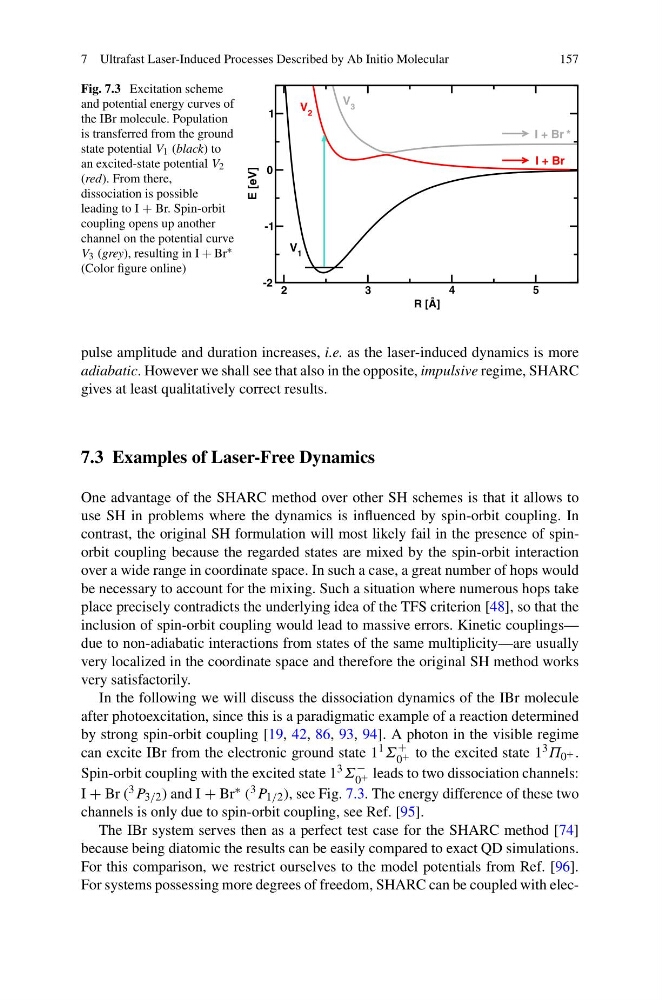
Fig. 7.3 Excitation scheme
and potential energy curves of
the IBr molecule. Population
is transferred from the ground
state potential V 1 (black) to
an excited-state potential V 2
(red). From there,
dissociation is possible
leading to I + Br. Spin-orbit
coupling opens up another
channel on the potential curve
V 3 (grey), resulting in I + Br ∗
(Color figure online)
pulse amplitude and duration increases, i.e. as the laser-induced dynamics is more
adiabatic. However we shall see that also in the opposite, impulsive regime, SHARC
gives at least qualitatively correct results.
7.3 Examples of Laser-Free Dynamics
One advantage of the SHARC method over other SH schemes is that it allows to
use SH in problems where the dynamics is influenced by spin-orbit coupling. In
contrast, the original SH formulation will most likely fail in the presence of spinorbit coupling because the regarded states are mixed by the spin-orbit interaction
over a wide range in coordinate space. In such a case, a great number of hops would
be necessary to account for the mixing. Such a situation where numerous hops take
place precisely contradicts the underlying idea of the TFS criterion [48], so that the
inclusion of spin-orbit coupling would lead to massive errors. Kinetic couplings—
due to non-adiabatic interactions from states of the same multiplicity—are usually
very localized in the coordinate space and therefore the original SH method works
very satisfactorily.
In the following we will discuss the dissociation dynamics of the IBr molecule
after photoexcitation, since this is a paradigmatic example of a reaction determined
by strong spin-orbit coupling [19, 42, 86, 93, 94]. A photon in the visible regime
can excite IBr from the electronic ground state 1 1 Σ
+
0 + to the excited state 1 3 Π 0 + .
Spin-orbit coupling with the excited state 1 3 Σ
−
0 + leads to two dissociation channels:
I + Br ( 3 P 3/2 ) and I + Br ∗ ( 3 P 1/2 ), see Fig. 7.3. The energy difference of these two
channels is only due to spin-orbit coupling, see Ref. [95].
The IBr system serves then as a perfect test case for the SHARC method [74]
because being diatomic the results can be easily compared to exact QD simulations.
For this comparison, we restrict ourselves to the model potentials from Ref. [96].
For systems possessing more degrees of freedom, SHARC can be coupled with elec-
157
Fig. 7.3 Excitation scheme
and potential energy curves of
the IBr molecule. Population
is transferred from the ground
state potential V 1 (black) to
an excited-state potential V 2
(red). From there,
dissociation is possible
leading to I + Br. Spin-orbit
coupling opens up another
channel on the potential curve
V 3 (grey), resulting in I + Br ∗
(Color figure online)
pulse amplitude and duration increases, i.e. as the laser-induced dynamics is more
adiabatic. However we shall see that also in the opposite, impulsive regime, SHARC
gives at least qualitatively correct results.
7.3 Examples of Laser-Free Dynamics
One advantage of the SHARC method over other SH schemes is that it allows to
use SH in problems where the dynamics is influenced by spin-orbit coupling. In
contrast, the original SH formulation will most likely fail in the presence of spinorbit coupling because the regarded states are mixed by the spin-orbit interaction
over a wide range in coordinate space. In such a case, a great number of hops would
be necessary to account for the mixing. Such a situation where numerous hops take
place precisely contradicts the underlying idea of the TFS criterion [48], so that the
inclusion of spin-orbit coupling would lead to massive errors. Kinetic couplings—
due to non-adiabatic interactions from states of the same multiplicity—are usually
very localized in the coordinate space and therefore the original SH method works
very satisfactorily.
In the following we will discuss the dissociation dynamics of the IBr molecule
after photoexcitation, since this is a paradigmatic example of a reaction determined
by strong spin-orbit coupling [19, 42, 86, 93, 94]. A photon in the visible regime
can excite IBr from the electronic ground state 1 1 Σ
+
0 + to the excited state 1 3 Π 0 + .
Spin-orbit coupling with the excited state 1 3 Σ
−
0 + leads to two dissociation channels:
I + Br ( 3 P 3/2 ) and I + Br ∗ ( 3 P 1/2 ), see Fig. 7.3. The energy difference of these two
channels is only due to spin-orbit coupling, see Ref. [95].
The IBr system serves then as a perfect test case for the SHARC method [74]
because being diatomic the results can be easily compared to exact QD simulations.
For this comparison, we restrict ourselves to the model potentials from Ref. [96].
For systems possessing more degrees of freedom, SHARC can be coupled with elec-