

158
L. González et al.
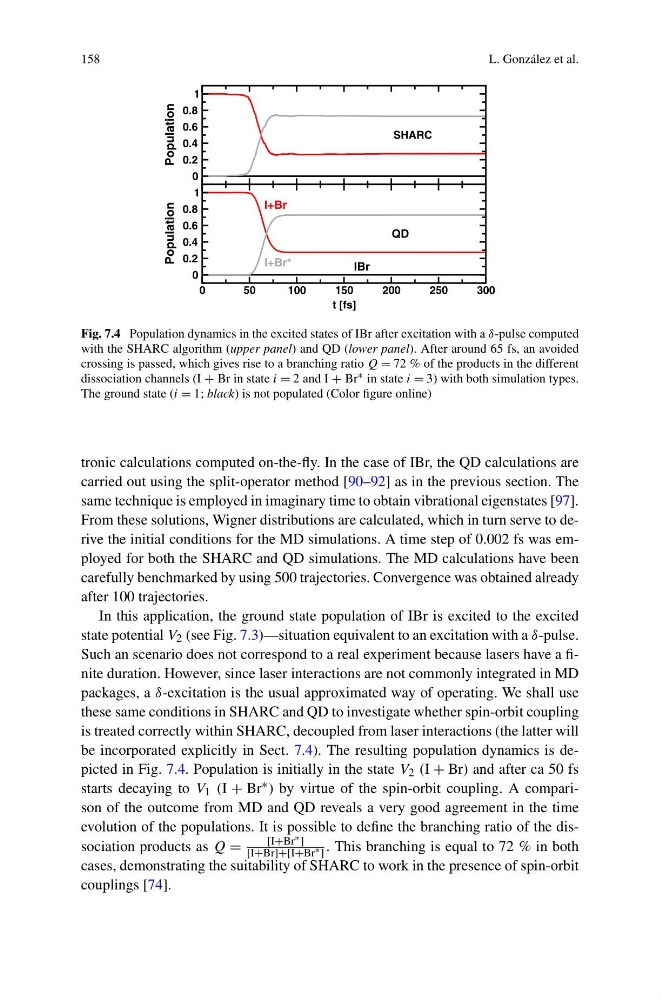
Fig. 7.4 Population dynamics in the excited states of IBr after excitation with a δ-pulse computed
with the SHARC algorithm (upper panel) and QD (lower panel). After around 65 fs, an avoided
crossing is passed, which gives rise to a branching ratio Q = 72 % of the products in the different
dissociation channels (I + Br in state i = 2 and I + Br ∗ in state i = 3) with both simulation types.
The ground state (i = 1; black) is not populated (Color figure online)
tronic calculations computed on-the-fly. In the case of IBr, the QD calculations are
carried out using the split-operator method [90–92] as in the previous section. The
same technique is employed in imaginary time to obtain vibrational eigenstates [97].
From these solutions, Wigner distributions are calculated, which in turn serve to derive the initial conditions for the MD simulations. A time step of 0.002 fs was employed for both the SHARC and QD simulations. The MD calculations have been
carefully benchmarked by using 500 trajectories. Convergence was obtained already
after 100 trajectories.
In this application, the ground state population of IBr is excited to the excited
state potential V 2 (see Fig. 7.3)—situation equivalent to an excitation with a δ-pulse.
Such an scenario does not correspond to a real experiment because lasers have a finite duration. However, since laser interactions are not commonly integrated in MD
packages, a δ-excitation is the usual approximated way of operating. We shall use
these same conditions in SHARC and QD to investigate whether spin-orbit coupling
is treated correctly within SHARC, decoupled from laser interactions (the latter will
be incorporated explicitly in Sect. 7.4). The resulting population dynamics is depicted in Fig. 7.4. Population is initially in the state V 2 (I + Br) and after ca 50 fs
starts decaying to V 1 (I + Br ∗ ) by virtue of the spin-orbit coupling. A comparison of the outcome from MD and QD reveals a very good agreement in the time
evolution of the populations. It is possible to define the branching ratio of the dissociation products as Q =
[I+Br ∗ ]
[I+Br]+[I+Br ∗ ] . This branching is equal to 72 % in both
cases, demonstrating the suitability of SHARC to work in the presence of spin-orbit
couplings [74].
L. González et al.
Fig. 7.4 Population dynamics in the excited states of IBr after excitation with a δ-pulse computed
with the SHARC algorithm (upper panel) and QD (lower panel). After around 65 fs, an avoided
crossing is passed, which gives rise to a branching ratio Q = 72 % of the products in the different
dissociation channels (I + Br in state i = 2 and I + Br ∗ in state i = 3) with both simulation types.
The ground state (i = 1; black) is not populated (Color figure online)
tronic calculations computed on-the-fly. In the case of IBr, the QD calculations are
carried out using the split-operator method [90–92] as in the previous section. The
same technique is employed in imaginary time to obtain vibrational eigenstates [97].
From these solutions, Wigner distributions are calculated, which in turn serve to derive the initial conditions for the MD simulations. A time step of 0.002 fs was employed for both the SHARC and QD simulations. The MD calculations have been
carefully benchmarked by using 500 trajectories. Convergence was obtained already
after 100 trajectories.
In this application, the ground state population of IBr is excited to the excited
state potential V 2 (see Fig. 7.3)—situation equivalent to an excitation with a δ-pulse.
Such an scenario does not correspond to a real experiment because lasers have a finite duration. However, since laser interactions are not commonly integrated in MD
packages, a δ-excitation is the usual approximated way of operating. We shall use
these same conditions in SHARC and QD to investigate whether spin-orbit coupling
is treated correctly within SHARC, decoupled from laser interactions (the latter will
be incorporated explicitly in Sect. 7.4). The resulting population dynamics is depicted in Fig. 7.4. Population is initially in the state V 2 (I + Br) and after ca 50 fs
starts decaying to V 1 (I + Br ∗ ) by virtue of the spin-orbit coupling. A comparison of the outcome from MD and QD reveals a very good agreement in the time
evolution of the populations. It is possible to define the branching ratio of the dissociation products as Q =
[I+Br ∗ ]
[I+Br]+[I+Br ∗ ] . This branching is equal to 72 % in both
cases, demonstrating the suitability of SHARC to work in the presence of spin-orbit
couplings [74].