

156
L. González et al.
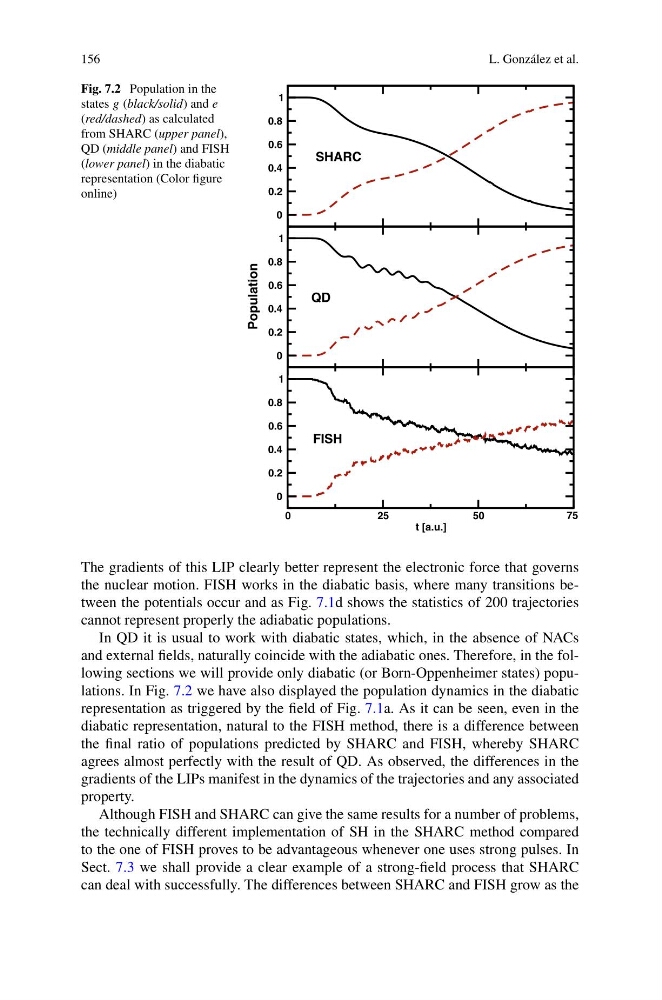
Fig. 7.2 Population in the
states g (black/solid) and e
(red/dashed) as calculated
from SHARC (upper panel),
QD (middle panel) and FISH
(lower panel) in the diabatic
representation (Color figure
online)
The gradients of this LIP clearly better represent the electronic force that governs
the nuclear motion. FISH works in the diabatic basis, where many transitions between the potentials occur and as Fig. 7.1d shows the statistics of 200 trajectories
cannot represent properly the adiabatic populations.
In QD it is usual to work with diabatic states, which, in the absence of NACs
and external fields, naturally coincide with the adiabatic ones. Therefore, in the following sections we will provide only diabatic (or Born-Oppenheimer states) populations. In Fig. 7.2 we have also displayed the population dynamics in the diabatic
representation as triggered by the field of Fig. 7.1a. As it can be seen, even in the
diabatic representation, natural to the FISH method, there is a difference between
the final ratio of populations predicted by SHARC and FISH, whereby SHARC
agrees almost perfectly with the result of QD. As observed, the differences in the
gradients of the LIPs manifest in the dynamics of the trajectories and any associated
property.
Although FISH and SHARC can give the same results for a number of problems,
the technically different implementation of SH in the SHARC method compared
to the one of FISH proves to be advantageous whenever one uses strong pulses. In
Sect. 7.3 we shall provide a clear example of a strong-field process that SHARC
can deal with successfully. The differences between SHARC and FISH grow as the
L. González et al.
Fig. 7.2 Population in the
states g (black/solid) and e
(red/dashed) as calculated
from SHARC (upper panel),
QD (middle panel) and FISH
(lower panel) in the diabatic
representation (Color figure
online)
The gradients of this LIP clearly better represent the electronic force that governs
the nuclear motion. FISH works in the diabatic basis, where many transitions between the potentials occur and as Fig. 7.1d shows the statistics of 200 trajectories
cannot represent properly the adiabatic populations.
In QD it is usual to work with diabatic states, which, in the absence of NACs
and external fields, naturally coincide with the adiabatic ones. Therefore, in the following sections we will provide only diabatic (or Born-Oppenheimer states) populations. In Fig. 7.2 we have also displayed the population dynamics in the diabatic
representation as triggered by the field of Fig. 7.1a. As it can be seen, even in the
diabatic representation, natural to the FISH method, there is a difference between
the final ratio of populations predicted by SHARC and FISH, whereby SHARC
agrees almost perfectly with the result of QD. As observed, the differences in the
gradients of the LIPs manifest in the dynamics of the trajectories and any associated
property.
Although FISH and SHARC can give the same results for a number of problems,
the technically different implementation of SH in the SHARC method compared
to the one of FISH proves to be advantageous whenever one uses strong pulses. In
Sect. 7.3 we shall provide a clear example of a strong-field process that SHARC
can deal with successfully. The differences between SHARC and FISH grow as the