

7 Ultrafast Laser-Induced Processes Described by Ab Initio Molecular
149
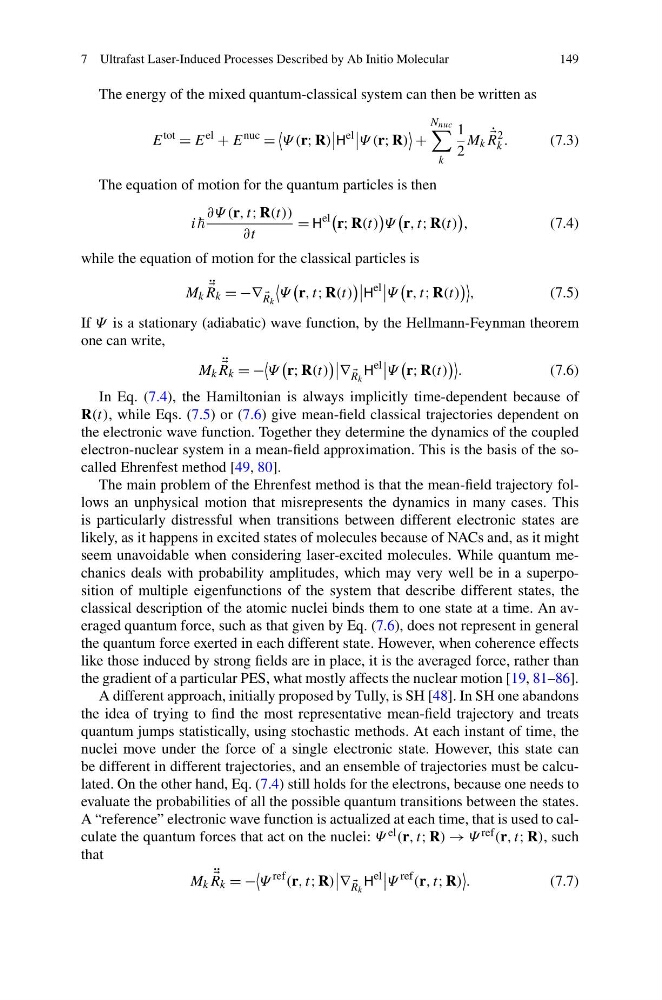
The energy of the mixed quantum-classical system can then be written as
E
tot
= E
el
+ E
nuc
=
Ψ (r; R)
H
el
Ψ (r; R)
+
N nuc
k
1
2
M k
˙
R
2
k .
(7.3)
The equation of motion for the quantum particles is then
i
∂Ψ (r, t; R(t))
∂t
= H
el
r; R(t)
Ψ
r, t; R(t)
,
(7.4)
while the equation of motion for the classical particles is
M k
¨
R k = −∇
R k
Ψ
r, t; R(t)
H
el
Ψ
r, t; R(t)
,
(7.5)
If Ψ is a stationary (adiabatic) wave function, by the Hellmann-Feynman theorem
one can write,
M k
¨
R k = −
Ψ
r; R(t)
∇
R k
H
el
Ψ
r; R(t)
.
(7.6)
In Eq. (7.4), the Hamiltonian is always implicitly time-dependent because of
R(t), while Eqs. (7.5) or (7.6) give mean-field classical trajectories dependent on
the electronic wave function. Together they determine the dynamics of the coupled
electron-nuclear system in a mean-field approximation. This is the basis of the socalled Ehrenfest method [49, 80].
The main problem of the Ehrenfest method is that the mean-field trajectory follows an unphysical motion that misrepresents the dynamics in many cases. This
is particularly distressful when transitions between different electronic states are
likely, as it happens in excited states of molecules because of NACs and, as it might
seem unavoidable when considering laser-excited molecules. While quantum mechanics deals with probability amplitudes, which may very well be in a superposition of multiple eigenfunctions of the system that describe different states, the
classical description of the atomic nuclei binds them to one state at a time. An averaged quantum force, such as that given by Eq. (7.6), does not represent in general
the quantum force exerted in each different state. However, when coherence effects
like those induced by strong fields are in place, it is the averaged force, rather than
the gradient of a particular PES, what mostly affects the nuclear motion [19, 81–86].
A different approach, initially proposed by Tully, is SH [48]. In SH one abandons
the idea of trying to find the most representative mean-field trajectory and treats
quantum jumps statistically, using stochastic methods. At each instant of time, the
nuclei move under the force of a single electronic state. However, this state can
be different in different trajectories, and an ensemble of trajectories must be calculated. On the other hand, Eq. (7.4) still holds for the electrons, because one needs to
evaluate the probabilities of all the possible quantum transitions between the states.
A “reference” electronic wave function is actualized at each time, that is used to calculate the quantum forces that act on the nuclei: Ψ el (r, t; R) → Ψ ref (r, t; R), such
that
M k
¨
R k = −
Ψ
ref (r, t; R)
∇
R k
H
el
Ψ
ref (r, t; R)
.
(7.7)
149
The energy of the mixed quantum-classical system can then be written as
E
tot
= E
el
+ E
nuc
=
Ψ (r; R)
H
el
Ψ (r; R)
+
N nuc
k
1
2
M k
˙
R
2
k .
(7.3)
The equation of motion for the quantum particles is then
i
∂Ψ (r, t; R(t))
∂t
= H
el
r; R(t)
Ψ
r, t; R(t)
,
(7.4)
while the equation of motion for the classical particles is
M k
¨
R k = −∇
R k
Ψ
r, t; R(t)
H
el
Ψ
r, t; R(t)
,
(7.5)
If Ψ is a stationary (adiabatic) wave function, by the Hellmann-Feynman theorem
one can write,
M k
¨
R k = −
Ψ
r; R(t)
∇
R k
H
el
Ψ
r; R(t)
.
(7.6)
In Eq. (7.4), the Hamiltonian is always implicitly time-dependent because of
R(t), while Eqs. (7.5) or (7.6) give mean-field classical trajectories dependent on
the electronic wave function. Together they determine the dynamics of the coupled
electron-nuclear system in a mean-field approximation. This is the basis of the socalled Ehrenfest method [49, 80].
The main problem of the Ehrenfest method is that the mean-field trajectory follows an unphysical motion that misrepresents the dynamics in many cases. This
is particularly distressful when transitions between different electronic states are
likely, as it happens in excited states of molecules because of NACs and, as it might
seem unavoidable when considering laser-excited molecules. While quantum mechanics deals with probability amplitudes, which may very well be in a superposition of multiple eigenfunctions of the system that describe different states, the
classical description of the atomic nuclei binds them to one state at a time. An averaged quantum force, such as that given by Eq. (7.6), does not represent in general
the quantum force exerted in each different state. However, when coherence effects
like those induced by strong fields are in place, it is the averaged force, rather than
the gradient of a particular PES, what mostly affects the nuclear motion [19, 81–86].
A different approach, initially proposed by Tully, is SH [48]. In SH one abandons
the idea of trying to find the most representative mean-field trajectory and treats
quantum jumps statistically, using stochastic methods. At each instant of time, the
nuclei move under the force of a single electronic state. However, this state can
be different in different trajectories, and an ensemble of trajectories must be calculated. On the other hand, Eq. (7.4) still holds for the electrons, because one needs to
evaluate the probabilities of all the possible quantum transitions between the states.
A “reference” electronic wave function is actualized at each time, that is used to calculate the quantum forces that act on the nuclei: Ψ el (r, t; R) → Ψ ref (r, t; R), such
that
M k
¨
R k = −
Ψ
ref (r, t; R)
∇
R k
H
el
Ψ
ref (r, t; R)
.
(7.7)