

148
L. González et al.
of the system with an external laser field is explicitly considered. The latter methodology is needed when the deactivation occurs during the laser excitation. Moreover,
the explicit consideration of the external field allows one to use control techniques
by changing the shape of the field. Here, we shall consider two limiting cases, the
impulsive and the adiabatic time-evolution, represented by two paradigmatic control schemes, the ultrafast pump-dump control and the APLIP (Adiabatic Passage
by Light Induced Potentials) scheme, respectively.
7.2 Methodologies for Ab Initio Molecular Dynamics
7.2.1 Surface Hopping vs. Ehrenfest Dynamics
In this section we shall concentrate on methods that treat the dynamics of the
molecule by a mixed quantum-classical approach. In principle one could decide
which degree of freedom follows which (classical or quantum) equation, but in practice all nuclear degrees of freedom will be considered classical variables, while all
electronic degrees of freedom will be regarded as quantum operators. This practice
follows the same criteria as the distinction between parameters and operators in the
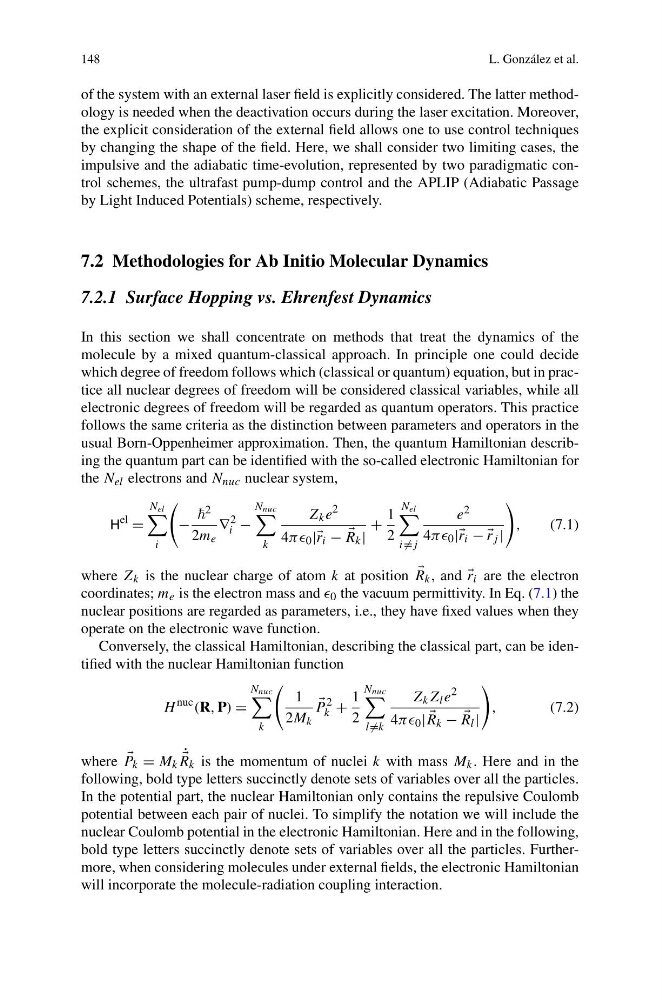
usual Born-Oppenheimer approximation. Then, the quantum Hamiltonian describing the quantum part can be identified with the so-called electronic Hamiltonian for
the N el electrons and N nuc nuclear system,
H
el
=
N el
i
−
2
2m e
∇
2
i −
N nuc
k
Z k e
2
4ππ 0 || r i −
R k |
+
1
2
N el
i =j
e 2
4ππ 0 || r i − −
r j |
,
(7.1)
where Z k is the nuclear charge of atom k at position
R k , and
r i are the electron
coordinates; m e is the electron mass and 0 the vacuum permittivity. In Eq. (7.1) the
nuclear positions are regarded as parameters, i.e., they have fixed values when they
operate on the electronic wave function.
Conversely, the classical Hamiltonian, describing the classical part, can be identified with the nuclear Hamiltonian function
H
nuc (R, P) =
N nuc
k
1
2M k
P
2
k +
1
2
N nuc
l =k
Z k Z l e
2
4ππ 0 |
R k −
R l |
,
(7.2)
where
P k = M k
˙
R k is the momentum of nuclei k with mass M k . Here and in the
following, bold type letters succinctly denote sets of variables over all the particles.
In the potential part, the nuclear Hamiltonian only contains the repulsive Coulomb
potential between each pair of nuclei. To simplify the notation we will include the
nuclear Coulomb potential in the electronic Hamiltonian. Here and in the following,
bold type letters succinctly denote sets of variables over all the particles. Furthermore, when considering molecules under external fields, the electronic Hamiltonian
will incorporate the molecule-radiation coupling interaction.
L. González et al.
of the system with an external laser field is explicitly considered. The latter methodology is needed when the deactivation occurs during the laser excitation. Moreover,
the explicit consideration of the external field allows one to use control techniques
by changing the shape of the field. Here, we shall consider two limiting cases, the
impulsive and the adiabatic time-evolution, represented by two paradigmatic control schemes, the ultrafast pump-dump control and the APLIP (Adiabatic Passage
by Light Induced Potentials) scheme, respectively.
7.2 Methodologies for Ab Initio Molecular Dynamics
7.2.1 Surface Hopping vs. Ehrenfest Dynamics
In this section we shall concentrate on methods that treat the dynamics of the
molecule by a mixed quantum-classical approach. In principle one could decide
which degree of freedom follows which (classical or quantum) equation, but in practice all nuclear degrees of freedom will be considered classical variables, while all
electronic degrees of freedom will be regarded as quantum operators. This practice
follows the same criteria as the distinction between parameters and operators in the
usual Born-Oppenheimer approximation. Then, the quantum Hamiltonian describing the quantum part can be identified with the so-called electronic Hamiltonian for
the N el electrons and N nuc nuclear system,
H
el
=
N el
i
−
2
2m e
∇
2
i −
N nuc
k
Z k e
2
4ππ 0 || r i −
R k |
+
1
2
N el
i =j
e 2
4ππ 0 || r i − −
r j |
,
(7.1)
where Z k is the nuclear charge of atom k at position
R k , and
r i are the electron
coordinates; m e is the electron mass and 0 the vacuum permittivity. In Eq. (7.1) the
nuclear positions are regarded as parameters, i.e., they have fixed values when they
operate on the electronic wave function.
Conversely, the classical Hamiltonian, describing the classical part, can be identified with the nuclear Hamiltonian function
H
nuc (R, P) =
N nuc
k
1
2M k
P
2
k +
1
2
N nuc
l =k
Z k Z l e
2
4ππ 0 |
R k −
R l |
,
(7.2)
where
P k = M k
˙
R k is the momentum of nuclei k with mass M k . Here and in the
following, bold type letters succinctly denote sets of variables over all the particles.
In the potential part, the nuclear Hamiltonian only contains the repulsive Coulomb
potential between each pair of nuclei. To simplify the notation we will include the
nuclear Coulomb potential in the electronic Hamiltonian. Here and in the following,
bold type letters succinctly denote sets of variables over all the particles. Furthermore, when considering molecules under external fields, the electronic Hamiltonian
will incorporate the molecule-radiation coupling interaction.