

136
G.M. Roberts and V.G. Stavros
stretch mode in 1 ππ ∗ ; tunneling always proceeds through the same barrier area, irrespective of the initial pump energy. Using the calculated 1-D potential energy cuts
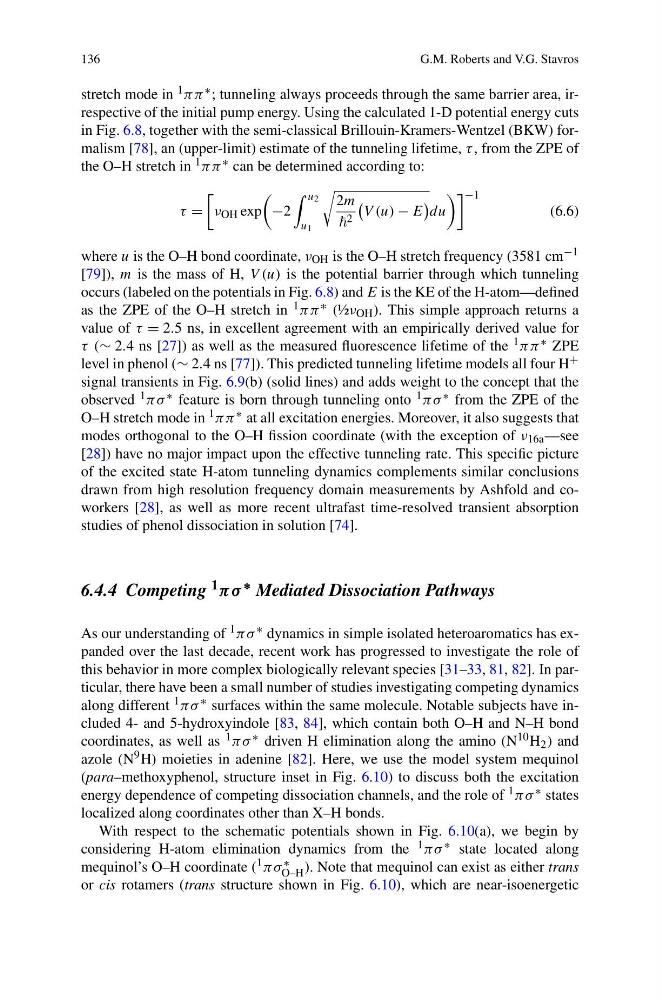
in Fig. 6.8, together with the semi-classical Brillouin-Kramers-Wentzel (BKW) formalism [78], an (upper-limit) estimate of the tunneling lifetime, τ , from the ZPE of
the O–H stretch in 1 ππ ∗ can be determined according to:
τ =
ν OH exp
−2
u 2
u 1
2m
2
V (u) − E
du
−1
(6.6)
where u is the O–H bond coordinate, ν OH is the O–H stretch frequency (3581 cm −1
[79]), m is the mass of H, V (u) is the potential barrier through which tunneling
occurs (labeled on the potentials in Fig. 6.8) and E is the KE of the H-atom—defined
as the ZPE of the O–H stretch in 1 ππ ∗ (½ν OH ). This simple approach returns a
value of τ = 2.5 ns, in excellent agreement with an empirically derived value for
τ (∼ 2.4 ns [27]) as well as the measured fluorescence lifetime of the 1 ππ ∗ ZPE
level in phenol (∼ 2.4 ns [77]). This predicted tunneling lifetime models all four H +
signal transients in Fig. 6.9(b) (solid lines) and adds weight to the concept that the
observed 1 πσ ∗ feature is born through tunneling onto 1 πσ ∗ from the ZPE of the
O–H stretch mode in 1 ππ ∗ at all excitation energies. Moreover, it also suggests that
modes orthogonal to the O–H fission coordinate (with the exception of ν 16a —see
[28]) have no major impact upon the effective tunneling rate. This specific picture
of the excited state H-atom tunneling dynamics complements similar conclusions
drawn from high resolution frequency domain measurements by Ashfold and coworkers [28], as well as more recent ultrafast time-resolved transient absorption
studies of phenol dissociation in solution [74].
6.4.4 Competing 1 πσ ∗ Mediated Dissociation Pathways
As our understanding of 1 πσ ∗ dynamics in simple isolated heteroaromatics has expanded over the last decade, recent work has progressed to investigate the role of
this behavior in more complex biologically relevant species [31–33, 81, 82]. In particular, there have been a small number of studies investigating competing dynamics
along different 1 πσ ∗ surfaces within the same molecule. Notable subjects have included 4- and 5-hydroxyindole [83, 84], which contain both O–H and N–H bond
coordinates, as well as 1 πσ ∗ driven H elimination along the amino (N 10 H 2 ) and
azole (N 9 H) moieties in adenine [82]. Here, we use the model system mequinol
(para–methoxyphenol, structure inset in Fig. 6.10) to discuss both the excitation
energy dependence of competing dissociation channels, and the role of 1 πσ ∗ states
localized along coordinates other than X–H bonds.
With respect to the schematic potentials shown in Fig. 6.10(a), we begin by
considering H-atom elimination dynamics from the 1 πσ ∗ state located along
mequinol’s O–H coordinate ( 1 πσ ∗
O–H ). Note that mequinol can exist as either trans
or cis rotamers (trans structure shown in Fig. 6.10), which are near-isoenergetic
G.M. Roberts and V.G. Stavros
stretch mode in 1 ππ ∗ ; tunneling always proceeds through the same barrier area, irrespective of the initial pump energy. Using the calculated 1-D potential energy cuts
in Fig. 6.8, together with the semi-classical Brillouin-Kramers-Wentzel (BKW) formalism [78], an (upper-limit) estimate of the tunneling lifetime, τ , from the ZPE of
the O–H stretch in 1 ππ ∗ can be determined according to:
τ =
ν OH exp
−2
u 2
u 1
2m
2
V (u) − E
du
−1
(6.6)
where u is the O–H bond coordinate, ν OH is the O–H stretch frequency (3581 cm −1
[79]), m is the mass of H, V (u) is the potential barrier through which tunneling
occurs (labeled on the potentials in Fig. 6.8) and E is the KE of the H-atom—defined
as the ZPE of the O–H stretch in 1 ππ ∗ (½ν OH ). This simple approach returns a
value of τ = 2.5 ns, in excellent agreement with an empirically derived value for
τ (∼ 2.4 ns [27]) as well as the measured fluorescence lifetime of the 1 ππ ∗ ZPE
level in phenol (∼ 2.4 ns [77]). This predicted tunneling lifetime models all four H +
signal transients in Fig. 6.9(b) (solid lines) and adds weight to the concept that the
observed 1 πσ ∗ feature is born through tunneling onto 1 πσ ∗ from the ZPE of the
O–H stretch mode in 1 ππ ∗ at all excitation energies. Moreover, it also suggests that
modes orthogonal to the O–H fission coordinate (with the exception of ν 16a —see
[28]) have no major impact upon the effective tunneling rate. This specific picture
of the excited state H-atom tunneling dynamics complements similar conclusions
drawn from high resolution frequency domain measurements by Ashfold and coworkers [28], as well as more recent ultrafast time-resolved transient absorption
studies of phenol dissociation in solution [74].
6.4.4 Competing 1 πσ ∗ Mediated Dissociation Pathways
As our understanding of 1 πσ ∗ dynamics in simple isolated heteroaromatics has expanded over the last decade, recent work has progressed to investigate the role of
this behavior in more complex biologically relevant species [31–33, 81, 82]. In particular, there have been a small number of studies investigating competing dynamics
along different 1 πσ ∗ surfaces within the same molecule. Notable subjects have included 4- and 5-hydroxyindole [83, 84], which contain both O–H and N–H bond
coordinates, as well as 1 πσ ∗ driven H elimination along the amino (N 10 H 2 ) and
azole (N 9 H) moieties in adenine [82]. Here, we use the model system mequinol
(para–methoxyphenol, structure inset in Fig. 6.10) to discuss both the excitation
energy dependence of competing dissociation channels, and the role of 1 πσ ∗ states
localized along coordinates other than X–H bonds.
With respect to the schematic potentials shown in Fig. 6.10(a), we begin by
considering H-atom elimination dynamics from the 1 πσ ∗ state located along
mequinol’s O–H coordinate ( 1 πσ ∗
O–H ). Note that mequinol can exist as either trans
or cis rotamers (trans structure shown in Fig. 6.10), which are near-isoenergetic