

128
G.M. Roberts and V.G. Stavros
of t, subsequently allows a H + signal transient to be constructed. This transient
can finally be analyzed via a kinetic fit to return a timescale, τ , which solely reflects
the 1 πσ ∗ mediated AX–H fission dynamics.
In addition to the combined time and energy resolution gained by TR-VMI, image reconstruction methods also return a quantitative measure of the photofragment
angular distributions, which can often be a critical tool for gleaning additional information about photodissociation processes [48] (note that this is not possible when
using the magnetic-bottle analyzers mentioned above). Photoexcitation will preferentially excite molecules that have their electronic transition dipole moment (μ)
aligned parallel to the electric field vector of the pump laser (ε), where ε is parallel
to plane of the position sensitive detector. For direct dissociation along 1 πσ ∗ states,
which typically occurs on a timescale much faster than parent molecule rotation
(see for example [20]), the angular recoil distribution of the photofragments will be
preserved, and is related to the orientation of the dissociating bond coordinate with
respect to μ. For a one-photon induced dissociation process, in the limit of axial
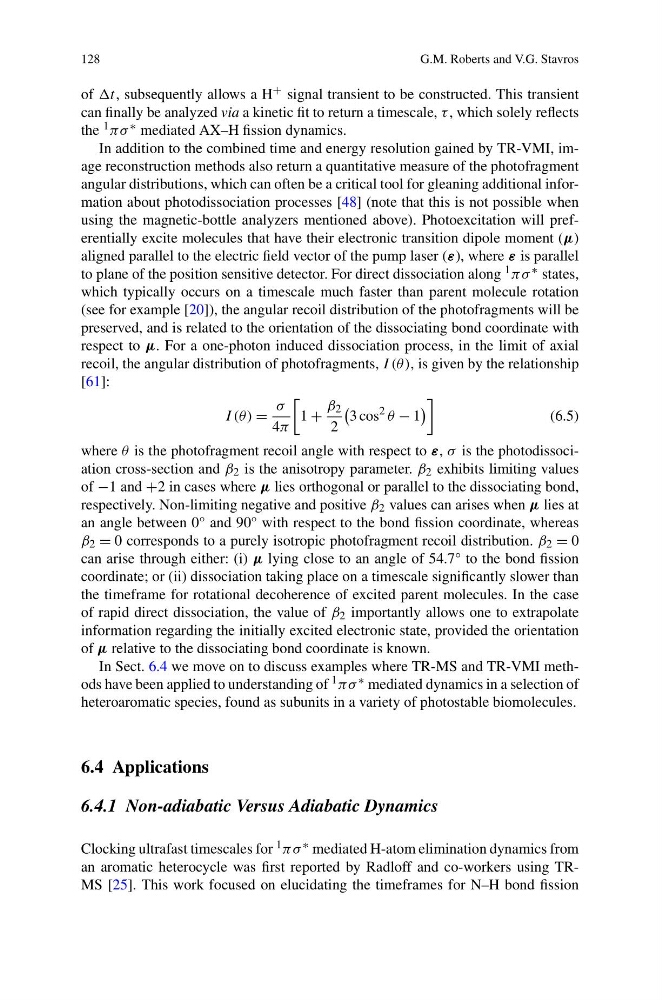
recoil, the angular distribution of photofragments, I (θ), is given by the relationship
[61]:
I (θ) =
σ
4π
1 +
β 2
2
3 cos
2 θ − 1
(6.5)
where θ is the photofragment recoil angle with respect to ε, σ is the photodissociation cross-section and β 2 is the anisotropy parameter. β 2 exhibits limiting values
of −1 and +2 in cases where μ lies orthogonal or parallel to the dissociating bond,
respectively. Non-limiting negative and positive β 2 values can arises when μ lies at
an angle between 0° and 90° with respect to the bond fission coordinate, whereas
β 2 = 0 corresponds to a purely isotropic photofragment recoil distribution. β 2 = 0
can arise through either: (i) μ lying close to an angle of 54.7° to the bond fission
coordinate; or (ii) dissociation taking place on a timescale significantly slower than
the timeframe for rotational decoherence of excited parent molecules. In the case
of rapid direct dissociation, the value of β 2 importantly allows one to extrapolate
information regarding the initially excited electronic state, provided the orientation
of μ relative to the dissociating bond coordinate is known.
In Sect. 6.4 we move on to discuss examples where TR-MS and TR-VMI methods have been applied to understanding of 1 πσ ∗ mediated dynamics in a selection of
heteroaromatic species, found as subunits in a variety of photostable biomolecules.
6.4 Applications
6.4.1 Non-adiabatic Versus Adiabatic Dynamics
Clocking ultrafast timescales for 1 πσ ∗ mediated H-atom elimination dynamics from
an aromatic heterocycle was first reported by Radloff and co-workers using TRMS [25]. This work focused on elucidating the timeframes for N–H bond fission
G.M. Roberts and V.G. Stavros
of t, subsequently allows a H + signal transient to be constructed. This transient
can finally be analyzed via a kinetic fit to return a timescale, τ , which solely reflects
the 1 πσ ∗ mediated AX–H fission dynamics.
In addition to the combined time and energy resolution gained by TR-VMI, image reconstruction methods also return a quantitative measure of the photofragment
angular distributions, which can often be a critical tool for gleaning additional information about photodissociation processes [48] (note that this is not possible when
using the magnetic-bottle analyzers mentioned above). Photoexcitation will preferentially excite molecules that have their electronic transition dipole moment (μ)
aligned parallel to the electric field vector of the pump laser (ε), where ε is parallel
to plane of the position sensitive detector. For direct dissociation along 1 πσ ∗ states,
which typically occurs on a timescale much faster than parent molecule rotation
(see for example [20]), the angular recoil distribution of the photofragments will be
preserved, and is related to the orientation of the dissociating bond coordinate with
respect to μ. For a one-photon induced dissociation process, in the limit of axial
recoil, the angular distribution of photofragments, I (θ), is given by the relationship
[61]:
I (θ) =
σ
4π
1 +
β 2
2
3 cos
2 θ − 1
(6.5)
where θ is the photofragment recoil angle with respect to ε, σ is the photodissociation cross-section and β 2 is the anisotropy parameter. β 2 exhibits limiting values
of −1 and +2 in cases where μ lies orthogonal or parallel to the dissociating bond,
respectively. Non-limiting negative and positive β 2 values can arises when μ lies at
an angle between 0° and 90° with respect to the bond fission coordinate, whereas
β 2 = 0 corresponds to a purely isotropic photofragment recoil distribution. β 2 = 0
can arise through either: (i) μ lying close to an angle of 54.7° to the bond fission
coordinate; or (ii) dissociation taking place on a timescale significantly slower than
the timeframe for rotational decoherence of excited parent molecules. In the case
of rapid direct dissociation, the value of β 2 importantly allows one to extrapolate
information regarding the initially excited electronic state, provided the orientation
of μ relative to the dissociating bond coordinate is known.
In Sect. 6.4 we move on to discuss examples where TR-MS and TR-VMI methods have been applied to understanding of 1 πσ ∗ mediated dynamics in a selection of
heteroaromatic species, found as subunits in a variety of photostable biomolecules.
6.4 Applications
6.4.1 Non-adiabatic Versus Adiabatic Dynamics
Clocking ultrafast timescales for 1 πσ ∗ mediated H-atom elimination dynamics from
an aromatic heterocycle was first reported by Radloff and co-workers using TRMS [25]. This work focused on elucidating the timeframes for N–H bond fission