

6 Biomolecules, Photostability and 1 πσ ∗ States
129
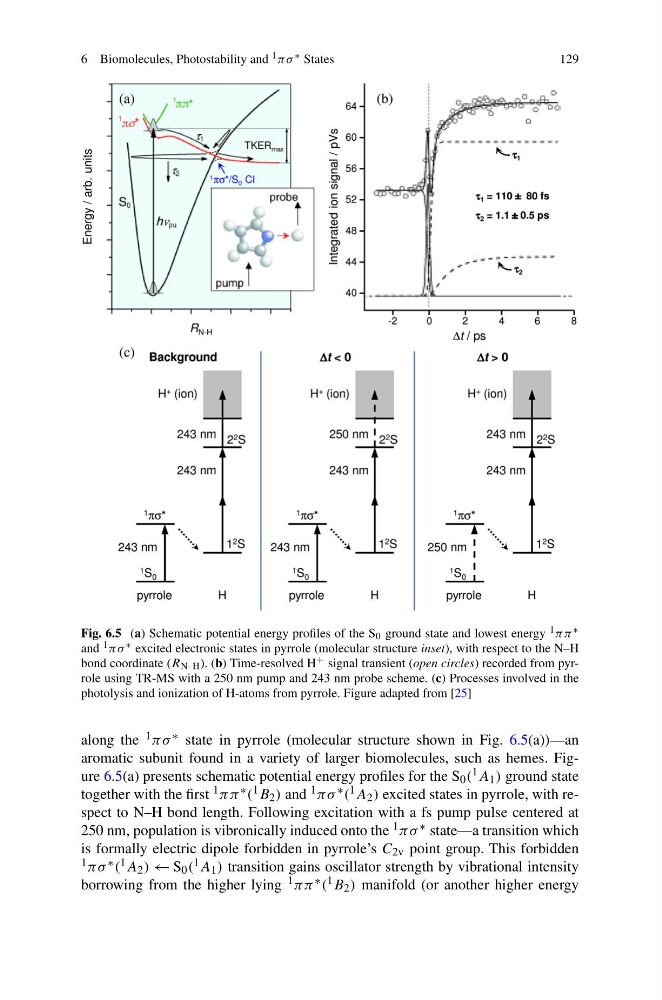
Fig. 6.5 (a) Schematic potential energy profiles of the S 0 ground state and lowest energy 1 ππ ∗
and 1 πσ ∗ excited electronic states in pyrrole (molecular structure inset), with respect to the N–H
bond coordinate (R N–H ). (b) Time-resolved H + signal transient (open circles) recorded from pyrrole using TR-MS with a 250 nm pump and 243 nm probe scheme. (c) Processes involved in the
photolysis and ionization of H-atoms from pyrrole. Figure adapted from [25]
along the 1 πσ ∗ state in pyrrole (molecular structure shown in Fig. 6.5(a))—an
aromatic subunit found in a variety of larger biomolecules, such as hemes. Figure 6.5(a) presents schematic potential energy profiles for the S 0 ( 1 A 1 ) ground state
together with the first 1 ππ ∗ ( 1 B 2 ) and 1 πσ ∗ ( 1 A 2 ) excited states in pyrrole, with respect to N–H bond length. Following excitation with a fs pump pulse centered at
250 nm, population is vibronically induced onto the 1 πσ ∗ state—a transition which
is formally electric dipole forbidden in pyrrole’s C 2v point group. This forbidden
1 πσ ∗ ( 1 A 2 ) ← S 0 ( 1 A 1 ) transition gains oscillator strength by vibrational intensity
borrowing from the higher lying 1 ππ ∗ ( 1 B 2 ) manifold (or another higher energy
129
Fig. 6.5 (a) Schematic potential energy profiles of the S 0 ground state and lowest energy 1 ππ ∗
and 1 πσ ∗ excited electronic states in pyrrole (molecular structure inset), with respect to the N–H
bond coordinate (R N–H ). (b) Time-resolved H + signal transient (open circles) recorded from pyrrole using TR-MS with a 250 nm pump and 243 nm probe scheme. (c) Processes involved in the
photolysis and ionization of H-atoms from pyrrole. Figure adapted from [25]
along the 1 πσ ∗ state in pyrrole (molecular structure shown in Fig. 6.5(a))—an
aromatic subunit found in a variety of larger biomolecules, such as hemes. Figure 6.5(a) presents schematic potential energy profiles for the S 0 ( 1 A 1 ) ground state
together with the first 1 ππ ∗ ( 1 B 2 ) and 1 πσ ∗ ( 1 A 2 ) excited states in pyrrole, with respect to N–H bond length. Following excitation with a fs pump pulse centered at
250 nm, population is vibronically induced onto the 1 πσ ∗ state—a transition which
is formally electric dipole forbidden in pyrrole’s C 2v point group. This forbidden
1 πσ ∗ ( 1 A 2 ) ← S 0 ( 1 A 1 ) transition gains oscillator strength by vibrational intensity
borrowing from the higher lying 1 ππ ∗ ( 1 B 2 ) manifold (or another higher energy