

5 Time-Resolved Photoelectron Spectroscopy for Excited State Dynamics
113
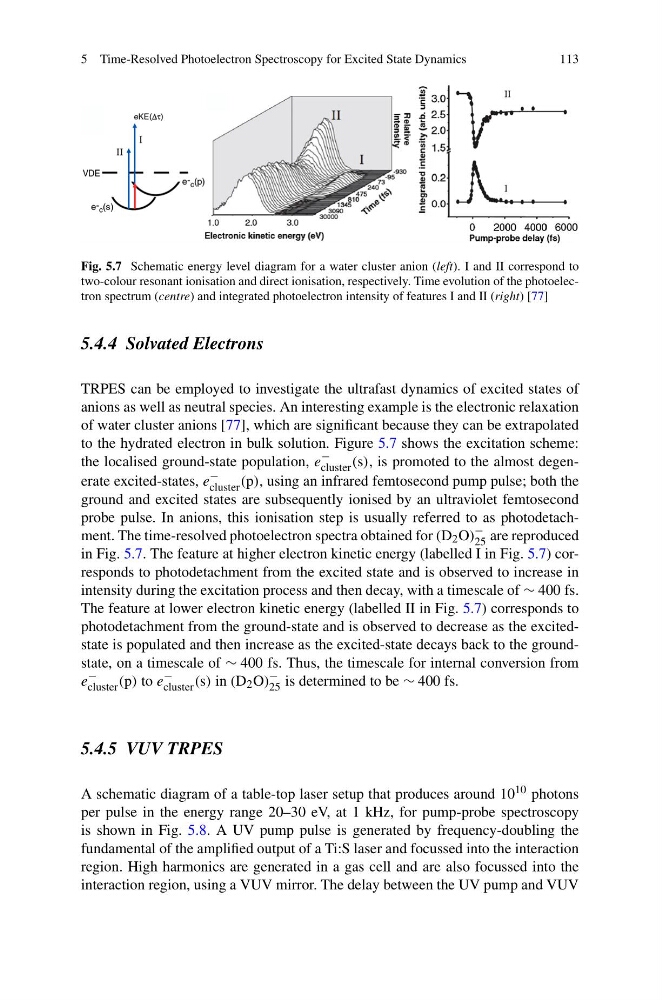
Fig. 5.7 Schematic energy level diagram for a water cluster anion (left). I and II correspond to
two-colour resonant ionisation and direct ionisation, respectively. Time evolution of the photoelectron spectrum (centre) and integrated photoelectron intensity of features I and II (right) [77]
5.4.4 Solvated Electrons
TRPES can be employed to investigate the ultrafast dynamics of excited states of
anions as well as neutral species. An interesting example is the electronic relaxation
of water cluster anions [77], which are significant because they can be extrapolated
to the hydrated electron in bulk solution. Figure 5.7 shows the excitation scheme:
the localised ground-state population, e
−
cluster (s), is promoted to the almost degenerate excited-states, e
−
cluster (p), using an infrared femtosecond pump pulse; both the
ground and excited states are subsequently ionised by an ultraviolet femtosecond
probe pulse. In anions, this ionisation step is usually referred to as photodetachment. The time-resolved photoelectron spectra obtained for (D 2 O)
−
25 are reproduced
in Fig. 5.7. The feature at higher electron kinetic energy (labelled I in Fig. 5.7) corresponds to photodetachment from the excited state and is observed to increase in
intensity during the excitation process and then decay, with a timescale of ∼ 400 fs.
The feature at lower electron kinetic energy (labelled II in Fig. 5.7) corresponds to
photodetachment from the ground-state and is observed to decrease as the excitedstate is populated and then increase as the excited-state decays back to the groundstate, on a timescale of ∼ 400 fs. Thus, the timescale for internal conversion from
e
−
cluster (p) to e
−
cluster (s) in (D 2 O)
−
25 is determined to be ∼ 400 fs.
5.4.5 VUV TRPES
A schematic diagram of a table-top laser setup that produces around 10 10 photons
per pulse in the energy range 20–30 eV, at 1 kHz, for pump-probe spectroscopy
is shown in Fig. 5.8. A UV pump pulse is generated by frequency-doubling the
fundamental of the amplified output of a Ti:S laser and focussed into the interaction
region. High harmonics are generated in a gas cell and are also focussed into the
interaction region, using a VUV mirror. The delay between the UV pump and VUV
113
Fig. 5.7 Schematic energy level diagram for a water cluster anion (left). I and II correspond to
two-colour resonant ionisation and direct ionisation, respectively. Time evolution of the photoelectron spectrum (centre) and integrated photoelectron intensity of features I and II (right) [77]
5.4.4 Solvated Electrons
TRPES can be employed to investigate the ultrafast dynamics of excited states of
anions as well as neutral species. An interesting example is the electronic relaxation
of water cluster anions [77], which are significant because they can be extrapolated
to the hydrated electron in bulk solution. Figure 5.7 shows the excitation scheme:
the localised ground-state population, e
−
cluster (s), is promoted to the almost degenerate excited-states, e
−
cluster (p), using an infrared femtosecond pump pulse; both the
ground and excited states are subsequently ionised by an ultraviolet femtosecond
probe pulse. In anions, this ionisation step is usually referred to as photodetachment. The time-resolved photoelectron spectra obtained for (D 2 O)
−
25 are reproduced
in Fig. 5.7. The feature at higher electron kinetic energy (labelled I in Fig. 5.7) corresponds to photodetachment from the excited state and is observed to increase in
intensity during the excitation process and then decay, with a timescale of ∼ 400 fs.
The feature at lower electron kinetic energy (labelled II in Fig. 5.7) corresponds to
photodetachment from the ground-state and is observed to decrease as the excitedstate is populated and then increase as the excited-state decays back to the groundstate, on a timescale of ∼ 400 fs. Thus, the timescale for internal conversion from
e
−
cluster (p) to e
−
cluster (s) in (D 2 O)
−
25 is determined to be ∼ 400 fs.
5.4.5 VUV TRPES
A schematic diagram of a table-top laser setup that produces around 10 10 photons
per pulse in the energy range 20–30 eV, at 1 kHz, for pump-probe spectroscopy
is shown in Fig. 5.8. A UV pump pulse is generated by frequency-doubling the
fundamental of the amplified output of a Ti:S laser and focussed into the interaction
region. High harmonics are generated in a gas cell and are also focussed into the
interaction region, using a VUV mirror. The delay between the UV pump and VUV