

114
R. Spesyvtsev et al.
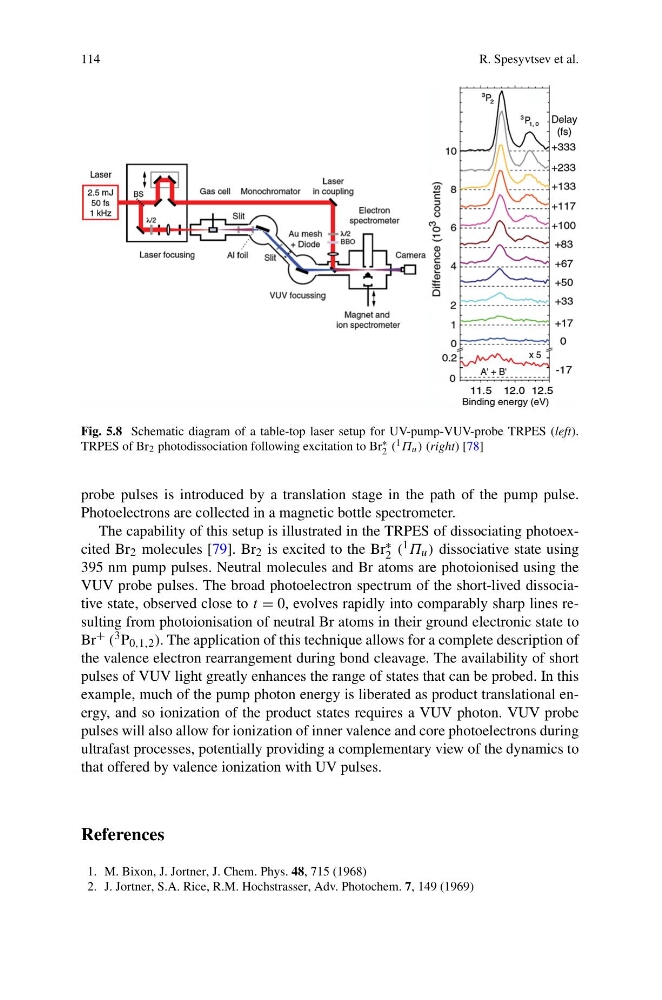
Fig. 5.8 Schematic diagram of a table-top laser setup for UV-pump-VUV-probe TRPES (left).
TRPES of Br 2 photodissociation following excitation to Br ∗
2 ( 1 Π u ) (right) [78]
probe pulses is introduced by a translation stage in the path of the pump pulse.
Photoelectrons are collected in a magnetic bottle spectrometer.
The capability of this setup is illustrated in the TRPES of dissociating photoexcited Br 2 molecules [79]. Br 2 is excited to the Br ∗
2 ( 1 Π u ) dissociative state using
395 nm pump pulses. Neutral molecules and Br atoms are photoionised using the
VUV probe pulses. The broad photoelectron spectrum of the short-lived dissociative state, observed close to t = 0, evolves rapidly into comparably sharp lines resulting from photoionisation of neutral Br atoms in their ground electronic state to
Br + ( 3 P 0,1,2 ). The application of this technique allows for a complete description of
the valence electron rearrangement during bond cleavage. The availability of short
pulses of VUV light greatly enhances the range of states that can be probed. In this
example, much of the pump photon energy is liberated as product translational energy, and so ionization of the product states requires a VUV photon. VUV probe
pulses will also allow for ionization of inner valence and core photoelectrons during
ultrafast processes, potentially providing a complementary view of the dynamics to
that offered by valence ionization with UV pulses.
References
1. M. Bixon, J. Jortner, J. Chem. Phys. 48, 715 (1968)
2. J. Jortner, S.A. Rice, R.M. Hochstrasser, Adv. Photochem. 7, 149 (1969)
R. Spesyvtsev et al.
Fig. 5.8 Schematic diagram of a table-top laser setup for UV-pump-VUV-probe TRPES (left).
TRPES of Br 2 photodissociation following excitation to Br ∗
2 ( 1 Π u ) (right) [78]
probe pulses is introduced by a translation stage in the path of the pump pulse.
Photoelectrons are collected in a magnetic bottle spectrometer.
The capability of this setup is illustrated in the TRPES of dissociating photoexcited Br 2 molecules [79]. Br 2 is excited to the Br ∗
2 ( 1 Π u ) dissociative state using
395 nm pump pulses. Neutral molecules and Br atoms are photoionised using the
VUV probe pulses. The broad photoelectron spectrum of the short-lived dissociative state, observed close to t = 0, evolves rapidly into comparably sharp lines resulting from photoionisation of neutral Br atoms in their ground electronic state to
Br + ( 3 P 0,1,2 ). The application of this technique allows for a complete description of
the valence electron rearrangement during bond cleavage. The availability of short
pulses of VUV light greatly enhances the range of states that can be probed. In this
example, much of the pump photon energy is liberated as product translational energy, and so ionization of the product states requires a VUV photon. VUV probe
pulses will also allow for ionization of inner valence and core photoelectrons during
ultrafast processes, potentially providing a complementary view of the dynamics to
that offered by valence ionization with UV pulses.
References
1. M. Bixon, J. Jortner, J. Chem. Phys. 48, 715 (1968)
2. J. Jortner, S.A. Rice, R.M. Hochstrasser, Adv. Photochem. 7, 149 (1969)