

5 Time-Resolved Photoelectron Spectroscopy for Excited State Dynamics
111
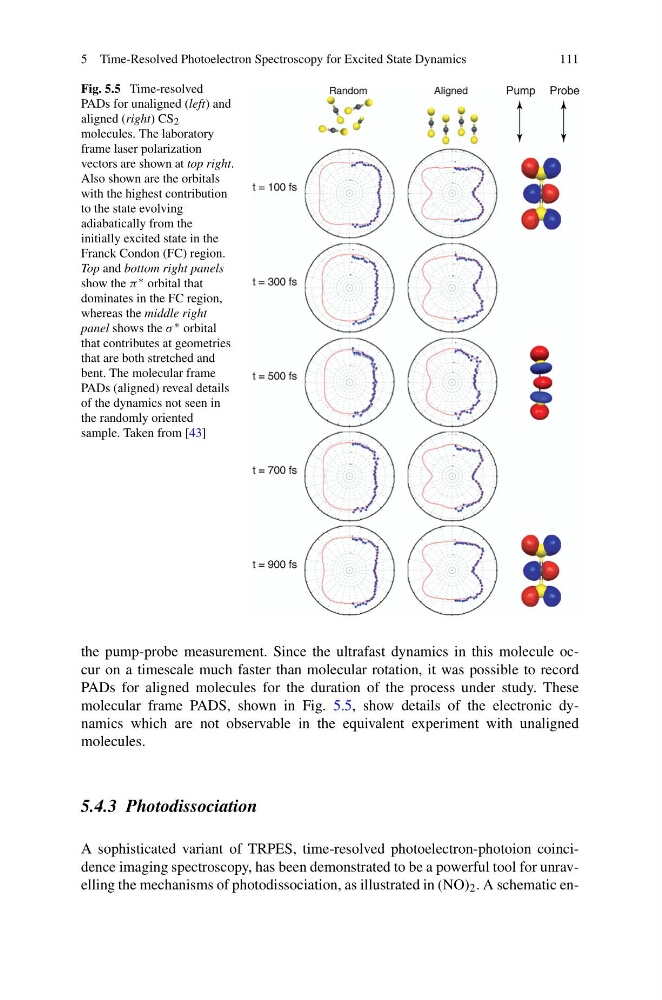
Fig. 5.5 Time-resolved
PADs for unaligned (left) and
aligned (right) CS 2
molecules. The laboratory
frame laser polarization
vectors are shown at top right.
Also shown are the orbitals
with the highest contribution
to the state evolving
adiabatically from the
initially excited state in the
Franck Condon (FC) region.
Top and bottom right panels
show the π ∗ orbital that
dominates in the FC region,
whereas the middle right
panel shows the σ ∗ orbital
that contributes at geometries
that are both stretched and
bent. The molecular frame
PADs (aligned) reveal details
of the dynamics not seen in
the randomly oriented
sample. Taken from [43]
the pump-probe measurement. Since the ultrafast dynamics in this molecule occur on a timescale much faster than molecular rotation, it was possible to record
PADs for aligned molecules for the duration of the process under study. These
molecular frame PADS, shown in Fig. 5.5, show details of the electronic dynamics which are not observable in the equivalent experiment with unaligned
molecules.
5.4.3 Photodissociation
A sophisticated variant of TRPES, time-resolved photoelectron-photoion coincidence imaging spectroscopy, has been demonstrated to be a powerful tool for unravelling the mechanisms of photodissociation, as illustrated in (NO) 2 . A schematic en-
111
Fig. 5.5 Time-resolved
PADs for unaligned (left) and
aligned (right) CS 2
molecules. The laboratory
frame laser polarization
vectors are shown at top right.
Also shown are the orbitals
with the highest contribution
to the state evolving
adiabatically from the
initially excited state in the
Franck Condon (FC) region.
Top and bottom right panels
show the π ∗ orbital that
dominates in the FC region,
whereas the middle right
panel shows the σ ∗ orbital
that contributes at geometries
that are both stretched and
bent. The molecular frame
PADs (aligned) reveal details
of the dynamics not seen in
the randomly oriented
sample. Taken from [43]
the pump-probe measurement. Since the ultrafast dynamics in this molecule occur on a timescale much faster than molecular rotation, it was possible to record
PADs for aligned molecules for the duration of the process under study. These
molecular frame PADS, shown in Fig. 5.5, show details of the electronic dynamics which are not observable in the equivalent experiment with unaligned
molecules.
5.4.3 Photodissociation
A sophisticated variant of TRPES, time-resolved photoelectron-photoion coincidence imaging spectroscopy, has been demonstrated to be a powerful tool for unravelling the mechanisms of photodissociation, as illustrated in (NO) 2 . A schematic en-