

2.7 Unimolecular Photochemical Reactions in Organic Molecules
73
O
hν
+ CO
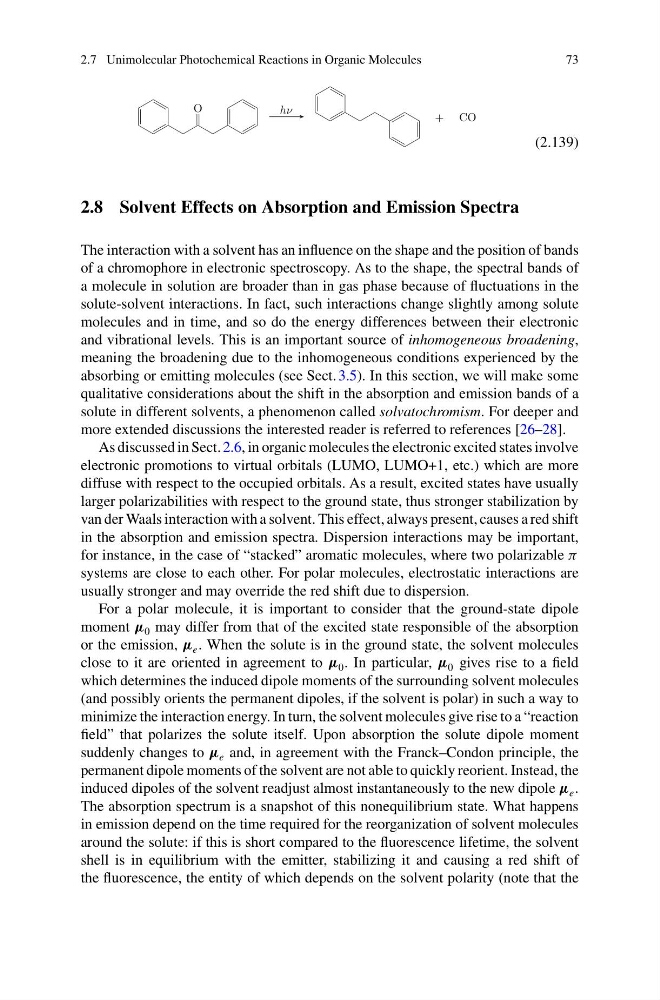
(2.139)
2.8 Solvent Effects on Absorption and Emission Spectra
The interaction with a solvent has an influence on the shape and the position of bands
of a chromophore in electronic spectroscopy. As to the shape, the spectral bands of
a molecule in solution are broader than in gas phase because of fluctuations in the
solute-solvent interactions. In fact, such interactions change slightly among solute
molecules and in time, and so do the energy differences between their electronic
and vibrational levels. This is an important source of inhomogeneous broadening,
meaning the broadening due to the inhomogeneous conditions experienced by the
absorbing or emitting molecules (see Sect. 3.5). In this section, we will make some
qualitative considerations about the shift in the absorption and emission bands of a
solute in different solvents, a phenomenon called solvatochromism. For deeper and
more extended discussions the interested reader is referred to references [26–28].
As discussed in Sect. 2.6, in organic molecules the electronic excited states involve
electronic promotions to virtual orbitals (LUMO, LUMO+1, etc.) which are more
diffuse with respect to the occupied orbitals. As a result, excited states have usually
larger polarizabilities with respect to the ground state, thus stronger stabilization by
van der Waals interaction with a solvent. This effect, always present, causes a red shift
in the absorption and emission spectra. Dispersion interactions may be important,
for instance, in the case of “stacked” aromatic molecules, where two polarizable π
systems are close to each other. For polar molecules, electrostatic interactions are
usually stronger and may override the red shift due to dispersion.
For a polar molecule, it is important to consider that the ground-state dipole
moment μ 0 may differ from that of the excited state responsible of the absorption
or the emission, μ e . When the solute is in the ground state, the solvent molecules
close to it are oriented in agreement to μ 0 . In particular, μ 0 gives rise to a field
which determines the induced dipole moments of the surrounding solvent molecules
(and possibly orients the permanent dipoles, if the solvent is polar) in such a way to
minimize the interaction energy. In turn, the solvent molecules give rise to a “reaction
field” that polarizes the solute itself. Upon absorption the solute dipole moment
suddenly changes to μ e and, in agreement with the Franck–Condon principle, the
permanent dipole moments of the solvent are not able to quickly reorient. Instead, the
induced dipoles of the solvent readjust almost instantaneously to the new dipole μ e .
The absorption spectrum is a snapshot of this nonequilibrium state. What happens
in emission depend on the time required for the reorganization of solvent molecules
around the solute: if this is short compared to the fluorescence lifetime, the solvent
shell is in equilibrium with the emitter, stabilizing it and causing a red shift of
the fluorescence, the entity of which depends on the solvent polarity (note that the
73
O
hν
+ CO
(2.139)
2.8 Solvent Effects on Absorption and Emission Spectra
The interaction with a solvent has an influence on the shape and the position of bands
of a chromophore in electronic spectroscopy. As to the shape, the spectral bands of
a molecule in solution are broader than in gas phase because of fluctuations in the
solute-solvent interactions. In fact, such interactions change slightly among solute
molecules and in time, and so do the energy differences between their electronic
and vibrational levels. This is an important source of inhomogeneous broadening,
meaning the broadening due to the inhomogeneous conditions experienced by the
absorbing or emitting molecules (see Sect. 3.5). In this section, we will make some
qualitative considerations about the shift in the absorption and emission bands of a
solute in different solvents, a phenomenon called solvatochromism. For deeper and
more extended discussions the interested reader is referred to references [26–28].
As discussed in Sect. 2.6, in organic molecules the electronic excited states involve
electronic promotions to virtual orbitals (LUMO, LUMO+1, etc.) which are more
diffuse with respect to the occupied orbitals. As a result, excited states have usually
larger polarizabilities with respect to the ground state, thus stronger stabilization by
van der Waals interaction with a solvent. This effect, always present, causes a red shift
in the absorption and emission spectra. Dispersion interactions may be important,
for instance, in the case of “stacked” aromatic molecules, where two polarizable π
systems are close to each other. For polar molecules, electrostatic interactions are
usually stronger and may override the red shift due to dispersion.
For a polar molecule, it is important to consider that the ground-state dipole
moment μ 0 may differ from that of the excited state responsible of the absorption
or the emission, μ e . When the solute is in the ground state, the solvent molecules
close to it are oriented in agreement to μ 0 . In particular, μ 0 gives rise to a field
which determines the induced dipole moments of the surrounding solvent molecules
(and possibly orients the permanent dipoles, if the solvent is polar) in such a way to
minimize the interaction energy. In turn, the solvent molecules give rise to a “reaction
field” that polarizes the solute itself. Upon absorption the solute dipole moment
suddenly changes to μ e and, in agreement with the Franck–Condon principle, the
permanent dipole moments of the solvent are not able to quickly reorient. Instead, the
induced dipoles of the solvent readjust almost instantaneously to the new dipole μ e .
The absorption spectrum is a snapshot of this nonequilibrium state. What happens
in emission depend on the time required for the reorganization of solvent molecules
around the solute: if this is short compared to the fluorescence lifetime, the solvent
shell is in equilibrium with the emitter, stabilizing it and causing a red shift of
the fluorescence, the entity of which depends on the solvent polarity (note that the