

74
2 Molecular States
Table 2.5 Solvatochromic shifts of absorption bands. The maximum absorption wavelength (λ max ,
nm) for the given band (n → π ∗ , π → π ∗ or CT) is reported. PNPB is the molecule shown in
Fig. 2.10, for which the color of the solution is indicated in parenthesis. ε r is the dielectric constant
of the solvent. Data from [26, 29]
Solvent
Pyrimidine
Benzophenone Benzophenone PNPB
Molecule
ε r
n → π ∗
n → π ∗
π → π ∗
CT
n-hexane
1.89
–
347
248
–
Anisole
4.33
–
–
–
771 (yellow)
Ether
4.34
290
344
249
–
Acetone
20.7
–
–
–
667 (green)
Isopentanol
14.7
–
–
–
583 (blue)
Acetonitrile
37.5
287
339
251
–
Ethanol
25.1
–
332
252
550 (violet)
Methanol
32.6
280
331
253
516 (red)
Water
78.5
271
322
258
453
ground state will also be out of equilibrium after photon emission, so contributing to
the red shift). This is what happens in many cases for fluorescent molecules in low
viscosity solvents. Conversely, if the solvent relaxation is slow and/or the lifetime
of the excited state is too short, the fluorescence is emitted from the nonequilibrium
Franck–Condon state, with no shift due to reorganization.
In general, n → π
∗ transitions entail a sizeable decrease in polarity. In fact,
in a n → π
∗ state an electron is displaced from a nonbonding orbital, usually
localized in an outlying region, to a more central and delocalized orbital. Therefore,
the interaction with the solvent stabilizes more the ground than the excited n → π
∗
state, and the resulting blue shift of the absorption band increases with the solvent
polarity (see Table 2.5). Especially large blue shift are expected in protic solvents,
where the n lone pair is involved in a hydrogen bond. This may lead to the inversion
of n → π
∗ and π → π
∗ bands in solution. In particular, the S 1 state may change
its nature from n → π
∗ in the gas phase to π → π
∗ in solution, with important
consequences on the molecular photochemistry and photophysics. In fact, as we shall
see in Sect. 3.11, fluorescence and other slow processes normally take place in the
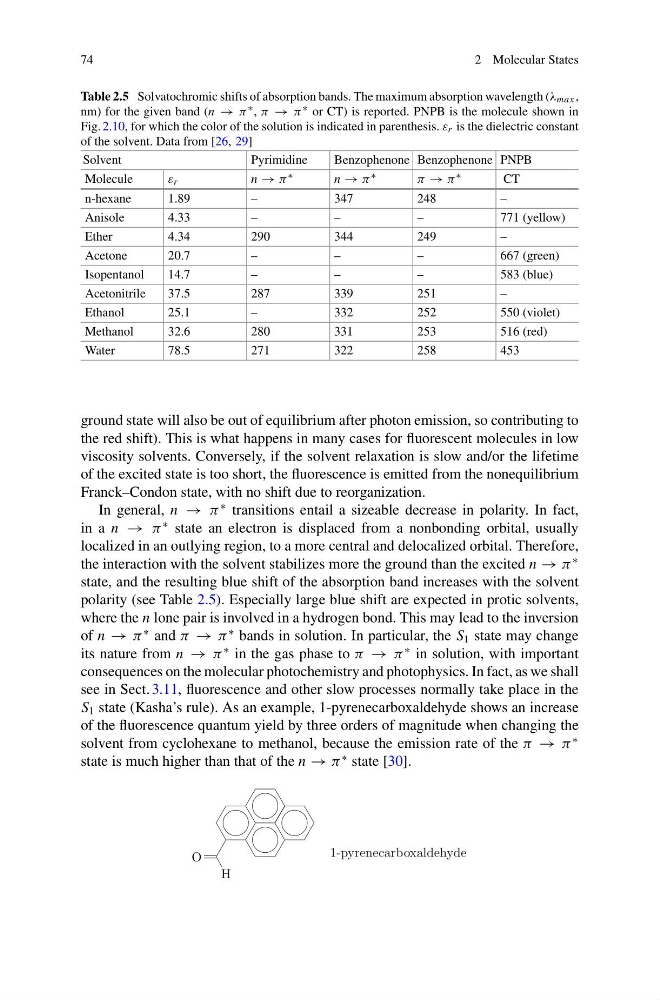
S 1 state (Kasha’s rule). As an example, 1-pyrenecarboxaldehyde shows an increase
of the fluorescence quantum yield by three orders of magnitude when changing the
solvent from cyclohexane to methanol, because the emission rate of the π → π
∗
state is much higher than that of the n → π
∗ state [30].
O
H
1-pyrenecarboxaldehyde
2 Molecular States
Table 2.5 Solvatochromic shifts of absorption bands. The maximum absorption wavelength (λ max ,
nm) for the given band (n → π ∗ , π → π ∗ or CT) is reported. PNPB is the molecule shown in
Fig. 2.10, for which the color of the solution is indicated in parenthesis. ε r is the dielectric constant
of the solvent. Data from [26, 29]
Solvent
Pyrimidine
Benzophenone Benzophenone PNPB
Molecule
ε r
n → π ∗
n → π ∗
π → π ∗
CT
n-hexane
1.89
–
347
248
–
Anisole
4.33
–
–
–
771 (yellow)
Ether
4.34
290
344
249
–
Acetone
20.7
–
–
–
667 (green)
Isopentanol
14.7
–
–
–
583 (blue)
Acetonitrile
37.5
287
339
251
–
Ethanol
25.1
–
332
252
550 (violet)
Methanol
32.6
280
331
253
516 (red)
Water
78.5
271
322
258
453
ground state will also be out of equilibrium after photon emission, so contributing to
the red shift). This is what happens in many cases for fluorescent molecules in low
viscosity solvents. Conversely, if the solvent relaxation is slow and/or the lifetime
of the excited state is too short, the fluorescence is emitted from the nonequilibrium
Franck–Condon state, with no shift due to reorganization.
In general, n → π
∗ transitions entail a sizeable decrease in polarity. In fact,
in a n → π
∗ state an electron is displaced from a nonbonding orbital, usually
localized in an outlying region, to a more central and delocalized orbital. Therefore,
the interaction with the solvent stabilizes more the ground than the excited n → π
∗
state, and the resulting blue shift of the absorption band increases with the solvent
polarity (see Table 2.5). Especially large blue shift are expected in protic solvents,
where the n lone pair is involved in a hydrogen bond. This may lead to the inversion
of n → π
∗ and π → π
∗ bands in solution. In particular, the S 1 state may change
its nature from n → π
∗ in the gas phase to π → π
∗ in solution, with important
consequences on the molecular photochemistry and photophysics. In fact, as we shall
see in Sect. 3.11, fluorescence and other slow processes normally take place in the
S 1 state (Kasha’s rule). As an example, 1-pyrenecarboxaldehyde shows an increase
of the fluorescence quantum yield by three orders of magnitude when changing the
solvent from cyclohexane to methanol, because the emission rate of the π → π
∗
state is much higher than that of the n → π
∗ state [30].
O
H
1-pyrenecarboxaldehyde