

72
2 Molecular States
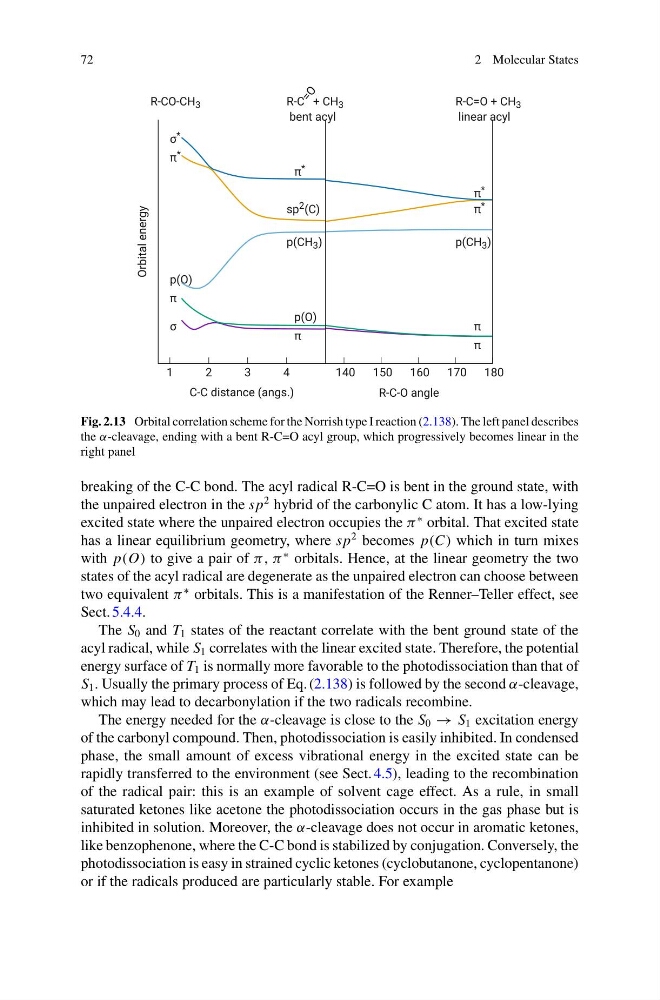
Fig. 2.13 Orbital correlation scheme for the Norrish type I reaction (2.138). The left panel describes
the α-cleavage, ending with a bent R-C=O acyl group, which progressively becomes linear in the
right panel
breaking of the C-C bond. The acyl radical R-C=O is bent in the ground state, with
the unpaired electron in the sp
2 hybrid of the carbonylic C atom. It has a low-lying
excited state where the unpaired electron occupies the π
∗ orbital. That excited state
has a linear equilibrium geometry, where sp
2 becomes p(C) which in turn mixes
with p(O) to give a pair of π , π
∗ orbitals. Hence, at the linear geometry the two
states of the acyl radical are degenerate as the unpaired electron can choose between
two equivalent π
∗ orbitals. This is a manifestation of the Renner–Teller effect, see
Sect. 5.4.4.
The S 0 and T 1 states of the reactant correlate with the bent ground state of the
acyl radical, while S 1 correlates with the linear excited state. Therefore, the potential
energy surface of T 1 is normally more favorable to the photodissociation than that of
S 1 . Usually the primary process of Eq. (2.138) is followed by the second α-cleavage,
which may lead to decarbonylation if the two radicals recombine.
The energy needed for the α-cleavage is close to the S 0 → S 1 excitation energy
of the carbonyl compound. Then, photodissociation is easily inhibited. In condensed
phase, the small amount of excess vibrational energy in the excited state can be
rapidly transferred to the environment (see Sect. 4.5), leading to the recombination
of the radical pair: this is an example of solvent cage effect. As a rule, in small
saturated ketones like acetone the photodissociation occurs in the gas phase but is
inhibited in solution. Moreover, the α-cleavage does not occur in aromatic ketones,
like benzophenone, where the C-C bond is stabilized by conjugation. Conversely, the
photodissociation is easy in strained cyclic ketones (cyclobutanone, cyclopentanone)
or if the radicals produced are particularly stable. For example
2 Molecular States
Fig. 2.13 Orbital correlation scheme for the Norrish type I reaction (2.138). The left panel describes
the α-cleavage, ending with a bent R-C=O acyl group, which progressively becomes linear in the
right panel
breaking of the C-C bond. The acyl radical R-C=O is bent in the ground state, with
the unpaired electron in the sp
2 hybrid of the carbonylic C atom. It has a low-lying
excited state where the unpaired electron occupies the π
∗ orbital. That excited state
has a linear equilibrium geometry, where sp
2 becomes p(C) which in turn mixes
with p(O) to give a pair of π , π
∗ orbitals. Hence, at the linear geometry the two
states of the acyl radical are degenerate as the unpaired electron can choose between
two equivalent π
∗ orbitals. This is a manifestation of the Renner–Teller effect, see
Sect. 5.4.4.
The S 0 and T 1 states of the reactant correlate with the bent ground state of the
acyl radical, while S 1 correlates with the linear excited state. Therefore, the potential
energy surface of T 1 is normally more favorable to the photodissociation than that of
S 1 . Usually the primary process of Eq. (2.138) is followed by the second α-cleavage,
which may lead to decarbonylation if the two radicals recombine.
The energy needed for the α-cleavage is close to the S 0 → S 1 excitation energy
of the carbonyl compound. Then, photodissociation is easily inhibited. In condensed
phase, the small amount of excess vibrational energy in the excited state can be
rapidly transferred to the environment (see Sect. 4.5), leading to the recombination
of the radical pair: this is an example of solvent cage effect. As a rule, in small
saturated ketones like acetone the photodissociation occurs in the gas phase but is
inhibited in solution. Moreover, the α-cleavage does not occur in aromatic ketones,
like benzophenone, where the C-C bond is stabilized by conjugation. Conversely, the
photodissociation is easy in strained cyclic ketones (cyclobutanone, cyclopentanone)
or if the radicals produced are particularly stable. For example