

2.7 Unimolecular Photochemical Reactions in Organic Molecules
71
as the shift [1, 3] cannot be antarafacial, and the photochemical shift [1, 3] supra
would require UV light with λ < 200 nm.
The stereochemical behavior shown in Table 2.4 can be explained considering
the cyclic intermediate referred above. In that system, HOMO and LUMO orbitals
are obtained from the linear combination of the 1s orbital of the H atom which
is transferred and the SOMO (singly occupied molecular orbital) of the remaining
molecular fragment. In turn, the SOMO is a π orbital of a conjugated system with
n s centers and n s electrons (note that in the intermediate C 1 and C n s belong to the
π system, both contributing with one electron and a partly hybridated p orbital).
In a suprafacial mechanism, a SOMO with an even number of nodes has a bonding
interaction with the 1s orbital: in fact, in that case the linear combination of p
orbitals which represents the SOMO is such that the p orbitals on C 1 and C n s are in
phase. Noting that n s is odd and the number of nodes in the SOMO is (n s − 1)/2, we
obtain the correlation Table 2.4 for thermal reactions. Concerning the photochemical
process, one has to consider the interaction of the 1s orbital with SOMO+1, which
of course has (n s + 1)/2 nodes, yielding an inverted stereospecificity with respect
to the thermal reaction.
The stereochemistry of a sigmatropic rearrangement in which atoms or groups
different from hydrogen are transferred, can be analyzed in a similar way. However,
if the unpaired electron of the migrating group is in a p orbital, as in the methyl
radical, it can establish bonding interactions with p or hybrid orbitals of opposite
signs on C 1 and C n s , so inverting the rules of Table 2.4.
2.7.4 Photodissociation of Carbonyl Compounds
The carbonyl compounds have a rich photochemistry. Here we focus on the “Norrish
type I” reaction, which is the photodissociation of the C-C bond in α position with
respect to C=O. In aliphatic aldehydes and ketones S 1 and T 1 have n → π
∗ character
and are close in energy, with similar potential energy surfaces and efficient ISC.
Therefore, the α-cleavage (as well as other photochemical processes) may take place
either in S 1 or in T 1 .
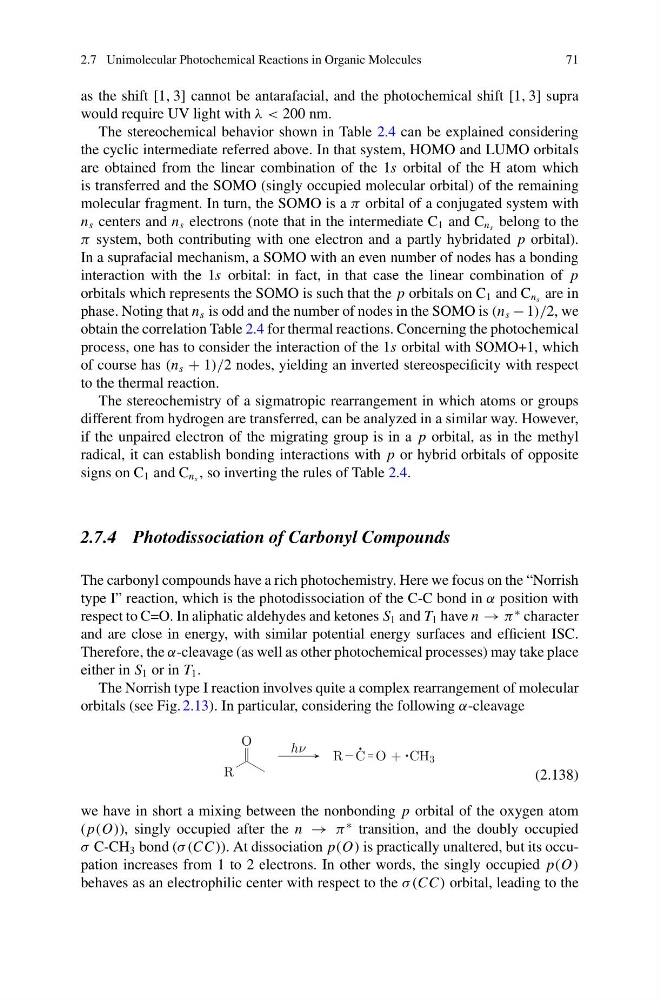
The Norrish type I reaction involves quite a complex rearrangement of molecular
orbitals (see Fig. 2.13). In particular, considering the following α-cleavage
R
O
hν
R C O + CH 3
(2.138)
we have in short a mixing between the nonbonding p orbital of the oxygen atom
( p(O)), singly occupied after the n → π
∗ transition, and the doubly occupied
σ C-CH 3 bond (σ (CC)). At dissociation p(O) is practically unaltered, but its occupation increases from 1 to 2 electrons. In other words, the singly occupied p(O)
behaves as an electrophilic center with respect to the σ (CC) orbital, leading to the
71
as the shift [1, 3] cannot be antarafacial, and the photochemical shift [1, 3] supra
would require UV light with λ < 200 nm.
The stereochemical behavior shown in Table 2.4 can be explained considering
the cyclic intermediate referred above. In that system, HOMO and LUMO orbitals
are obtained from the linear combination of the 1s orbital of the H atom which
is transferred and the SOMO (singly occupied molecular orbital) of the remaining
molecular fragment. In turn, the SOMO is a π orbital of a conjugated system with
n s centers and n s electrons (note that in the intermediate C 1 and C n s belong to the
π system, both contributing with one electron and a partly hybridated p orbital).
In a suprafacial mechanism, a SOMO with an even number of nodes has a bonding
interaction with the 1s orbital: in fact, in that case the linear combination of p
orbitals which represents the SOMO is such that the p orbitals on C 1 and C n s are in
phase. Noting that n s is odd and the number of nodes in the SOMO is (n s − 1)/2, we
obtain the correlation Table 2.4 for thermal reactions. Concerning the photochemical
process, one has to consider the interaction of the 1s orbital with SOMO+1, which
of course has (n s + 1)/2 nodes, yielding an inverted stereospecificity with respect
to the thermal reaction.
The stereochemistry of a sigmatropic rearrangement in which atoms or groups
different from hydrogen are transferred, can be analyzed in a similar way. However,
if the unpaired electron of the migrating group is in a p orbital, as in the methyl
radical, it can establish bonding interactions with p or hybrid orbitals of opposite
signs on C 1 and C n s , so inverting the rules of Table 2.4.
2.7.4 Photodissociation of Carbonyl Compounds
The carbonyl compounds have a rich photochemistry. Here we focus on the “Norrish
type I” reaction, which is the photodissociation of the C-C bond in α position with
respect to C=O. In aliphatic aldehydes and ketones S 1 and T 1 have n → π
∗ character
and are close in energy, with similar potential energy surfaces and efficient ISC.
Therefore, the α-cleavage (as well as other photochemical processes) may take place
either in S 1 or in T 1 .
The Norrish type I reaction involves quite a complex rearrangement of molecular
orbitals (see Fig. 2.13). In particular, considering the following α-cleavage
R
O
hν
R C O + CH 3
(2.138)
we have in short a mixing between the nonbonding p orbital of the oxygen atom
( p(O)), singly occupied after the n → π
∗ transition, and the doubly occupied
σ C-CH 3 bond (σ (CC)). At dissociation p(O) is practically unaltered, but its occupation increases from 1 to 2 electrons. In other words, the singly occupied p(O)
behaves as an electrophilic center with respect to the σ (CC) orbital, leading to the