

70
2 Molecular States
Quite the opposite is true for the thermal reaction, which prefers the conrotatory
pathway. Note that symmetry conservation is just a way to identify which orbitals of
the reactant can be gradually transformed into which orbitals of the reaction product.
In fact, the orbital correlations can also be established without reference to symmetry,
on the basis of continuous transformations along a reaction pathway.
2.7.3 Sigmatropic Reactions
In sigmatropic rearrangements one has a conjugated π system formed by carbon
atoms C 2 –C n s plus an aliphatic (sp
3 ) carbon atom C 1 connected to C 2 : a hydrogen
atom migrates from C 1 to C n s and the double bonds are displaced accordingly. Similar
to the electrocyclic processes, sigmatropic rearrangements are concerted reactions,
and one may have stereospecific thermal or photochemical sigmatropic rearrangements, with a stereochemical course depending on the number of electrons involved
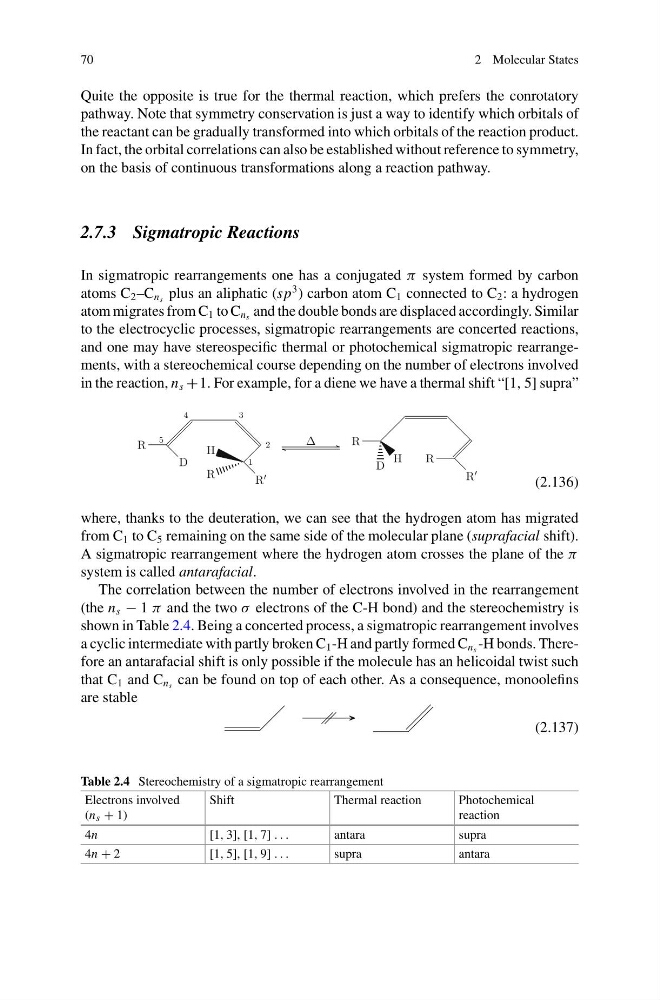
in the reaction, n s + 1. For example, for a diene we have a thermal shift “[1, 5] supra”
R
D
5
4
3
2
1
H
R
R
Δ
R
D
H
R
R
(2.136)
where, thanks to the deuteration, we can see that the hydrogen atom has migrated
from C 1 to C 5 remaining on the same side of the molecular plane (suprafacial shift).
A sigmatropic rearrangement where the hydrogen atom crosses the plane of the π
system is called antarafacial.
The correlation between the number of electrons involved in the rearrangement
(the n s − 1 π and the two σ electrons of the C-H bond) and the stereochemistry is
shown in Table 2.4. Being a concerted process, a sigmatropic rearrangement involves
a cyclic intermediate with partly broken C 1 -H and partly formed C n s -H bonds. Therefore an antarafacial shift is only possible if the molecule has an helicoidal twist such
that C 1 and C n s can be found on top of each other. As a consequence, monoolefins
are stable
(2.137)
Table 2.4 Stereochemistry of a sigmatropic rearrangement
Electrons involved
(n s + 1)
Shift
Thermal reaction
Photochemical
reaction
4n
[1, 3], [1, 7] . . .
antara
supra
4n + 2
[1, 5], [1, 9] . . .
supra
antara
2 Molecular States
Quite the opposite is true for the thermal reaction, which prefers the conrotatory
pathway. Note that symmetry conservation is just a way to identify which orbitals of
the reactant can be gradually transformed into which orbitals of the reaction product.
In fact, the orbital correlations can also be established without reference to symmetry,
on the basis of continuous transformations along a reaction pathway.
2.7.3 Sigmatropic Reactions
In sigmatropic rearrangements one has a conjugated π system formed by carbon
atoms C 2 –C n s plus an aliphatic (sp
3 ) carbon atom C 1 connected to C 2 : a hydrogen
atom migrates from C 1 to C n s and the double bonds are displaced accordingly. Similar
to the electrocyclic processes, sigmatropic rearrangements are concerted reactions,
and one may have stereospecific thermal or photochemical sigmatropic rearrangements, with a stereochemical course depending on the number of electrons involved
in the reaction, n s + 1. For example, for a diene we have a thermal shift “[1, 5] supra”
R
D
5
4
3
2
1
H
R
R
Δ
R
D
H
R
R
(2.136)
where, thanks to the deuteration, we can see that the hydrogen atom has migrated
from C 1 to C 5 remaining on the same side of the molecular plane (suprafacial shift).
A sigmatropic rearrangement where the hydrogen atom crosses the plane of the π
system is called antarafacial.
The correlation between the number of electrons involved in the rearrangement
(the n s − 1 π and the two σ electrons of the C-H bond) and the stereochemistry is
shown in Table 2.4. Being a concerted process, a sigmatropic rearrangement involves
a cyclic intermediate with partly broken C 1 -H and partly formed C n s -H bonds. Therefore an antarafacial shift is only possible if the molecule has an helicoidal twist such
that C 1 and C n s can be found on top of each other. As a consequence, monoolefins
are stable
(2.137)
Table 2.4 Stereochemistry of a sigmatropic rearrangement
Electrons involved
(n s + 1)
Shift
Thermal reaction
Photochemical
reaction
4n
[1, 3], [1, 7] . . .
antara
supra
4n + 2
[1, 5], [1, 9] . . .
supra
antara