

2.7 Unimolecular Photochemical Reactions in Organic Molecules
69
Fig. 2.11 Conrotatory and
disrotatory ring-closure in an
electrocyclic reaction
R
R
disrotatory
R
R
R
R
conrotatory
R
R
Table 2.3 Stereochemistry of an electrocyclic reaction
Electrons involved (2n c )
Thermal reaction
Photochemical reaction
4n
Conrotatory
Disrotatory
4n + 2
Disrotatory
Conrotatory
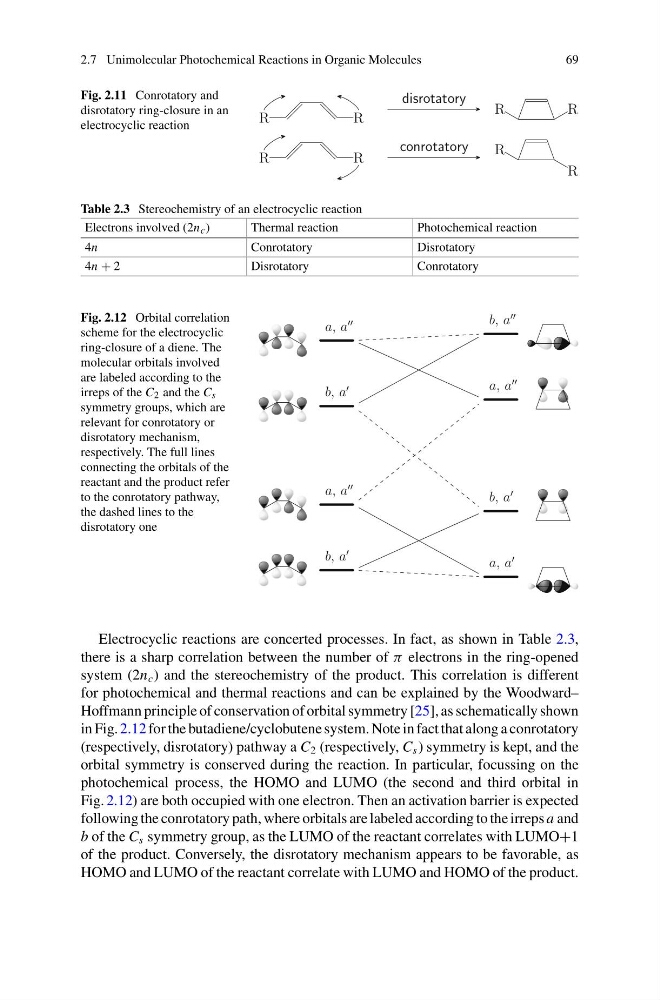
Fig. 2.12 Orbital correlation
scheme for the electrocyclic
ring-closure of a diene. The
molecular orbitals involved
are labeled according to the
irreps of the C 2 and the C s
symmetry groups, which are
relevant for conrotatory or
disrotatory mechanism,
respectively. The full lines
connecting the orbitals of the
reactant and the product refer
to the conrotatory pathway,
the dashed lines to the
disrotatory one
b, a
a, a
b, a
a, a
a, a
b, a
a, a
b, a
Electrocyclic reactions are concerted processes. In fact, as shown in Table 2.3,
there is a sharp correlation between the number of π electrons in the ring-opened
system (2n c ) and the stereochemistry of the product. This correlation is different
for photochemical and thermal reactions and can be explained by the Woodward–
Hoffmann principle of conservation of orbital symmetry [25], as schematically shown
in Fig. 2.12 for the butadiene/cyclobutene system. Note in fact that along a conrotatory
(respectively, disrotatory) pathway a C 2 (respectively, C s ) symmetry is kept, and the
orbital symmetry is conserved during the reaction. In particular, focussing on the
photochemical process, the HOMO and LUMO (the second and third orbital in
Fig. 2.12) are both occupied with one electron. Then an activation barrier is expected
following the conrotatory path, where orbitals are labeled according to the irreps a and
b of the C s symmetry group, as the LUMO of the reactant correlates with LUMO+1
of the product. Conversely, the disrotatory mechanism appears to be favorable, as
HOMO and LUMO of the reactant correlate with LUMO and HOMO of the product.
69
Fig. 2.11 Conrotatory and
disrotatory ring-closure in an
electrocyclic reaction
R
R
disrotatory
R
R
R
R
conrotatory
R
R
Table 2.3 Stereochemistry of an electrocyclic reaction
Electrons involved (2n c )
Thermal reaction
Photochemical reaction
4n
Conrotatory
Disrotatory
4n + 2
Disrotatory
Conrotatory
Fig. 2.12 Orbital correlation
scheme for the electrocyclic
ring-closure of a diene. The
molecular orbitals involved
are labeled according to the
irreps of the C 2 and the C s
symmetry groups, which are
relevant for conrotatory or
disrotatory mechanism,
respectively. The full lines
connecting the orbitals of the
reactant and the product refer
to the conrotatory pathway,
the dashed lines to the
disrotatory one
b, a
a, a
b, a
a, a
a, a
b, a
a, a
b, a
Electrocyclic reactions are concerted processes. In fact, as shown in Table 2.3,
there is a sharp correlation between the number of π electrons in the ring-opened
system (2n c ) and the stereochemistry of the product. This correlation is different
for photochemical and thermal reactions and can be explained by the Woodward–
Hoffmann principle of conservation of orbital symmetry [25], as schematically shown
in Fig. 2.12 for the butadiene/cyclobutene system. Note in fact that along a conrotatory
(respectively, disrotatory) pathway a C 2 (respectively, C s ) symmetry is kept, and the
orbital symmetry is conserved during the reaction. In particular, focussing on the
photochemical process, the HOMO and LUMO (the second and third orbital in
Fig. 2.12) are both occupied with one electron. Then an activation barrier is expected
following the conrotatory path, where orbitals are labeled according to the irreps a and
b of the C s symmetry group, as the LUMO of the reactant correlates with LUMO+1
of the product. Conversely, the disrotatory mechanism appears to be favorable, as
HOMO and LUMO of the reactant correlate with LUMO and HOMO of the product.