

68
2 Molecular States
2.7 Unimolecular Photochemical Reactions in Organic
Molecules
We give here a short account of the photochemical reactivity of organic molecules,
considering only some of the main photochemical processes. More information on
organic photochemistry can be found in Klán and Wirz [23] or Turro et al. [24].
2.7.1 Photoisomerization of Alkenes
In the ground state, the cis–trans isomerization in alkenes has a high activation energy
(around 250 kJ/mol in monoalkenes, see Fig. 2.8) and requires therefore high temperatures, or the use of a catalyzer. In any case, in the end the (thermodynamic) equilibrium mixture of the two isomers is obtained. At variance, the photoisomerization
is usually easy and fast, and both cis → trans and trans → cis photoisomerizations
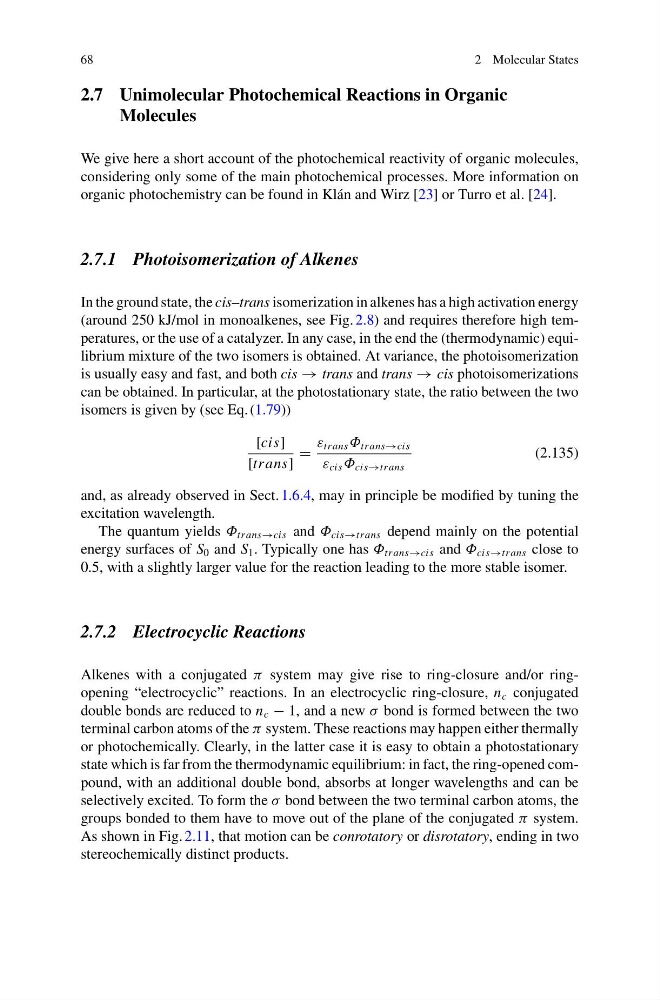
can be obtained. In particular, at the photostationary state, the ratio between the two
isomers is given by (see Eq. (1.79))
[cis]
[trans]
=
ε trans Φ trans→cis
ε cis Φ cis→trans
(2.135)
and, as already observed in Sect. 1.6.4, may in principle be modified by tuning the
excitation wavelength.
The quantum yields Φ trans→cis and Φ cis→trans depend mainly on the potential
energy surfaces of S 0 and S 1 . Typically one has Φ trans→cis and Φ cis→trans close to
0.5, with a slightly larger value for the reaction leading to the more stable isomer.
2.7.2 Electrocyclic Reactions
Alkenes with a conjugated π system may give rise to ring-closure and/or ringopening “electrocyclic” reactions. In an electrocyclic ring-closure, n c conjugated
double bonds are reduced to n c − 1, and a new σ bond is formed between the two
terminal carbon atoms of the π system. These reactions may happen either thermally
or photochemically. Clearly, in the latter case it is easy to obtain a photostationary
state which is far from the thermodynamic equilibrium: in fact, the ring-opened compound, with an additional double bond, absorbs at longer wavelengths and can be
selectively excited. To form the σ bond between the two terminal carbon atoms, the
groups bonded to them have to move out of the plane of the conjugated π system.
As shown in Fig. 2.11, that motion can be conrotatory or disrotatory, ending in two
stereochemically distinct products.
2 Molecular States
2.7 Unimolecular Photochemical Reactions in Organic
Molecules
We give here a short account of the photochemical reactivity of organic molecules,
considering only some of the main photochemical processes. More information on
organic photochemistry can be found in Klán and Wirz [23] or Turro et al. [24].
2.7.1 Photoisomerization of Alkenes
In the ground state, the cis–trans isomerization in alkenes has a high activation energy
(around 250 kJ/mol in monoalkenes, see Fig. 2.8) and requires therefore high temperatures, or the use of a catalyzer. In any case, in the end the (thermodynamic) equilibrium mixture of the two isomers is obtained. At variance, the photoisomerization
is usually easy and fast, and both cis → trans and trans → cis photoisomerizations
can be obtained. In particular, at the photostationary state, the ratio between the two
isomers is given by (see Eq. (1.79))
[cis]
[trans]
=
ε trans Φ trans→cis
ε cis Φ cis→trans
(2.135)
and, as already observed in Sect. 1.6.4, may in principle be modified by tuning the
excitation wavelength.
The quantum yields Φ trans→cis and Φ cis→trans depend mainly on the potential
energy surfaces of S 0 and S 1 . Typically one has Φ trans→cis and Φ cis→trans close to
0.5, with a slightly larger value for the reaction leading to the more stable isomer.
2.7.2 Electrocyclic Reactions
Alkenes with a conjugated π system may give rise to ring-closure and/or ringopening “electrocyclic” reactions. In an electrocyclic ring-closure, n c conjugated
double bonds are reduced to n c − 1, and a new σ bond is formed between the two
terminal carbon atoms of the π system. These reactions may happen either thermally
or photochemically. Clearly, in the latter case it is easy to obtain a photostationary
state which is far from the thermodynamic equilibrium: in fact, the ring-opened compound, with an additional double bond, absorbs at longer wavelengths and can be
selectively excited. To form the σ bond between the two terminal carbon atoms, the
groups bonded to them have to move out of the plane of the conjugated π system.
As shown in Fig. 2.11, that motion can be conrotatory or disrotatory, ending in two
stereochemically distinct products.