

2.6 Electronic States of Polyatomics and Photoreactivity
67
more strongly coupled and therefore mixed with π → π
∗ singlets, which in turn
have large transition dipoles with S 0 . Therefore, molecules where S 1 and T 1 have
n → π
∗ character usually have Φ P Φ F (where Φ F and Φ P are the fluorescence
and phosphorescence quantum yields, respectively). This happens in many carbonyl
compounds, especially the aromatic ones. For example, benzophenone has Φ F ≈
10
−5 and Φ P 0.9 (in rigid glasses at 77 K).
2.6.7 Charge Transfer States
Molecules containing electron-rich (donor, D) and electron-poor (acceptor, A) moieties are called push–pull systems. Considering A and D as separate entities, one
expects for A a large electron affinity and for D a small ionization potential. In
other words, the LUMO of A is particularly low in energy, while HOMO of D is
particularly high. In these systems the first excited state usually corresponds to the
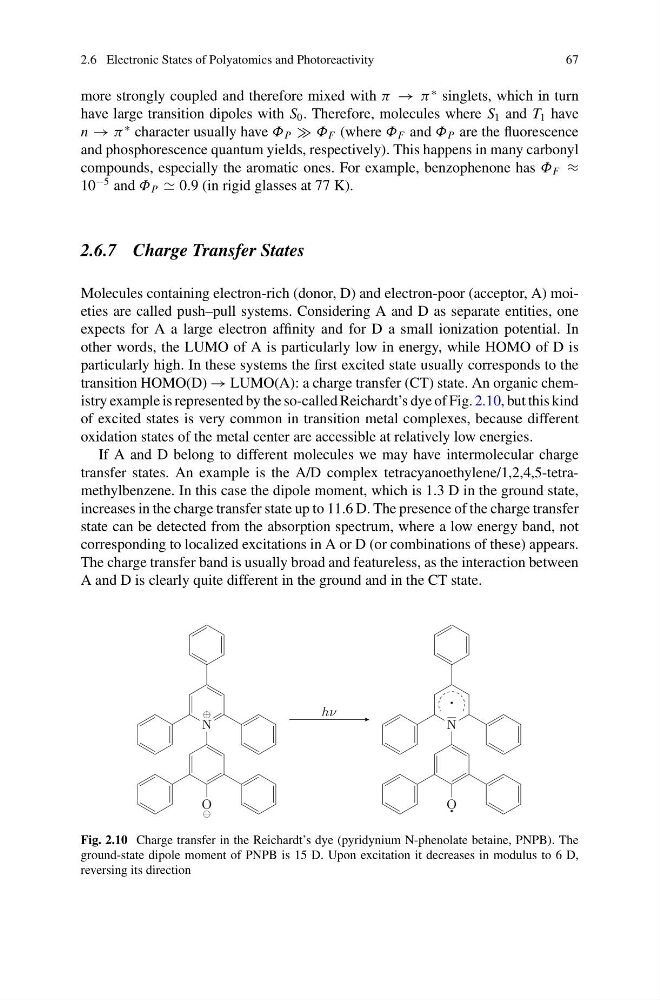
transition HOMO(D) → LUMO(A): a charge transfer (CT) state. An organic chemistry example is represented by the so-called Reichardt’s dye of Fig. 2.10, but this kind
of excited states is very common in transition metal complexes, because different
oxidation states of the metal center are accessible at relatively low energies.
If A and D belong to different molecules we may have intermolecular charge
transfer states. An example is the A/D complex tetracyanoethylene/1,2,4,5-tetramethylbenzene. In this case the dipole moment, which is 1.3 D in the ground state,
increases in the charge transfer state up to 11.6 D. The presence of the charge transfer
state can be detected from the absorption spectrum, where a low energy band, not
corresponding to localized excitations in A or D (or combinations of these) appears.
The charge transfer band is usually broad and featureless, as the interaction between
A and D is clearly quite different in the ground and in the CT state.
⊕
N
O
hν
N
O
Fig. 2.10 Charge transfer in the Reichardt’s dye (pyridynium N-phenolate betaine, PNPB). The
ground-state dipole moment of PNPB is 15 D. Upon excitation it decreases in modulus to 6 D,
reversing its direction
67
more strongly coupled and therefore mixed with π → π
∗ singlets, which in turn
have large transition dipoles with S 0 . Therefore, molecules where S 1 and T 1 have
n → π
∗ character usually have Φ P Φ F (where Φ F and Φ P are the fluorescence
and phosphorescence quantum yields, respectively). This happens in many carbonyl
compounds, especially the aromatic ones. For example, benzophenone has Φ F ≈
10
−5 and Φ P 0.9 (in rigid glasses at 77 K).
2.6.7 Charge Transfer States
Molecules containing electron-rich (donor, D) and electron-poor (acceptor, A) moieties are called push–pull systems. Considering A and D as separate entities, one
expects for A a large electron affinity and for D a small ionization potential. In
other words, the LUMO of A is particularly low in energy, while HOMO of D is
particularly high. In these systems the first excited state usually corresponds to the
transition HOMO(D) → LUMO(A): a charge transfer (CT) state. An organic chemistry example is represented by the so-called Reichardt’s dye of Fig. 2.10, but this kind
of excited states is very common in transition metal complexes, because different
oxidation states of the metal center are accessible at relatively low energies.
If A and D belong to different molecules we may have intermolecular charge
transfer states. An example is the A/D complex tetracyanoethylene/1,2,4,5-tetramethylbenzene. In this case the dipole moment, which is 1.3 D in the ground state,
increases in the charge transfer state up to 11.6 D. The presence of the charge transfer
state can be detected from the absorption spectrum, where a low energy band, not
corresponding to localized excitations in A or D (or combinations of these) appears.
The charge transfer band is usually broad and featureless, as the interaction between
A and D is clearly quite different in the ground and in the CT state.
⊕
N
O
hν
N
O
Fig. 2.10 Charge transfer in the Reichardt’s dye (pyridynium N-phenolate betaine, PNPB). The
ground-state dipole moment of PNPB is 15 D. Upon excitation it decreases in modulus to 6 D,
reversing its direction