

2.6 Electronic States of Polyatomics and Photoreactivity
59
For the sake of simplicity, here we have assumed that a and b are orthogonal: s =
a |b = 0. Of course this is in general not the case for two atomic orbitals belonging
to different atoms, especially if they have to form a bonding MO. However, one
can orthogonalize two atomic orbitals, generating orbitals as similar as possible to
the original ones (see Appendix E). The mixing coefficient λ > 0 depends on the
internuclear distance R AB and on the chemical environment. In particular, if we
assume A more electronegative than B, then λ ≤ 1. Note that λ = 1 when A and B
are identical (symmetric case, see Fig. 2.3). Moreover, increasing R AB the interaction
becomes smaller, so that λ tends to zero, and the two molecular orbitals σ and σ
∗
boil down to a and b (except in the symmetric case where λ = 1 independently of
R AB ).
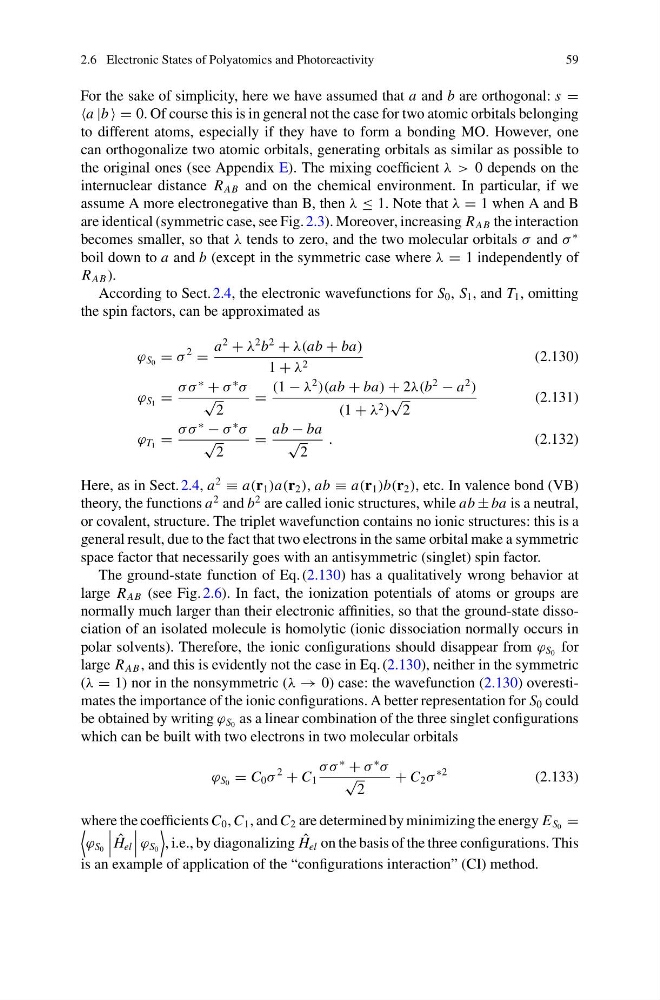
According to Sect. 2.4, the electronic wavefunctions for S 0 , S 1 , and T 1 , omitting
the spin factors, can be approximated as
ϕ S 0 = σ
2
=
a
2
+ λ
2 b
2
+ λ(ab + ba)
1 + λ 2
(2.130)
ϕ S 1 =
σ σ
∗
+ σ
∗
σ
√
2
=
(1 − λ
2
)(ab + ba) + 2λ(b
2
− a
2
)
(1 + λ 2 )
√
2
(2.131)
ϕ T 1 =
σ σ
∗
− σ
∗
σ
√
2
=
ab − ba
√
2
.
(2.132)
Here, as in Sect. 2.4, a
2
≡ a(r 1 )a(r 2 ), ab ≡ a(r 1 )b(r 2 ), etc. In valence bond (VB)
theory, the functions a
2 and b
2 are called ionic structures, while ab ± ba is a neutral,
or covalent, structure. The triplet wavefunction contains no ionic structures: this is a
general result, due to the fact that two electrons in the same orbital make a symmetric
space factor that necessarily goes with an antisymmetric (singlet) spin factor.
The ground-state function of Eq. (2.130) has a qualitatively wrong behavior at
large R AB (see Fig. 2.6). In fact, the ionization potentials of atoms or groups are
normally much larger than their electronic affinities, so that the ground-state dissociation of an isolated molecule is homolytic (ionic dissociation normally occurs in
polar solvents). Therefore, the ionic configurations should disappear from ϕ S 0 for
large R AB , and this is evidently not the case in Eq. (2.130), neither in the symmetric
(λ = 1) nor in the nonsymmetric (λ → 0) case: the wavefunction (2.130) overestimates the importance of the ionic configurations. A better representation for S 0 could
be obtained by writing ϕ S 0 as a linear combination of the three singlet configurations
which can be built with two electrons in two molecular orbitals
ϕ S 0 = C 0 σ
2
+ C 1
σ σ
∗
+ σ
∗
σ
√
2
+ C 2 σ
∗2
(2.133)
where the coefficients C 0 , C 1 , and C 2 are determined by minimizing the energy E S 0 =
ϕ S 0
ˆ
H el
ϕ S 0
, i.e., by diagonalizing ˆ
H el on the basis of the three configurations. This
is an example of application of the “configurations interaction” (CI) method.
59
For the sake of simplicity, here we have assumed that a and b are orthogonal: s =
a |b = 0. Of course this is in general not the case for two atomic orbitals belonging
to different atoms, especially if they have to form a bonding MO. However, one
can orthogonalize two atomic orbitals, generating orbitals as similar as possible to
the original ones (see Appendix E). The mixing coefficient λ > 0 depends on the
internuclear distance R AB and on the chemical environment. In particular, if we
assume A more electronegative than B, then λ ≤ 1. Note that λ = 1 when A and B
are identical (symmetric case, see Fig. 2.3). Moreover, increasing R AB the interaction
becomes smaller, so that λ tends to zero, and the two molecular orbitals σ and σ
∗
boil down to a and b (except in the symmetric case where λ = 1 independently of
R AB ).
According to Sect. 2.4, the electronic wavefunctions for S 0 , S 1 , and T 1 , omitting
the spin factors, can be approximated as
ϕ S 0 = σ
2
=
a
2
+ λ
2 b
2
+ λ(ab + ba)
1 + λ 2
(2.130)
ϕ S 1 =
σ σ
∗
+ σ
∗
σ
√
2
=
(1 − λ
2
)(ab + ba) + 2λ(b
2
− a
2
)
(1 + λ 2 )
√
2
(2.131)
ϕ T 1 =
σ σ
∗
− σ
∗
σ
√
2
=
ab − ba
√
2
.
(2.132)
Here, as in Sect. 2.4, a
2
≡ a(r 1 )a(r 2 ), ab ≡ a(r 1 )b(r 2 ), etc. In valence bond (VB)
theory, the functions a
2 and b
2 are called ionic structures, while ab ± ba is a neutral,
or covalent, structure. The triplet wavefunction contains no ionic structures: this is a
general result, due to the fact that two electrons in the same orbital make a symmetric
space factor that necessarily goes with an antisymmetric (singlet) spin factor.
The ground-state function of Eq. (2.130) has a qualitatively wrong behavior at
large R AB (see Fig. 2.6). In fact, the ionization potentials of atoms or groups are
normally much larger than their electronic affinities, so that the ground-state dissociation of an isolated molecule is homolytic (ionic dissociation normally occurs in
polar solvents). Therefore, the ionic configurations should disappear from ϕ S 0 for
large R AB , and this is evidently not the case in Eq. (2.130), neither in the symmetric
(λ = 1) nor in the nonsymmetric (λ → 0) case: the wavefunction (2.130) overestimates the importance of the ionic configurations. A better representation for S 0 could
be obtained by writing ϕ S 0 as a linear combination of the three singlet configurations
which can be built with two electrons in two molecular orbitals
ϕ S 0 = C 0 σ
2
+ C 1
σ σ
∗
+ σ
∗
σ
√
2
+ C 2 σ
∗2
(2.133)
where the coefficients C 0 , C 1 , and C 2 are determined by minimizing the energy E S 0 =
ϕ S 0
ˆ
H el
ϕ S 0
, i.e., by diagonalizing ˆ
H el on the basis of the three configurations. This
is an example of application of the “configurations interaction” (CI) method.