

58
2 Molecular States
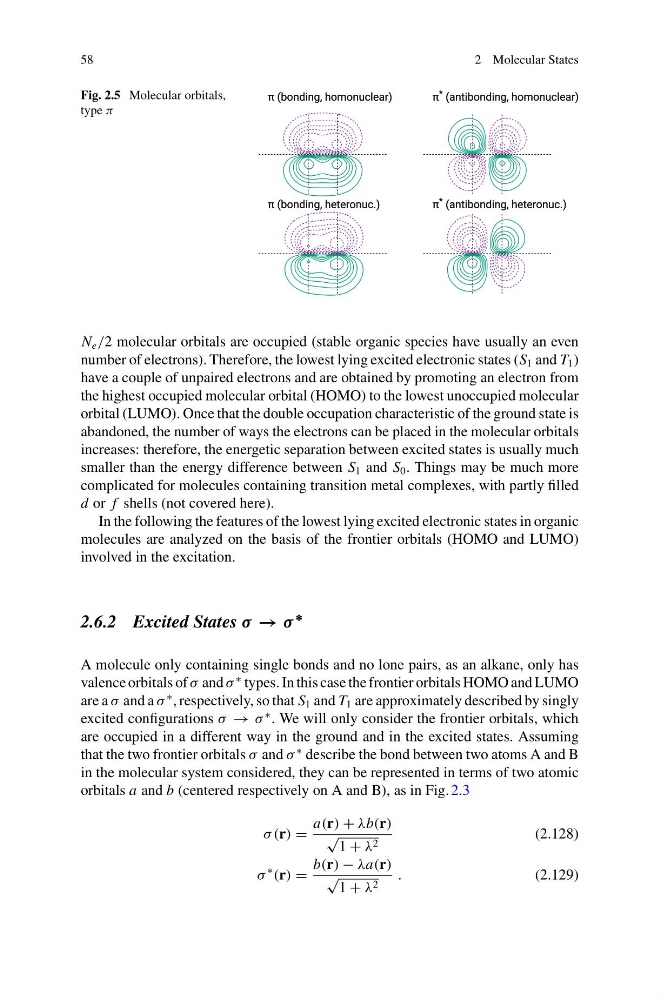
Fig. 2.5 Molecular orbitals,
type π
N e /2 molecular orbitals are occupied (stable organic species have usually an even
number of electrons). Therefore, the lowest lying excited electronic states (S 1 and T 1 )
have a couple of unpaired electrons and are obtained by promoting an electron from
the highest occupied molecular orbital (HOMO) to the lowest unoccupied molecular
orbital (LUMO). Once that the double occupation characteristic of the ground state is
abandoned, the number of ways the electrons can be placed in the molecular orbitals
increases: therefore, the energetic separation between excited states is usually much
smaller than the energy difference between S 1 and S 0 . Things may be much more
complicated for molecules containing transition metal complexes, with partly filled
d or f shells (not covered here).
In the following the features of the lowest lying excited electronic states in organic
molecules are analyzed on the basis of the frontier orbitals (HOMO and LUMO)
involved in the excitation.
2.6.2 Excited States σ → σ ∗
A molecule only containing single bonds and no lone pairs, as an alkane, only has
valence orbitals of σ and σ
∗ types. In this case the frontier orbitals HOMO and LUMO
are a σ and a σ
∗ , respectively, so that S 1 and T 1 are approximately described by singly
excited configurations σ → σ
∗ . We will only consider the frontier orbitals, which
are occupied in a different way in the ground and in the excited states. Assuming
that the two frontier orbitals σ and σ
∗ describe the bond between two atoms A and B
in the molecular system considered, they can be represented in terms of two atomic
orbitals a and b (centered respectively on A and B), as in Fig. 2.3
σ (r) =
a(r) + λb(r)
√
1 + λ 2
(2.128)
σ
∗
(r) =
b(r) − λa(r)
√
1 + λ 2
.
(2.129)
2 Molecular States
Fig. 2.5 Molecular orbitals,
type π
N e /2 molecular orbitals are occupied (stable organic species have usually an even
number of electrons). Therefore, the lowest lying excited electronic states (S 1 and T 1 )
have a couple of unpaired electrons and are obtained by promoting an electron from
the highest occupied molecular orbital (HOMO) to the lowest unoccupied molecular
orbital (LUMO). Once that the double occupation characteristic of the ground state is
abandoned, the number of ways the electrons can be placed in the molecular orbitals
increases: therefore, the energetic separation between excited states is usually much
smaller than the energy difference between S 1 and S 0 . Things may be much more
complicated for molecules containing transition metal complexes, with partly filled
d or f shells (not covered here).
In the following the features of the lowest lying excited electronic states in organic
molecules are analyzed on the basis of the frontier orbitals (HOMO and LUMO)
involved in the excitation.
2.6.2 Excited States σ → σ ∗
A molecule only containing single bonds and no lone pairs, as an alkane, only has
valence orbitals of σ and σ
∗ types. In this case the frontier orbitals HOMO and LUMO
are a σ and a σ
∗ , respectively, so that S 1 and T 1 are approximately described by singly
excited configurations σ → σ
∗ . We will only consider the frontier orbitals, which
are occupied in a different way in the ground and in the excited states. Assuming
that the two frontier orbitals σ and σ
∗ describe the bond between two atoms A and B
in the molecular system considered, they can be represented in terms of two atomic
orbitals a and b (centered respectively on A and B), as in Fig. 2.3
σ (r) =
a(r) + λb(r)
√
1 + λ 2
(2.128)
σ
∗
(r) =
b(r) − λa(r)
√
1 + λ 2
.
(2.129)