

2.6 Electronic States of Polyatomics and Photoreactivity
57
a
b
a − b
a + b
Degenerate atomic orbitals
with weak interaction
a
b
a − b
a + b
Degenerate atomic orbitals
with strong interaction
a
b
b − λ s a
a + λ s b
Atomic orbitals with different
energies, weak interaction
a
b
b − λ l a
a + λ l b
Atomic orbitals with different
energies, strong interaction
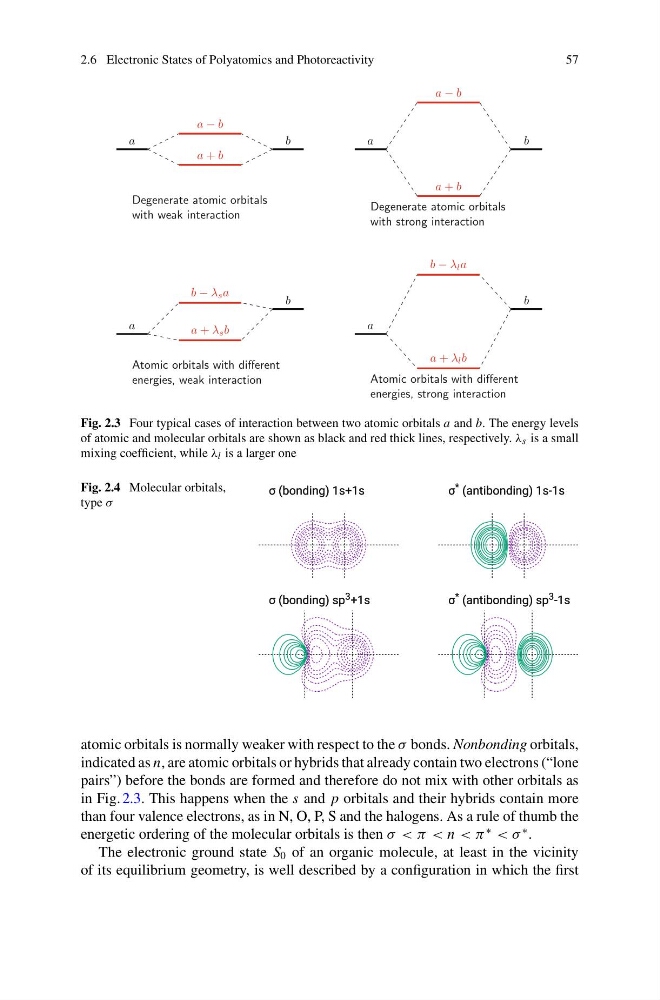
Fig. 2.3 Four typical cases of interaction between two atomic orbitals a and b. The energy levels
of atomic and molecular orbitals are shown as black and red thick lines, respectively. λ s is a small
mixing coefficient, while λ l is a larger one
Fig. 2.4 Molecular orbitals,
type σ
atomic orbitals is normally weaker with respect to the σ bonds. Nonbonding orbitals,
indicated as n, are atomic orbitals or hybrids that already contain two electrons (“lone
pairs”) before the bonds are formed and therefore do not mix with other orbitals as
in Fig. 2.3. This happens when the s and p orbitals and their hybrids contain more
than four valence electrons, as in N, O, P, S and the halogens. As a rule of thumb the
energetic ordering of the molecular orbitals is then σ < π < n < π
∗
< σ
∗ .
The electronic ground state S 0 of an organic molecule, at least in the vicinity
of its equilibrium geometry, is well described by a configuration in which the first
57
a
b
a − b
a + b
Degenerate atomic orbitals
with weak interaction
a
b
a − b
a + b
Degenerate atomic orbitals
with strong interaction
a
b
b − λ s a
a + λ s b
Atomic orbitals with different
energies, weak interaction
a
b
b − λ l a
a + λ l b
Atomic orbitals with different
energies, strong interaction
Fig. 2.3 Four typical cases of interaction between two atomic orbitals a and b. The energy levels
of atomic and molecular orbitals are shown as black and red thick lines, respectively. λ s is a small
mixing coefficient, while λ l is a larger one
Fig. 2.4 Molecular orbitals,
type σ
atomic orbitals is normally weaker with respect to the σ bonds. Nonbonding orbitals,
indicated as n, are atomic orbitals or hybrids that already contain two electrons (“lone
pairs”) before the bonds are formed and therefore do not mix with other orbitals as
in Fig. 2.3. This happens when the s and p orbitals and their hybrids contain more
than four valence electrons, as in N, O, P, S and the halogens. As a rule of thumb the
energetic ordering of the molecular orbitals is then σ < π < n < π
∗
< σ
∗ .
The electronic ground state S 0 of an organic molecule, at least in the vicinity
of its equilibrium geometry, is well described by a configuration in which the first