

56
2 Molecular States
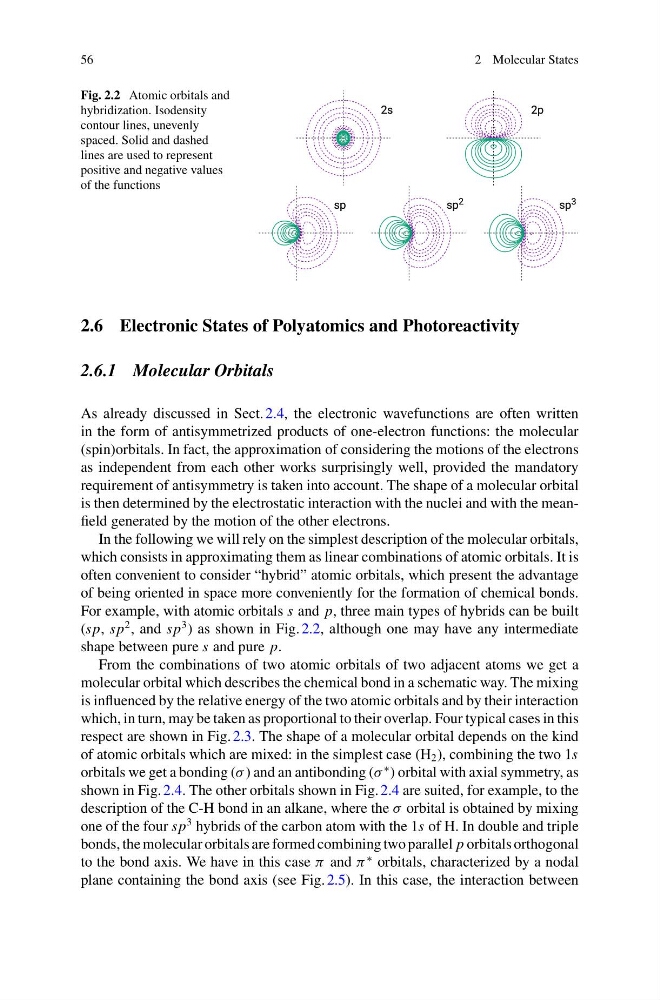
Fig. 2.2 Atomic orbitals and
hybridization. Isodensity
contour lines, unevenly
spaced. Solid and dashed
lines are used to represent
positive and negative values
of the functions
2.6 Electronic States of Polyatomics and Photoreactivity
2.6.1 Molecular Orbitals
As already discussed in Sect. 2.4, the electronic wavefunctions are often written
in the form of antisymmetrized products of one-electron functions: the molecular
(spin)orbitals. In fact, the approximation of considering the motions of the electrons
as independent from each other works surprisingly well, provided the mandatory
requirement of antisymmetry is taken into account. The shape of a molecular orbital
is then determined by the electrostatic interaction with the nuclei and with the meanfield generated by the motion of the other electrons.
In the following we will rely on the simplest description of the molecular orbitals,
which consists in approximating them as linear combinations of atomic orbitals. It is
often convenient to consider “hybrid” atomic orbitals, which present the advantage
of being oriented in space more conveniently for the formation of chemical bonds.
For example, with atomic orbitals s and p, three main types of hybrids can be built
(sp, sp
2 , and sp
3 ) as shown in Fig. 2.2, although one may have any intermediate
shape between pure s and pure p.
From the combinations of two atomic orbitals of two adjacent atoms we get a
molecular orbital which describes the chemical bond in a schematic way. The mixing
is influenced by the relative energy of the two atomic orbitals and by their interaction
which, in turn, may be taken as proportional to their overlap. Four typical cases in this
respect are shown in Fig. 2.3. The shape of a molecular orbital depends on the kind
of atomic orbitals which are mixed: in the simplest case (H 2 ), combining the two 1s
orbitals we get a bonding (σ ) and an antibonding (σ
∗ ) orbital with axial symmetry, as
shown in Fig. 2.4. The other orbitals shown in Fig. 2.4 are suited, for example, to the
description of the C-H bond in an alkane, where the σ orbital is obtained by mixing
one of the four sp
3 hybrids of the carbon atom with the 1s of H. In double and triple
bonds, the molecular orbitals are formed combining two parallel p orbitals orthogonal
to the bond axis. We have in this case π and π
∗ orbitals, characterized by a nodal
plane containing the bond axis (see Fig. 2.5). In this case, the interaction between
2 Molecular States
Fig. 2.2 Atomic orbitals and
hybridization. Isodensity
contour lines, unevenly
spaced. Solid and dashed
lines are used to represent
positive and negative values
of the functions
2.6 Electronic States of Polyatomics and Photoreactivity
2.6.1 Molecular Orbitals
As already discussed in Sect. 2.4, the electronic wavefunctions are often written
in the form of antisymmetrized products of one-electron functions: the molecular
(spin)orbitals. In fact, the approximation of considering the motions of the electrons
as independent from each other works surprisingly well, provided the mandatory
requirement of antisymmetry is taken into account. The shape of a molecular orbital
is then determined by the electrostatic interaction with the nuclei and with the meanfield generated by the motion of the other electrons.
In the following we will rely on the simplest description of the molecular orbitals,
which consists in approximating them as linear combinations of atomic orbitals. It is
often convenient to consider “hybrid” atomic orbitals, which present the advantage
of being oriented in space more conveniently for the formation of chemical bonds.
For example, with atomic orbitals s and p, three main types of hybrids can be built
(sp, sp
2 , and sp
3 ) as shown in Fig. 2.2, although one may have any intermediate
shape between pure s and pure p.
From the combinations of two atomic orbitals of two adjacent atoms we get a
molecular orbital which describes the chemical bond in a schematic way. The mixing
is influenced by the relative energy of the two atomic orbitals and by their interaction
which, in turn, may be taken as proportional to their overlap. Four typical cases in this
respect are shown in Fig. 2.3. The shape of a molecular orbital depends on the kind
of atomic orbitals which are mixed: in the simplest case (H 2 ), combining the two 1s
orbitals we get a bonding (σ ) and an antibonding (σ
∗ ) orbital with axial symmetry, as
shown in Fig. 2.4. The other orbitals shown in Fig. 2.4 are suited, for example, to the
description of the C-H bond in an alkane, where the σ orbital is obtained by mixing
one of the four sp
3 hybrids of the carbon atom with the 1s of H. In double and triple
bonds, the molecular orbitals are formed combining two parallel p orbitals orthogonal
to the bond axis. We have in this case π and π
∗ orbitals, characterized by a nodal
plane containing the bond axis (see Fig. 2.5). In this case, the interaction between