

2.5 Vibrational and Rotational States
55
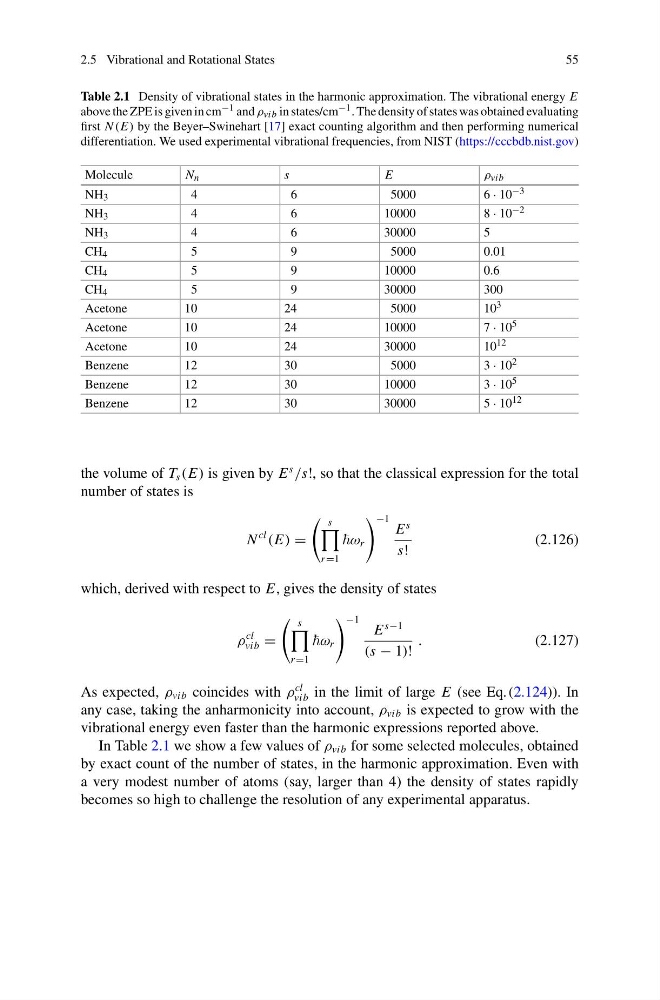
Table 2.1 Density of vibrational states in the harmonic approximation. The vibrational energy E
above the ZPE is given in cm −1 and ρ vib in states/cm −1 . The density of states was obtained evaluating
first N (E) by the Beyer–Swinehart [17] exact counting algorithm and then performing numerical
differentiation. We used experimental vibrational frequencies, from NIST (https://cccbdb.nist.gov)
Molecule
N n
s
E
ρ vib
NH 3
4
6
5000
6 · 10 −3
NH 3
4
6
10000
8 · 10 −2
NH 3
4
6
30000
5
CH 4
5
9
5000
0.01
CH 4
5
9
10000
0.6
CH 4
5
9
30000
300
Acetone
10
24
5000
10 3
Acetone
10
24
10000
7 · 10 5
Acetone
10
24
30000
10 12
Benzene
12
30
5000
3 · 10 2
Benzene
12
30
10000
3 · 10 5
Benzene
12
30
30000
5 · 10 12
the volume of T s (E) is given by E
s
/s!, so that the classical expression for the total
number of states is
N
cl
(E) =
s
r =1
ω r
−1
E
s
s!
(2.126)
which, derived with respect to E, gives the density of states
ρ
cl
vib =
s
r =1
ω r
−1
E
s−1
(s − 1)!
.
(2.127)
As expected, ρ vib coincides with ρ
cl
vib in the limit of large E (see Eq. (2.124)). In
any case, taking the anharmonicity into account, ρ vib is expected to grow with the
vibrational energy even faster than the harmonic expressions reported above.
In Table 2.1 we show a few values of ρ vib for some selected molecules, obtained
by exact count of the number of states, in the harmonic approximation. Even with
a very modest number of atoms (say, larger than 4) the density of states rapidly
becomes so high to challenge the resolution of any experimental apparatus.
55
Table 2.1 Density of vibrational states in the harmonic approximation. The vibrational energy E
above the ZPE is given in cm −1 and ρ vib in states/cm −1 . The density of states was obtained evaluating
first N (E) by the Beyer–Swinehart [17] exact counting algorithm and then performing numerical
differentiation. We used experimental vibrational frequencies, from NIST (https://cccbdb.nist.gov)
Molecule
N n
s
E
ρ vib
NH 3
4
6
5000
6 · 10 −3
NH 3
4
6
10000
8 · 10 −2
NH 3
4
6
30000
5
CH 4
5
9
5000
0.01
CH 4
5
9
10000
0.6
CH 4
5
9
30000
300
Acetone
10
24
5000
10 3
Acetone
10
24
10000
7 · 10 5
Acetone
10
24
30000
10 12
Benzene
12
30
5000
3 · 10 2
Benzene
12
30
10000
3 · 10 5
Benzene
12
30
30000
5 · 10 12
the volume of T s (E) is given by E
s
/s!, so that the classical expression for the total
number of states is
N
cl
(E) =
s
r =1
ω r
−1
E
s
s!
(2.126)
which, derived with respect to E, gives the density of states
ρ
cl
vib =
s
r =1
ω r
−1
E
s−1
(s − 1)!
.
(2.127)
As expected, ρ vib coincides with ρ
cl
vib in the limit of large E (see Eq. (2.124)). In
any case, taking the anharmonicity into account, ρ vib is expected to grow with the
vibrational energy even faster than the harmonic expressions reported above.
In Table 2.1 we show a few values of ρ vib for some selected molecules, obtained
by exact count of the number of states, in the harmonic approximation. Even with
a very modest number of atoms (say, larger than 4) the density of states rapidly
becomes so high to challenge the resolution of any experimental apparatus.