

54
2 Molecular States
it will evolve transferring the excitation to the other modes. This phenomenon is
called intramolecular vibrational energy redistribution (IVR) and is usually quite
fast in polyatomic molecules (see Sect. 4.3). IVR depends on the density of vibrational states and on their coupling. Clearly, it has a strong influence on the kinetics
of thermal unimolecular reactions, which depend on the ability to concentrate the
available vibrational energy along the reaction coordinate. For example, in the Rice,
Ramsperger, Kassel, and Marcus (RRKM) theory of unimolecular reactions it is
assumed that the vibrational energy is statistically distributed among the oscillators:
the microcanonical rate constant, which depends on the probability of gathering
enough energy in the reaction coordinate, is then related to the density of vibrational
states of the reactant [15].
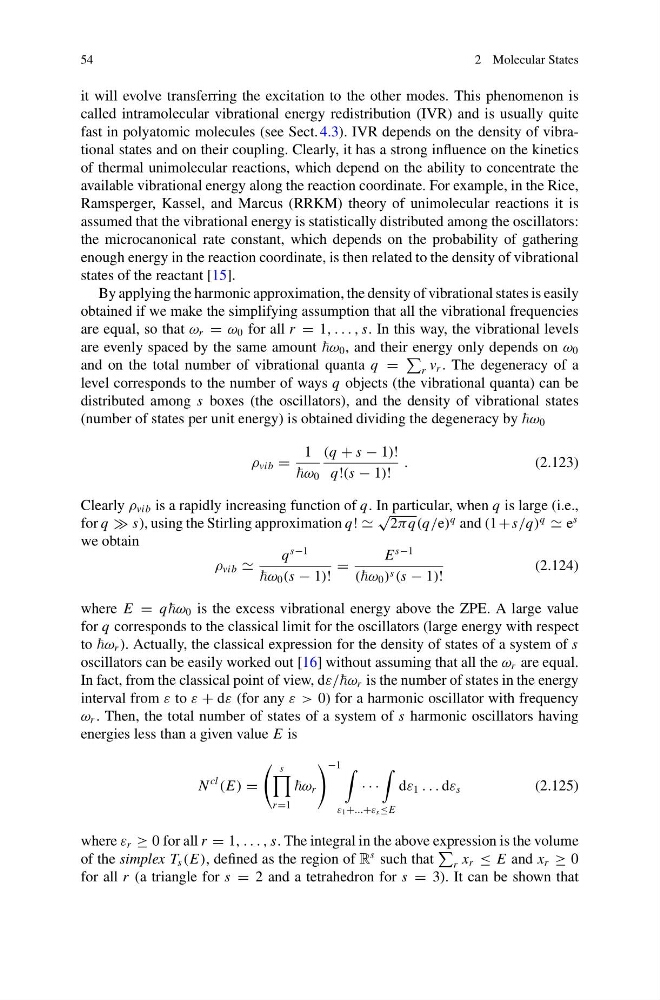
By applying the harmonic approximation, the density of vibrational states is easily
obtained if we make the simplifying assumption that all the vibrational frequencies
are equal, so that ω r = ω 0 for all r = 1, . . . , s. In this way, the vibrational levels
are evenly spaced by the same amount ω 0 , and their energy only depends on ω 0
and on the total number of vibrational quanta q =
r v r . The degeneracy of a
level corresponds to the number of ways q objects (the vibrational quanta) can be
distributed among s boxes (the oscillators), and the density of vibrational states
(number of states per unit energy) is obtained dividing the degeneracy by ω 0
ρ vib =
1
ω 0
(q + s − 1)!
q!(s − 1)!
.
(2.123)
Clearly ρ vib is a rapidly increasing function of q. In particular, when q is large (i.e.,
for q s), using the Stirling approximation q! !
√
2πq(q/e)
q and (1+s/q)
q
e
s
we obtain
ρ vib
q
s−1
ω 0 (s − 1)!
=
E
s−1
(ω 0 ) s (s − 1)!
(2.124)
where E = qω 0 is the excess vibrational energy above the ZPE. A large value
for q corresponds to the classical limit for the oscillators (large energy with respect
to ω r ). Actually, the classical expression for the density of states of a system of s
oscillators can be easily worked out [16] without assuming that all the ω r are equal.
In fact, from the classical point of view, dε/ω r is the number of states in the energy
interval from ε to ε + dε (for any ε > 0) for a harmonic oscillator with frequency
ω r . Then, the total number of states of a system of s harmonic oscillators having
energies less than a given value E is
N
cl
(E) =
s
r =1
ω r
−1
· · ·
ε 1 +...+ε s ≤E
dε 1 . . . dε s
(2.125)
where ε r ≥ 0 for all r = 1, . . . , s. The integral in the above expression is the volume
of the simplex T s (E), defined as the region of R
s such that
r x r ≤ E and x r ≥ 0
for all r (a triangle for s = 2 and a tetrahedron for s = 3). It can be shown that
2 Molecular States
it will evolve transferring the excitation to the other modes. This phenomenon is
called intramolecular vibrational energy redistribution (IVR) and is usually quite
fast in polyatomic molecules (see Sect. 4.3). IVR depends on the density of vibrational states and on their coupling. Clearly, it has a strong influence on the kinetics
of thermal unimolecular reactions, which depend on the ability to concentrate the
available vibrational energy along the reaction coordinate. For example, in the Rice,
Ramsperger, Kassel, and Marcus (RRKM) theory of unimolecular reactions it is
assumed that the vibrational energy is statistically distributed among the oscillators:
the microcanonical rate constant, which depends on the probability of gathering
enough energy in the reaction coordinate, is then related to the density of vibrational
states of the reactant [15].
By applying the harmonic approximation, the density of vibrational states is easily
obtained if we make the simplifying assumption that all the vibrational frequencies
are equal, so that ω r = ω 0 for all r = 1, . . . , s. In this way, the vibrational levels
are evenly spaced by the same amount ω 0 , and their energy only depends on ω 0
and on the total number of vibrational quanta q =
r v r . The degeneracy of a
level corresponds to the number of ways q objects (the vibrational quanta) can be
distributed among s boxes (the oscillators), and the density of vibrational states
(number of states per unit energy) is obtained dividing the degeneracy by ω 0
ρ vib =
1
ω 0
(q + s − 1)!
q!(s − 1)!
.
(2.123)
Clearly ρ vib is a rapidly increasing function of q. In particular, when q is large (i.e.,
for q s), using the Stirling approximation q! !
√
2πq(q/e)
q and (1+s/q)
q
e
s
we obtain
ρ vib
q
s−1
ω 0 (s − 1)!
=
E
s−1
(ω 0 ) s (s − 1)!
(2.124)
where E = qω 0 is the excess vibrational energy above the ZPE. A large value
for q corresponds to the classical limit for the oscillators (large energy with respect
to ω r ). Actually, the classical expression for the density of states of a system of s
oscillators can be easily worked out [16] without assuming that all the ω r are equal.
In fact, from the classical point of view, dε/ω r is the number of states in the energy
interval from ε to ε + dε (for any ε > 0) for a harmonic oscillator with frequency
ω r . Then, the total number of states of a system of s harmonic oscillators having
energies less than a given value E is
N
cl
(E) =
s
r =1
ω r
−1
· · ·
ε 1 +...+ε s ≤E
dε 1 . . . dε s
(2.125)
where ε r ≥ 0 for all r = 1, . . . , s. The integral in the above expression is the volume
of the simplex T s (E), defined as the region of R
s such that
r x r ≤ E and x r ≥ 0
for all r (a triangle for s = 2 and a tetrahedron for s = 3). It can be shown that