

60
2 Molecular States
σ
σ
σ
σ
σ
σ
σ
σ
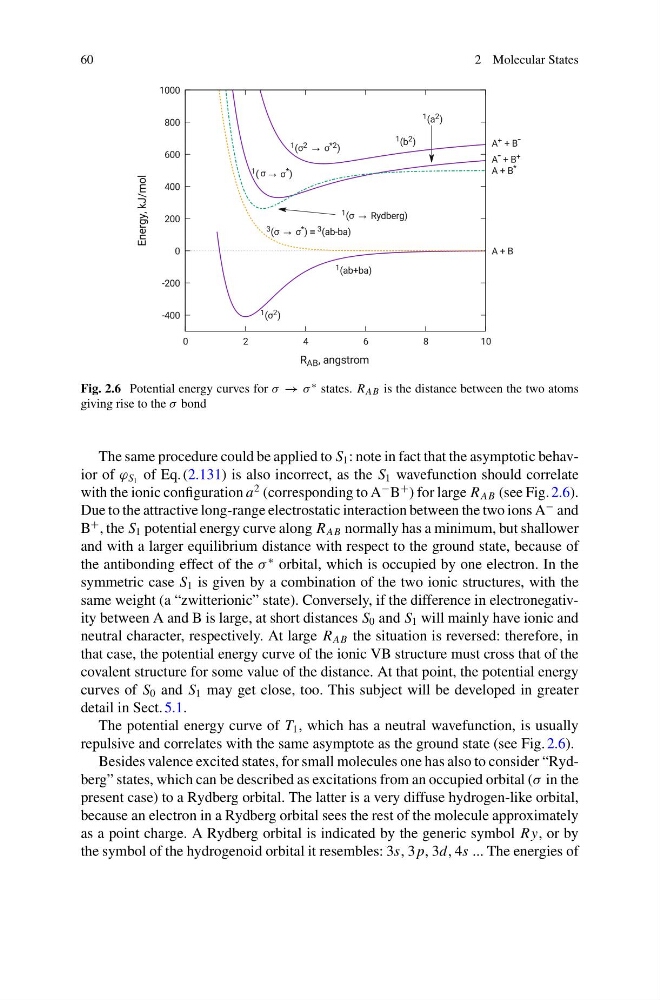
Fig. 2.6 Potential energy curves for σ → σ ∗ states. R AB is the distance between the two atoms
giving rise to the σ bond
The same procedure could be applied to S 1 : note in fact that the asymptotic behavior of ϕ S 1 of Eq. (2.131) is also incorrect, as the S 1 wavefunction should correlate
with the ionic configuration a
2 (corresponding to A
− B
+ ) for large R AB (see Fig. 2.6).
Due to the attractive long-range electrostatic interaction between the two ions A
− and
B
+ , the S 1 potential energy curve along R AB normally has a minimum, but shallower
and with a larger equilibrium distance with respect to the ground state, because of
the antibonding effect of the σ
∗ orbital, which is occupied by one electron. In the
symmetric case S 1 is given by a combination of the two ionic structures, with the
same weight (a “zwitterionic” state). Conversely, if the difference in electronegativity between A and B is large, at short distances S 0 and S 1 will mainly have ionic and
neutral character, respectively. At large R AB the situation is reversed: therefore, in
that case, the potential energy curve of the ionic VB structure must cross that of the
covalent structure for some value of the distance. At that point, the potential energy
curves of S 0 and S 1 may get close, too. This subject will be developed in greater
detail in Sect. 5.1.
The potential energy curve of T 1 , which has a neutral wavefunction, is usually
repulsive and correlates with the same asymptote as the ground state (see Fig. 2.6).
Besides valence excited states, for small molecules one has also to consider “Rydberg” states, which can be described as excitations from an occupied orbital (σ in the
present case) to a Rydberg orbital. The latter is a very diffuse hydrogen-like orbital,
because an electron in a Rydberg orbital sees the rest of the molecule approximately
as a point charge. A Rydberg orbital is indicated by the generic symbol Ry, or by
the symbol of the hydrogenoid orbital it resembles: 3s, 3p, 3d, 4s ... The energies of
2 Molecular States
σ
σ
σ
σ
σ
σ
σ
σ
Fig. 2.6 Potential energy curves for σ → σ ∗ states. R AB is the distance between the two atoms
giving rise to the σ bond
The same procedure could be applied to S 1 : note in fact that the asymptotic behavior of ϕ S 1 of Eq. (2.131) is also incorrect, as the S 1 wavefunction should correlate
with the ionic configuration a
2 (corresponding to A
− B
+ ) for large R AB (see Fig. 2.6).
Due to the attractive long-range electrostatic interaction between the two ions A
− and
B
+ , the S 1 potential energy curve along R AB normally has a minimum, but shallower
and with a larger equilibrium distance with respect to the ground state, because of
the antibonding effect of the σ
∗ orbital, which is occupied by one electron. In the
symmetric case S 1 is given by a combination of the two ionic structures, with the
same weight (a “zwitterionic” state). Conversely, if the difference in electronegativity between A and B is large, at short distances S 0 and S 1 will mainly have ionic and
neutral character, respectively. At large R AB the situation is reversed: therefore, in
that case, the potential energy curve of the ionic VB structure must cross that of the
covalent structure for some value of the distance. At that point, the potential energy
curves of S 0 and S 1 may get close, too. This subject will be developed in greater
detail in Sect. 5.1.
The potential energy curve of T 1 , which has a neutral wavefunction, is usually
repulsive and correlates with the same asymptote as the ground state (see Fig. 2.6).
Besides valence excited states, for small molecules one has also to consider “Rydberg” states, which can be described as excitations from an occupied orbital (σ in the
present case) to a Rydberg orbital. The latter is a very diffuse hydrogen-like orbital,
because an electron in a Rydberg orbital sees the rest of the molecule approximately
as a point charge. A Rydberg orbital is indicated by the generic symbol Ry, or by
the symbol of the hydrogenoid orbital it resembles: 3s, 3p, 3d, 4s ... The energies of