

52
2 Molecular States
up and their distances from the center of mass increase. As a result, for medium
to large molecules and/or large J it is often reasonable to neglect the quantization
of levels and to consider the overall rotation of the molecule as a classical motion.
We also note that, when talking about the molecular ground state, one usually refers
to the electronic and vibrational degrees of freedom, while rotations (and a fortiori
translations) are not considered, because a number of rotational states are always
populated, except at extremely low temperatures.
2.5.2 Vibrational States
The nuclear internal (or vibrational) motion is described by the vibrational Hamiltonian ˆ
H vib . The eigenvalue equation for ˆ
H vib is greatly simplified if the nuclear
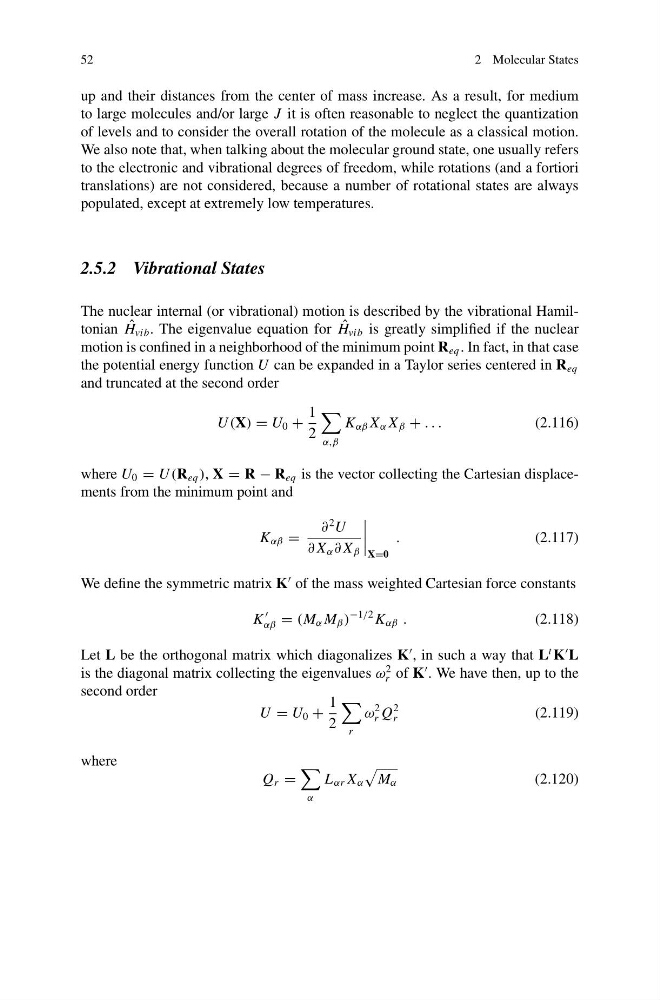
motion is confined in a neighborhood of the minimum point R eq . In fact, in that case
the potential energy function U can be expanded in a Taylor series centered in R eq
and truncated at the second order
U (X) = U 0 +
1
2
α,β
K αβ X α X β + . . .
(2.116)
where U 0 = U (R eq ), X = R − R eq is the vector collecting the Cartesian displacements from the minimum point and
K αβ =
∂
2 U
∂ X α ∂ X β
X=0
.
(2.117)
We define the symmetric matrix K
of the mass weighted Cartesian force constants
K
αβ = (M α M β )
−1/2 K αβ .
(2.118)
Let L be the orthogonal matrix which diagonalizes K
, in such a way that L
t K
L
is the diagonal matrix collecting the eigenvalues ω
2
r of K
. We have then, up to the
second order
U = U 0 +
1
2
r
ω
2
r Q
2
r
(2.119)
where
Q r =
α
L αr X α
M α
(2.120)
2 Molecular States
up and their distances from the center of mass increase. As a result, for medium
to large molecules and/or large J it is often reasonable to neglect the quantization
of levels and to consider the overall rotation of the molecule as a classical motion.
We also note that, when talking about the molecular ground state, one usually refers
to the electronic and vibrational degrees of freedom, while rotations (and a fortiori
translations) are not considered, because a number of rotational states are always
populated, except at extremely low temperatures.
2.5.2 Vibrational States
The nuclear internal (or vibrational) motion is described by the vibrational Hamiltonian ˆ
H vib . The eigenvalue equation for ˆ
H vib is greatly simplified if the nuclear
motion is confined in a neighborhood of the minimum point R eq . In fact, in that case
the potential energy function U can be expanded in a Taylor series centered in R eq
and truncated at the second order
U (X) = U 0 +
1
2
α,β
K αβ X α X β + . . .
(2.116)
where U 0 = U (R eq ), X = R − R eq is the vector collecting the Cartesian displacements from the minimum point and
K αβ =
∂
2 U
∂ X α ∂ X β
X=0
.
(2.117)
We define the symmetric matrix K
of the mass weighted Cartesian force constants
K
αβ = (M α M β )
−1/2 K αβ .
(2.118)
Let L be the orthogonal matrix which diagonalizes K
, in such a way that L
t K
L
is the diagonal matrix collecting the eigenvalues ω
2
r of K
. We have then, up to the
second order
U = U 0 +
1
2
r
ω
2
r Q
2
r
(2.119)
where
Q r =
α
L αr X α
M α
(2.120)