

2.5 Vibrational and Rotational States
51
J n being an orbital angular momentum, the quantum number J takes only integer
values, and so do M and K , which go from −J to J . Contrary to ˆ
J nz , in general ˆ
J nζ
does not commute with ˆ
H rot , so that D
(J )
K M are not, in general, eigenfunctions of the
rotational Hamiltonian: to find the ψ
J M
rot and the corresponding rotational energies
one has to evaluate the matrix element of ˆ
H rot on the basis of the Wigner functions
and diagonalize.
If two of the three principal moments of inertia are equal, the molecule is called
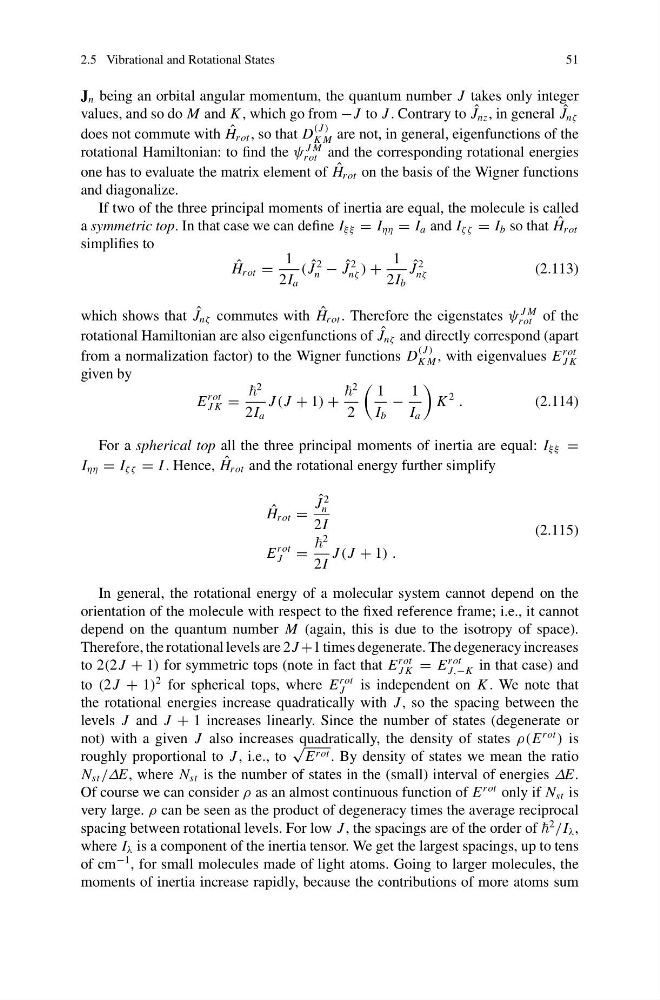
a symmetric top. In that case we can define I ξξ = I ηη = I a and I ζ ζ = I b so that ˆ
H rot
simplifies to
ˆ
H rot =
1
2I a
( ˆ
J
2
n − ˆ
J
2
nζ ) +
1
2I b
ˆ
J
2
nζ
(2.113)
which shows that ˆ
J nζ commutes with ˆ
H rot . Therefore the eigenstates ψ
J M
rot of the
rotational Hamiltonian are also eigenfunctions of ˆ
J nζ and directly correspond (apart
from a normalization factor) to the Wigner functions D
(J )
K M , with eigenvalues E
rot
J K
given by
E
rot
J K =
2
2I a
J (J + 1) +
2
2
1
I b
−
1
I a
K
2
.
(2.114)
For a spherical top all the three principal moments of inertia are equal: I ξξ =
I ηη = I ζ ζ = I . Hence, ˆ
H rot and the rotational energy further simplify
ˆ
H rot =
ˆ
J
2
n
2I
E
rot
J =
2
2I
J (J + 1) .
(2.115)
In general, the rotational energy of a molecular system cannot depend on the
orientation of the molecule with respect to the fixed reference frame; i.e., it cannot
depend on the quantum number M (again, this is due to the isotropy of space).
Therefore, the rotational levels are 2J +1 times degenerate. The degeneracy increases
to 2(2J + 1) for symmetric tops (note in fact that E
rot
J K = E
rot
J,−K in that case) and
to (2J + 1)
2 for spherical tops, where E
rot
J
is independent on K . We note that
the rotational energies increase quadratically with J , so the spacing between the
levels J and J + 1 increases linearly. Since the number of states (degenerate or
not) with a given J also increases quadratically, the density of states ρ(E
rot
) is
roughly proportional to J , i.e., to
√
E rot . By density of states we mean the ratio
N st /ΔE, where N st is the number of states in the (small) interval of energies ΔE.
Of course we can consider ρ as an almost continuous function of E
rot only if N st is
very large. ρ can be seen as the product of degeneracy times the average reciprocal
spacing between rotational levels. For low J , the spacings are of the order of
2
/I λ ,
where I λ is a component of the inertia tensor. We get the largest spacings, up to tens
of cm
−1 , for small molecules made of light atoms. Going to larger molecules, the
moments of inertia increase rapidly, because the contributions of more atoms sum
51
J n being an orbital angular momentum, the quantum number J takes only integer
values, and so do M and K , which go from −J to J . Contrary to ˆ
J nz , in general ˆ
J nζ
does not commute with ˆ
H rot , so that D
(J )
K M are not, in general, eigenfunctions of the
rotational Hamiltonian: to find the ψ
J M
rot and the corresponding rotational energies
one has to evaluate the matrix element of ˆ
H rot on the basis of the Wigner functions
and diagonalize.
If two of the three principal moments of inertia are equal, the molecule is called
a symmetric top. In that case we can define I ξξ = I ηη = I a and I ζ ζ = I b so that ˆ
H rot
simplifies to
ˆ
H rot =
1
2I a
( ˆ
J
2
n − ˆ
J
2
nζ ) +
1
2I b
ˆ
J
2
nζ
(2.113)
which shows that ˆ
J nζ commutes with ˆ
H rot . Therefore the eigenstates ψ
J M
rot of the
rotational Hamiltonian are also eigenfunctions of ˆ
J nζ and directly correspond (apart
from a normalization factor) to the Wigner functions D
(J )
K M , with eigenvalues E
rot
J K
given by
E
rot
J K =
2
2I a
J (J + 1) +
2
2
1
I b
−
1
I a
K
2
.
(2.114)
For a spherical top all the three principal moments of inertia are equal: I ξξ =
I ηη = I ζ ζ = I . Hence, ˆ
H rot and the rotational energy further simplify
ˆ
H rot =
ˆ
J
2
n
2I
E
rot
J =
2
2I
J (J + 1) .
(2.115)
In general, the rotational energy of a molecular system cannot depend on the
orientation of the molecule with respect to the fixed reference frame; i.e., it cannot
depend on the quantum number M (again, this is due to the isotropy of space).
Therefore, the rotational levels are 2J +1 times degenerate. The degeneracy increases
to 2(2J + 1) for symmetric tops (note in fact that E
rot
J K = E
rot
J,−K in that case) and
to (2J + 1)
2 for spherical tops, where E
rot
J
is independent on K . We note that
the rotational energies increase quadratically with J , so the spacing between the
levels J and J + 1 increases linearly. Since the number of states (degenerate or
not) with a given J also increases quadratically, the density of states ρ(E
rot
) is
roughly proportional to J , i.e., to
√
E rot . By density of states we mean the ratio
N st /ΔE, where N st is the number of states in the (small) interval of energies ΔE.
Of course we can consider ρ as an almost continuous function of E
rot only if N st is
very large. ρ can be seen as the product of degeneracy times the average reciprocal
spacing between rotational levels. For low J , the spacings are of the order of
2
/I λ ,
where I λ is a component of the inertia tensor. We get the largest spacings, up to tens
of cm
−1 , for small molecules made of light atoms. Going to larger molecules, the
moments of inertia increase rapidly, because the contributions of more atoms sum