

48
2 Molecular States
ˆ
H
B P
SO =
α
2
2
⎡
⎣
i,ν
Z ν
l iν
r
3
iν
· s i −
i = j
l i j
r
3
i j
· (s i + 2s j )
⎤
⎦
(2.101)
ˆ
H
DK H
SO
= 2α
2
⎡
⎣
i,ν
A i K i Z ν
l iν
r
3
iν
· s i K i A i −
i = j
A i K i A j
l i j
r
3
i j
· (s i + 2s j )A j K i A i
⎤
⎦
(2.102)
with
A i =
E i + c
2
2E i
1/2
K i =
c
2
E i + c 2
E i =
p
2
i c 2 + c 4
(2.103)
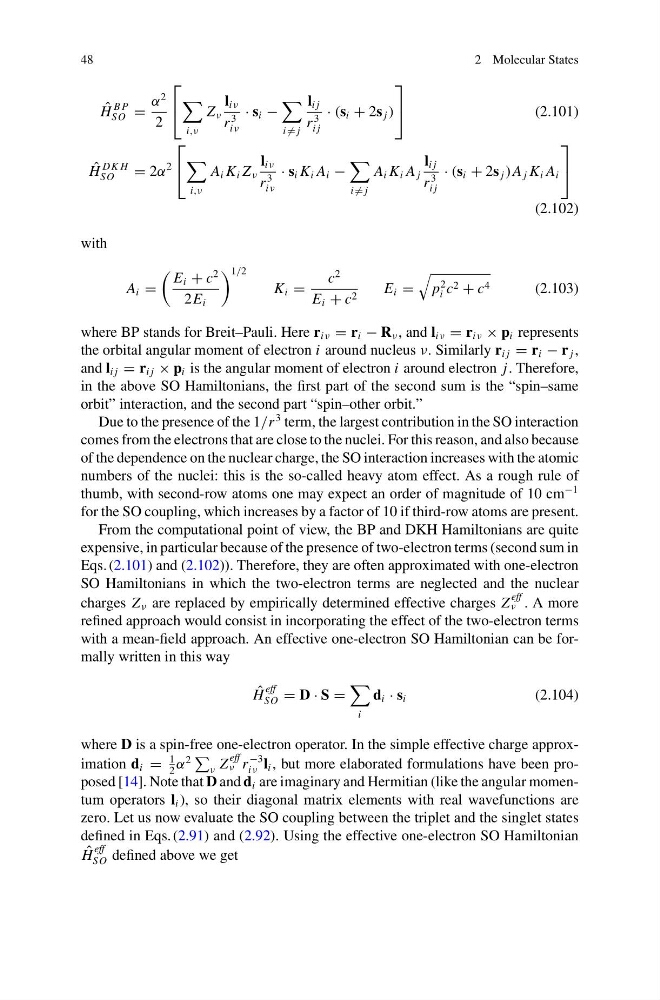
where BP stands for Breit–Pauli. Here r iν = r i − R ν , and l iν = r iν × p i represents
the orbital angular moment of electron i around nucleus ν. Similarly r i j = r i − r j ,
and l i j = r i j × p i is the angular moment of electron i around electron j. Therefore,
in the above SO Hamiltonians, the first part of the second sum is the “spin–same
orbit” interaction, and the second part “spin–other orbit.”
Due to the presence of the 1/r
3 term, the largest contribution in the SO interaction
comes from the electrons that are close to the nuclei. For this reason, and also because
of the dependence on the nuclear charge, the SO interaction increases with the atomic
numbers of the nuclei: this is the so-called heavy atom effect. As a rough rule of
thumb, with second-row atoms one may expect an order of magnitude of 10 cm
−1
for the SO coupling, which increases by a factor of 10 if third-row atoms are present.
From the computational point of view, the BP and DKH Hamiltonians are quite
expensive, in particular because of the presence of two-electron terms (second sum in
Eqs. (2.101) and (2.102)). Therefore, they are often approximated with one-electron
SO Hamiltonians in which the two-electron terms are neglected and the nuclear
charges Z ν are replaced by empirically determined effective charges Z
eff
ν . A more
refined approach would consist in incorporating the effect of the two-electron terms
with a mean-field approach. An effective one-electron SO Hamiltonian can be formally written in this way
ˆ
H
eff
SO = D · S =
i
d i · s i
(2.104)
where D is a spin-free one-electron operator. In the simple effective charge approximation d i =
1
2
α
2
ν Z
eff
ν r
−3
iν l i , but more elaborated formulations have been proposed [14]. Note that D and d i are imaginary and Hermitian (like the angular momentum operators l i ), so their diagonal matrix elements with real wavefunctions are
zero. Let us now evaluate the SO coupling between the triplet and the singlet states
defined in Eqs. (2.91) and (2.92). Using the effective one-electron SO Hamiltonian
ˆ
H
eff
SO defined above we get
2 Molecular States
ˆ
H
B P
SO =
α
2
2
⎡
⎣
i,ν
Z ν
l iν
r
3
iν
· s i −
i = j
l i j
r
3
i j
· (s i + 2s j )
⎤
⎦
(2.101)
ˆ
H
DK H
SO
= 2α
2
⎡
⎣
i,ν
A i K i Z ν
l iν
r
3
iν
· s i K i A i −
i = j
A i K i A j
l i j
r
3
i j
· (s i + 2s j )A j K i A i
⎤
⎦
(2.102)
with
A i =
E i + c
2
2E i
1/2
K i =
c
2
E i + c 2
E i =
p
2
i c 2 + c 4
(2.103)
where BP stands for Breit–Pauli. Here r iν = r i − R ν , and l iν = r iν × p i represents
the orbital angular moment of electron i around nucleus ν. Similarly r i j = r i − r j ,
and l i j = r i j × p i is the angular moment of electron i around electron j. Therefore,
in the above SO Hamiltonians, the first part of the second sum is the “spin–same
orbit” interaction, and the second part “spin–other orbit.”
Due to the presence of the 1/r
3 term, the largest contribution in the SO interaction
comes from the electrons that are close to the nuclei. For this reason, and also because
of the dependence on the nuclear charge, the SO interaction increases with the atomic
numbers of the nuclei: this is the so-called heavy atom effect. As a rough rule of
thumb, with second-row atoms one may expect an order of magnitude of 10 cm
−1
for the SO coupling, which increases by a factor of 10 if third-row atoms are present.
From the computational point of view, the BP and DKH Hamiltonians are quite
expensive, in particular because of the presence of two-electron terms (second sum in
Eqs. (2.101) and (2.102)). Therefore, they are often approximated with one-electron
SO Hamiltonians in which the two-electron terms are neglected and the nuclear
charges Z ν are replaced by empirically determined effective charges Z
eff
ν . A more
refined approach would consist in incorporating the effect of the two-electron terms
with a mean-field approach. An effective one-electron SO Hamiltonian can be formally written in this way
ˆ
H
eff
SO = D · S =
i
d i · s i
(2.104)
where D is a spin-free one-electron operator. In the simple effective charge approximation d i =
1
2
α
2
ν Z
eff
ν r
−3
iν l i , but more elaborated formulations have been proposed [14]. Note that D and d i are imaginary and Hermitian (like the angular momentum operators l i ), so their diagonal matrix elements with real wavefunctions are
zero. Let us now evaluate the SO coupling between the triplet and the singlet states
defined in Eqs. (2.91) and (2.92). Using the effective one-electron SO Hamiltonian
ˆ
H
eff
SO defined above we get