

2.4 The Electrostatic Approximation: Spin and Magnetic Couplings
49
S
ˆ
H
eff
SO
T
(1)
=
1
2
√
2
2
i=1
φ a φ b + φ b φ a |d i | φ a φ b − φ b φ a · αβ − βα |s i | αα
=
1
√
2
(φ b |d| φ b − φ a |d| φ a ) · β |s| α = 0
(2.105)
S
ˆ
H
eff
SO
T
(−1)
=
1
2
√
2
2
i=1
φ a φ b + φ b φ a |d i | φ a φ b − φ b φ a · αβ − βα |s i | ββ
=
1
√
2
(φ a |d| φ a − φ b |d| φ b ) · α |s| β = 0
(2.106)
S
ˆ
H
eff
SO
T
(0)
=
1
4
2
i=1
φ a φ b + φ b φ a |d i | φ a φ b − φ b φ a · αβ − βα |s i | αβ + βα
=
2
φ a
ˆ
d z
φ a
−
φ b
ˆ
d z
φ b
= 0
(2.107)
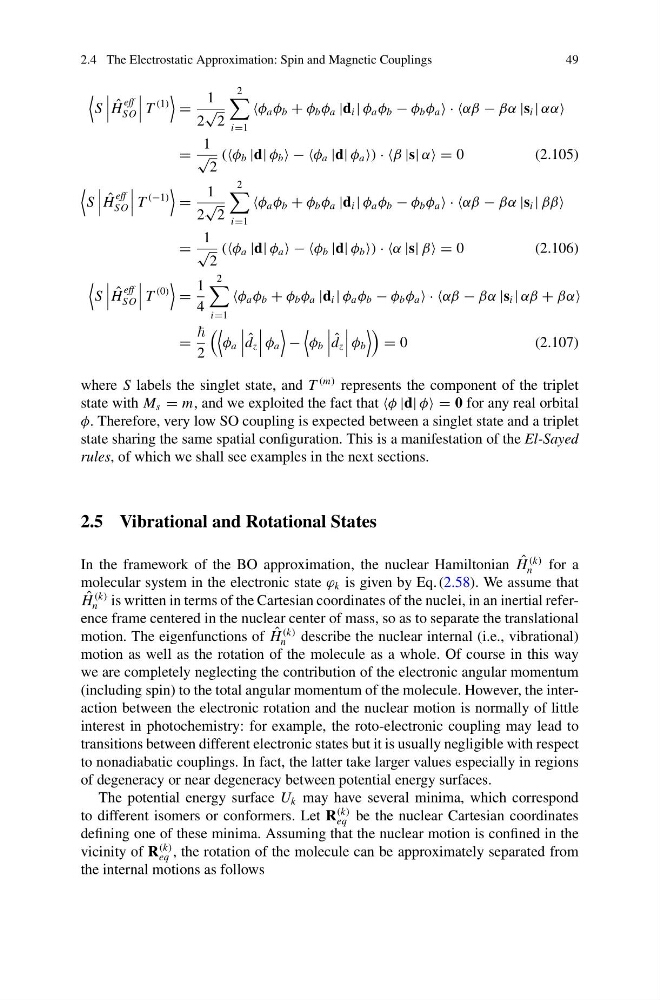
where S labels the singlet state, and T
(m) represents the component of the triplet
state with M s = m, and we exploited the fact that φ |d| φ = 0 for any real orbital
φ. Therefore, very low SO coupling is expected between a singlet state and a triplet
state sharing the same spatial configuration. This is a manifestation of the El-Sayed
rules, of which we shall see examples in the next sections.
2.5 Vibrational and Rotational States
In the framework of the BO approximation, the nuclear Hamiltonian ˆ
H
(k)
n
for a
molecular system in the electronic state ϕ k is given by Eq. (2.58). We assume that
ˆ
H
(k)
n is written in terms of the Cartesian coordinates of the nuclei, in an inertial reference frame centered in the nuclear center of mass, so as to separate the translational
motion. The eigenfunctions of ˆ
H
(k)
n describe the nuclear internal (i.e., vibrational)
motion as well as the rotation of the molecule as a whole. Of course in this way
we are completely neglecting the contribution of the electronic angular momentum
(including spin) to the total angular momentum of the molecule. However, the interaction between the electronic rotation and the nuclear motion is normally of little
interest in photochemistry: for example, the roto-electronic coupling may lead to
transitions between different electronic states but it is usually negligible with respect
to nonadiabatic couplings. In fact, the latter take larger values especially in regions
of degeneracy or near degeneracy between potential energy surfaces.
The potential energy surface U k may have several minima, which correspond
to different isomers or conformers. Let R
(k)
eq be the nuclear Cartesian coordinates
defining one of these minima. Assuming that the nuclear motion is confined in the
vicinity of R
(k)
eq , the rotation of the molecule can be approximately separated from
the internal motions as follows
49
S
ˆ
H
eff
SO
T
(1)
=
1
2
√
2
2
i=1
φ a φ b + φ b φ a |d i | φ a φ b − φ b φ a · αβ − βα |s i | αα
=
1
√
2
(φ b |d| φ b − φ a |d| φ a ) · β |s| α = 0
(2.105)
S
ˆ
H
eff
SO
T
(−1)
=
1
2
√
2
2
i=1
φ a φ b + φ b φ a |d i | φ a φ b − φ b φ a · αβ − βα |s i | ββ
=
1
√
2
(φ a |d| φ a − φ b |d| φ b ) · α |s| β = 0
(2.106)
S
ˆ
H
eff
SO
T
(0)
=
1
4
2
i=1
φ a φ b + φ b φ a |d i | φ a φ b − φ b φ a · αβ − βα |s i | αβ + βα
=
2
φ a
ˆ
d z
φ a
−
φ b
ˆ
d z
φ b
= 0
(2.107)
where S labels the singlet state, and T
(m) represents the component of the triplet
state with M s = m, and we exploited the fact that φ |d| φ = 0 for any real orbital
φ. Therefore, very low SO coupling is expected between a singlet state and a triplet
state sharing the same spatial configuration. This is a manifestation of the El-Sayed
rules, of which we shall see examples in the next sections.
2.5 Vibrational and Rotational States
In the framework of the BO approximation, the nuclear Hamiltonian ˆ
H
(k)
n
for a
molecular system in the electronic state ϕ k is given by Eq. (2.58). We assume that
ˆ
H
(k)
n is written in terms of the Cartesian coordinates of the nuclei, in an inertial reference frame centered in the nuclear center of mass, so as to separate the translational
motion. The eigenfunctions of ˆ
H
(k)
n describe the nuclear internal (i.e., vibrational)
motion as well as the rotation of the molecule as a whole. Of course in this way
we are completely neglecting the contribution of the electronic angular momentum
(including spin) to the total angular momentum of the molecule. However, the interaction between the electronic rotation and the nuclear motion is normally of little
interest in photochemistry: for example, the roto-electronic coupling may lead to
transitions between different electronic states but it is usually negligible with respect
to nonadiabatic couplings. In fact, the latter take larger values especially in regions
of degeneracy or near degeneracy between potential energy surfaces.
The potential energy surface U k may have several minima, which correspond
to different isomers or conformers. Let R
(k)
eq be the nuclear Cartesian coordinates
defining one of these minima. Assuming that the nuclear motion is confined in the
vicinity of R
(k)
eq , the rotation of the molecule can be approximately separated from
the internal motions as follows