

46
2 Molecular States
We could proceed considering more unpaired electrons (for a more systematic
approach, see, e.g., de Graaf and Broer [8]). However, in most organic molecules the
ground electronic state is well represented by a wavefunction in which each occupied
orbital has two electrons (often called a closed shell) and the lowest lying excited
states are singlets or triplets with no more than two unpaired electrons (see also
Sect. 1.4). Therefore, the above discussion is sufficient to approach spin problems in
many molecular systems.
2.4.2 Spin–Orbit Coupling
As we have seen, in the electrostatic approximation the molecular Hamiltonian does
not depend on spin. Therefore, the components of an electronic spin multiplet, which
share the same space parts (see e.g., (2.91)), are degenerate. More importantly, two
electronic states ϕ k and ϕ l having different spin part do not interact (i.e., ˆ
V
B O
kl
= 0)
so that the time evolution of the corresponding nuclear wavepackets does not lead to
any population transfer between Θ k and Θ l . It is therefore mandatory to include the
small interaction terms dependent on electronic spin in the electronic Hamiltonian
to account for radiative and nonradiative “spin-forbidden” processes (i.e., ISC and
phosphorescence, see Fig. 1.1). The most important interaction in this respect is the
spin–orbit (SO) coupling, which is considered in the present section.
An appraisal of the SO interaction can be obtained by the following argument of
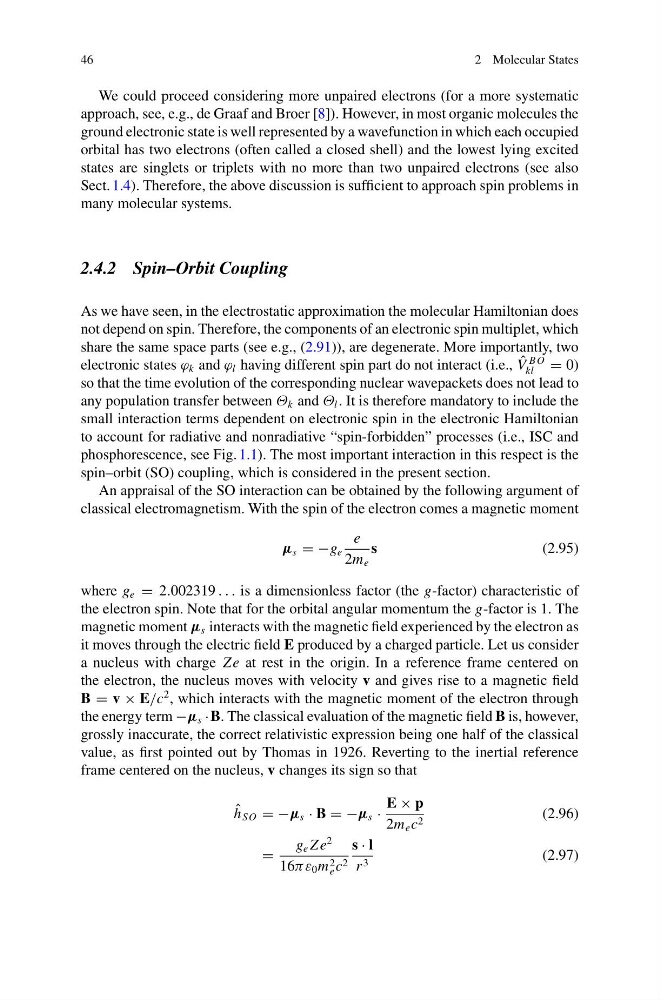
classical electromagnetism. With the spin of the electron comes a magnetic moment
μ s = −g e
e
2m e
s
(2.95)
where g e = 2.002319 . . . is a dimensionless factor (the g-factor) characteristic of
the electron spin. Note that for the orbital angular momentum the g-factor is 1. The
magnetic moment μ s interacts with the magnetic field experienced by the electron as
it moves through the electric field E produced by a charged particle. Let us consider
a nucleus with charge Ze at rest in the origin. In a reference frame centered on
the electron, the nucleus moves with velocity v and gives rise to a magnetic field
B = v × E/c
2 , which interacts with the magnetic moment of the electron through
the energy term −μ s · B. The classical evaluation of the magnetic field B is, however,
grossly inaccurate, the correct relativistic expression being one half of the classical
value, as first pointed out by Thomas in 1926. Reverting to the inertial reference
frame centered on the nucleus, v changes its sign so that
ˆ
h SO = −μ s · B = −μ s ·
E × p
2m e c 2
(2.96)
=
g e Ze
2
16πε 0 m 2
e c 2
s · l
r 3
(2.97)
2 Molecular States
We could proceed considering more unpaired electrons (for a more systematic
approach, see, e.g., de Graaf and Broer [8]). However, in most organic molecules the
ground electronic state is well represented by a wavefunction in which each occupied
orbital has two electrons (often called a closed shell) and the lowest lying excited
states are singlets or triplets with no more than two unpaired electrons (see also
Sect. 1.4). Therefore, the above discussion is sufficient to approach spin problems in
many molecular systems.
2.4.2 Spin–Orbit Coupling
As we have seen, in the electrostatic approximation the molecular Hamiltonian does
not depend on spin. Therefore, the components of an electronic spin multiplet, which
share the same space parts (see e.g., (2.91)), are degenerate. More importantly, two
electronic states ϕ k and ϕ l having different spin part do not interact (i.e., ˆ
V
B O
kl
= 0)
so that the time evolution of the corresponding nuclear wavepackets does not lead to
any population transfer between Θ k and Θ l . It is therefore mandatory to include the
small interaction terms dependent on electronic spin in the electronic Hamiltonian
to account for radiative and nonradiative “spin-forbidden” processes (i.e., ISC and
phosphorescence, see Fig. 1.1). The most important interaction in this respect is the
spin–orbit (SO) coupling, which is considered in the present section.
An appraisal of the SO interaction can be obtained by the following argument of
classical electromagnetism. With the spin of the electron comes a magnetic moment
μ s = −g e
e
2m e
s
(2.95)
where g e = 2.002319 . . . is a dimensionless factor (the g-factor) characteristic of
the electron spin. Note that for the orbital angular momentum the g-factor is 1. The
magnetic moment μ s interacts with the magnetic field experienced by the electron as
it moves through the electric field E produced by a charged particle. Let us consider
a nucleus with charge Ze at rest in the origin. In a reference frame centered on
the electron, the nucleus moves with velocity v and gives rise to a magnetic field
B = v × E/c
2 , which interacts with the magnetic moment of the electron through
the energy term −μ s · B. The classical evaluation of the magnetic field B is, however,
grossly inaccurate, the correct relativistic expression being one half of the classical
value, as first pointed out by Thomas in 1926. Reverting to the inertial reference
frame centered on the nucleus, v changes its sign so that
ˆ
h SO = −μ s · B = −μ s ·
E × p
2m e c 2
(2.96)
=
g e Ze
2
16πε 0 m 2
e c 2
s · l
r 3
(2.97)