

2.4 The Electrostatic Approximation: Spin and Magnetic Couplings
45
φ a φ b − φ b φ a
√
2
·
⎧
⎪ ⎪ ⎪ ⎨
⎪ ⎪ ⎪ ⎩
αα
S = 1, M S = 1
αβ + βα
√
2
S = 1, M S = 0
ββ
S = 1, M S = −1
(2.91)
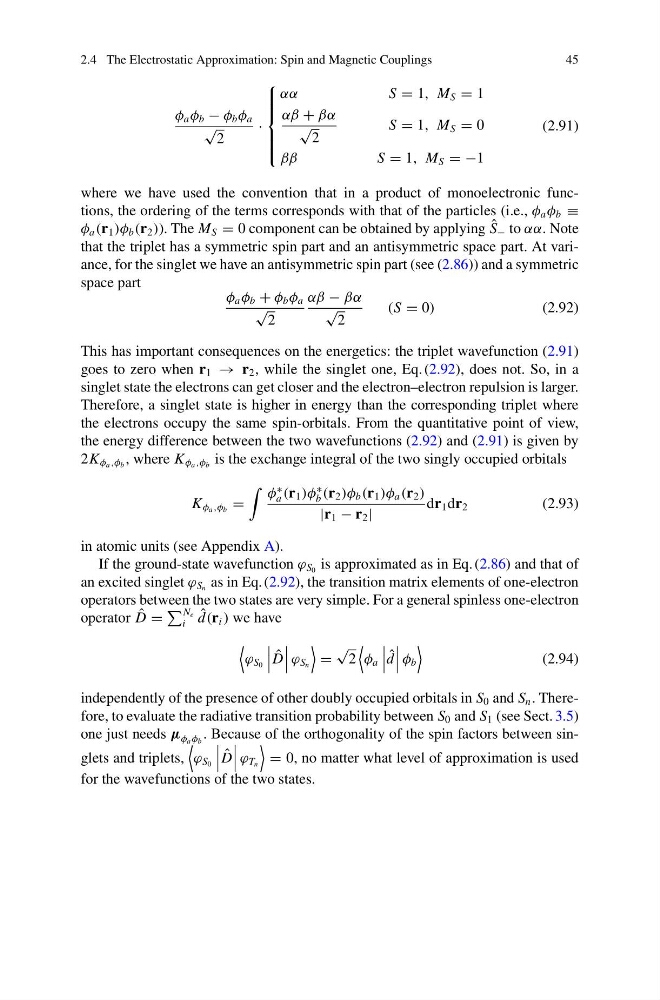
where we have used the convention that in a product of monoelectronic functions, the ordering of the terms corresponds with that of the particles (i.e., φ a φ b ≡
φ a (r 1 )φ b (r 2 )). The M S = 0 component can be obtained by applying ˆ
S − to αα. Note
that the triplet has a symmetric spin part and an antisymmetric space part. At variance, for the singlet we have an antisymmetric spin part (see (2.86)) and a symmetric
space part
φ a φ b + φ b φ a
√
2
αβ − βα
√
2
(S = 0)
(2.92)
This has important consequences on the energetics: the triplet wavefunction (2.91)
goes to zero when r 1 → r 2 , while the singlet one, Eq. (2.92), does not. So, in a
singlet state the electrons can get closer and the electron–electron repulsion is larger.
Therefore, a singlet state is higher in energy than the corresponding triplet where
the electrons occupy the same spin-orbitals. From the quantitative point of view,
the energy difference between the two wavefunctions (2.92) and (2.91) is given by
2K φ a ,φ b , where K φ a ,φ b is the exchange integral of the two singly occupied orbitals
K φ a ,φ b =
φ
∗
a (r 1 )φ
∗
b (r 2 )φ b (r 1 )φ a (r 2 )
|r 1 − r 2 |
dr 1 dr 2
(2.93)
in atomic units (see Appendix A).
If the ground-state wavefunction ϕ S 0 is approximated as in Eq. (2.86) and that of
an excited singlet ϕ S n as in Eq. (2.92), the transition matrix elements of one-electron
operators between the two states are very simple. For a general spinless one-electron
operator ˆ
D =
N e
i
ˆ
d(r i ) we have
ϕ S 0
ˆ
D
ϕ S n
=
√
2
φ a
ˆ
d
φ b
(2.94)
independently of the presence of other doubly occupied orbitals in S 0 and S n . Therefore, to evaluate the radiative transition probability between S 0 and S 1 (see Sect. 3.5)
one just needs μ φ a φ b . Because of the orthogonality of the spin factors between singlets and triplets,
ϕ S 0
ˆ
D
ϕ T n
= 0, no matter what level of approximation is used
for the wavefunctions of the two states.
45
φ a φ b − φ b φ a
√
2
·
⎧
⎪ ⎪ ⎪ ⎨
⎪ ⎪ ⎪ ⎩
αα
S = 1, M S = 1
αβ + βα
√
2
S = 1, M S = 0
ββ
S = 1, M S = −1
(2.91)
where we have used the convention that in a product of monoelectronic functions, the ordering of the terms corresponds with that of the particles (i.e., φ a φ b ≡
φ a (r 1 )φ b (r 2 )). The M S = 0 component can be obtained by applying ˆ
S − to αα. Note
that the triplet has a symmetric spin part and an antisymmetric space part. At variance, for the singlet we have an antisymmetric spin part (see (2.86)) and a symmetric
space part
φ a φ b + φ b φ a
√
2
αβ − βα
√
2
(S = 0)
(2.92)
This has important consequences on the energetics: the triplet wavefunction (2.91)
goes to zero when r 1 → r 2 , while the singlet one, Eq. (2.92), does not. So, in a
singlet state the electrons can get closer and the electron–electron repulsion is larger.
Therefore, a singlet state is higher in energy than the corresponding triplet where
the electrons occupy the same spin-orbitals. From the quantitative point of view,
the energy difference between the two wavefunctions (2.92) and (2.91) is given by
2K φ a ,φ b , where K φ a ,φ b is the exchange integral of the two singly occupied orbitals
K φ a ,φ b =
φ
∗
a (r 1 )φ
∗
b (r 2 )φ b (r 1 )φ a (r 2 )
|r 1 − r 2 |
dr 1 dr 2
(2.93)
in atomic units (see Appendix A).
If the ground-state wavefunction ϕ S 0 is approximated as in Eq. (2.86) and that of
an excited singlet ϕ S n as in Eq. (2.92), the transition matrix elements of one-electron
operators between the two states are very simple. For a general spinless one-electron
operator ˆ
D =
N e
i
ˆ
d(r i ) we have
ϕ S 0
ˆ
D
ϕ S n
=
√
2
φ a
ˆ
d
φ b
(2.94)
independently of the presence of other doubly occupied orbitals in S 0 and S n . Therefore, to evaluate the radiative transition probability between S 0 and S 1 (see Sect. 3.5)
one just needs μ φ a φ b . Because of the orthogonality of the spin factors between singlets and triplets,
ϕ S 0
ˆ
D
ϕ T n
= 0, no matter what level of approximation is used
for the wavefunctions of the two states.