

44
2 Molecular States
and it is called a Slater determinant. The spin-orbitals must be different, otherwise the
Slater determinant vanishes (see Levine [4] or McWeeny [7] for a deeper discussion
of the representation of electronic wavefunctions).
2.4.1 Singlet and Triplet Wavefunctions
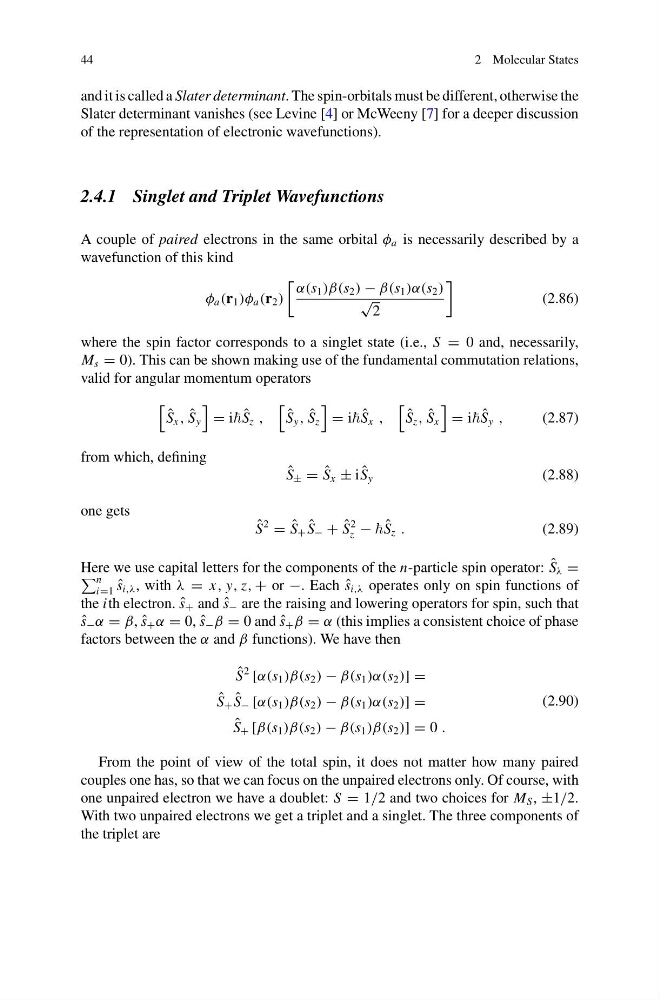
A couple of paired electrons in the same orbital φ a is necessarily described by a
wavefunction of this kind
φ a (r 1 )φ a (r 2 )
α(s 1 )β(s 2 ) − β(s 1 )α(s 2 )
√
2
(2.86)
where the spin factor corresponds to a singlet state (i.e., S = 0 and, necessarily,
M s = 0). This can be shown making use of the fundamental commutation relations,
valid for angular momentum operators
ˆ
S x , ˆ
S y
= i ˆ
S z ,
ˆ
S y , ˆ
S z
= i ˆ
S x ,
ˆ
S z , ˆ
S x
= i ˆ
S y ,
(2.87)
from which, defining
ˆ
S ± = ˆ
S x ± i ˆ
S y
(2.88)
one gets
ˆ
S
2
= ˆ
S + ˆ
S − + ˆ
S
2
z − ˆ
S z .
(2.89)
Here we use capital letters for the components of the n-particle spin operator: ˆ
S λ =
n
i=1 ˆ
s i,λ , with λ = x, y, z, + or −. Each ˆ
s i,λ operates only on spin functions of
the ith electron. ˆ
s + and ˆ
s − are the raising and lowering operators for spin, such that
ˆ
s − α = β, ˆ
s + α = 0, ˆ
s − β = 0 and ˆ
s + β = α (this implies a consistent choice of phase
factors between the α and β functions). We have then
ˆ
S
2 [α(s 1 )β(s 2 ) − β(s 1 )α(s 2 )] =
ˆ
S + ˆ
S − [α(s 1 )β(s 2 ) − β(s 1 )α(s 2 )] =
ˆ
S + [β(s 1 )β(s 2 ) − β(s 1 )β(s 2 )] = 0 .
(2.90)
From the point of view of the total spin, it does not matter how many paired
couples one has, so that we can focus on the unpaired electrons only. Of course, with
one unpaired electron we have a doublet: S = 1/2 and two choices for M S , ±1/2.
With two unpaired electrons we get a triplet and a singlet. The three components of
the triplet are
2 Molecular States
and it is called a Slater determinant. The spin-orbitals must be different, otherwise the
Slater determinant vanishes (see Levine [4] or McWeeny [7] for a deeper discussion
of the representation of electronic wavefunctions).
2.4.1 Singlet and Triplet Wavefunctions
A couple of paired electrons in the same orbital φ a is necessarily described by a
wavefunction of this kind
φ a (r 1 )φ a (r 2 )
α(s 1 )β(s 2 ) − β(s 1 )α(s 2 )
√
2
(2.86)
where the spin factor corresponds to a singlet state (i.e., S = 0 and, necessarily,
M s = 0). This can be shown making use of the fundamental commutation relations,
valid for angular momentum operators
ˆ
S x , ˆ
S y
= i ˆ
S z ,
ˆ
S y , ˆ
S z
= i ˆ
S x ,
ˆ
S z , ˆ
S x
= i ˆ
S y ,
(2.87)
from which, defining
ˆ
S ± = ˆ
S x ± i ˆ
S y
(2.88)
one gets
ˆ
S
2
= ˆ
S + ˆ
S − + ˆ
S
2
z − ˆ
S z .
(2.89)
Here we use capital letters for the components of the n-particle spin operator: ˆ
S λ =
n
i=1 ˆ
s i,λ , with λ = x, y, z, + or −. Each ˆ
s i,λ operates only on spin functions of
the ith electron. ˆ
s + and ˆ
s − are the raising and lowering operators for spin, such that
ˆ
s − α = β, ˆ
s + α = 0, ˆ
s − β = 0 and ˆ
s + β = α (this implies a consistent choice of phase
factors between the α and β functions). We have then
ˆ
S
2 [α(s 1 )β(s 2 ) − β(s 1 )α(s 2 )] =
ˆ
S + ˆ
S − [α(s 1 )β(s 2 ) − β(s 1 )α(s 2 )] =
ˆ
S + [β(s 1 )β(s 2 ) − β(s 1 )β(s 2 )] = 0 .
(2.90)
From the point of view of the total spin, it does not matter how many paired
couples one has, so that we can focus on the unpaired electrons only. Of course, with
one unpaired electron we have a doublet: S = 1/2 and two choices for M S , ±1/2.
With two unpaired electrons we get a triplet and a singlet. The three components of
the triplet are