

42
2 Molecular States
2.3.3 Time Evolution in the BO Framework
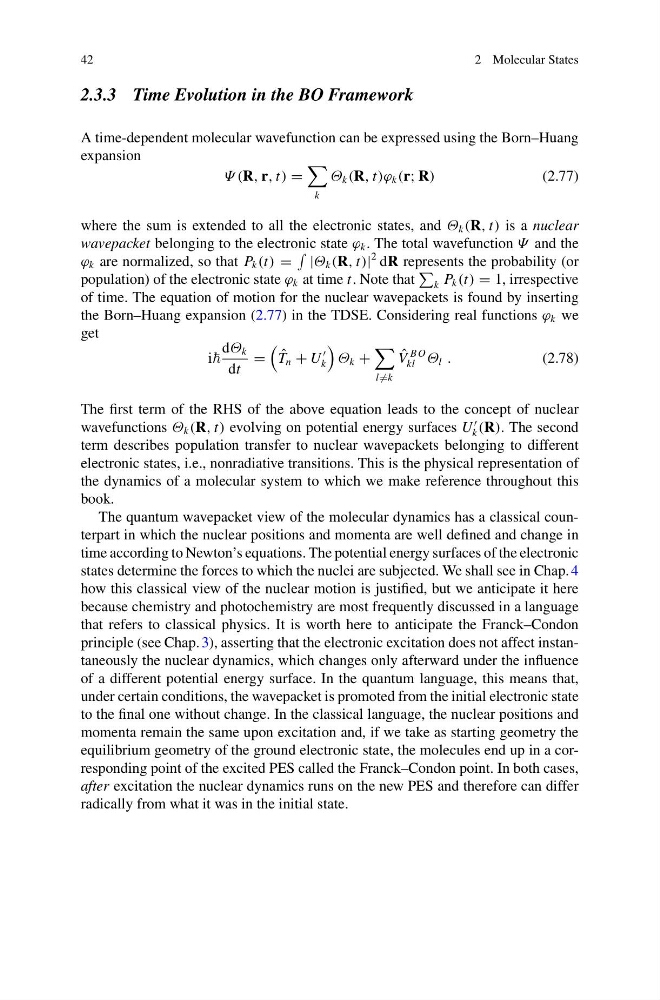
A time-dependent molecular wavefunction can be expressed using the Born–Huang
expansion
Ψ (R, r, t) =
k
Θ k (R, t)ϕ k (r; R)
(2.77)
where the sum is extended to all the electronic states, and Θ k (R, t) is a nuclear
wavepacket belonging to the electronic state ϕ k . The total wavefunction Ψ and the
ϕ k are normalized, so that P k (t) =
|Θ k (R, t)|
2 dR represents the probability (or
population) of the electronic state ϕ k at time t. Note that
k P k (t) = 1, irrespective
of time. The equation of motion for the nuclear wavepackets is found by inserting
the Born–Huang expansion (2.77) in the TDSE. Considering real functions ϕ k we
get
i
dΘ k
dt
=
ˆ
T n + U
k
Θ k +
l =k
ˆ
V
B O
kl Θ l .
(2.78)
The first term of the RHS of the above equation leads to the concept of nuclear
wavefunctions Θ k (R, t) evolving on potential energy surfaces U
k (R). The second
term describes population transfer to nuclear wavepackets belonging to different
electronic states, i.e., nonradiative transitions. This is the physical representation of
the dynamics of a molecular system to which we make reference throughout this
book.
The quantum wavepacket view of the molecular dynamics has a classical counterpart in which the nuclear positions and momenta are well defined and change in
time according to Newton’s equations. The potential energy surfaces of the electronic
states determine the forces to which the nuclei are subjected. We shall see in Chap. 4
how this classical view of the nuclear motion is justified, but we anticipate it here
because chemistry and photochemistry are most frequently discussed in a language
that refers to classical physics. It is worth here to anticipate the Franck–Condon
principle (see Chap. 3), asserting that the electronic excitation does not affect instantaneously the nuclear dynamics, which changes only afterward under the influence
of a different potential energy surface. In the quantum language, this means that,
under certain conditions, the wavepacket is promoted from the initial electronic state
to the final one without change. In the classical language, the nuclear positions and
momenta remain the same upon excitation and, if we take as starting geometry the
equilibrium geometry of the ground electronic state, the molecules end up in a corresponding point of the excited PES called the Franck–Condon point. In both cases,
after excitation the nuclear dynamics runs on the new PES and therefore can differ
radically from what it was in the initial state.
2 Molecular States
2.3.3 Time Evolution in the BO Framework
A time-dependent molecular wavefunction can be expressed using the Born–Huang
expansion
Ψ (R, r, t) =
k
Θ k (R, t)ϕ k (r; R)
(2.77)
where the sum is extended to all the electronic states, and Θ k (R, t) is a nuclear
wavepacket belonging to the electronic state ϕ k . The total wavefunction Ψ and the
ϕ k are normalized, so that P k (t) =
|Θ k (R, t)|
2 dR represents the probability (or
population) of the electronic state ϕ k at time t. Note that
k P k (t) = 1, irrespective
of time. The equation of motion for the nuclear wavepackets is found by inserting
the Born–Huang expansion (2.77) in the TDSE. Considering real functions ϕ k we
get
i
dΘ k
dt
=
ˆ
T n + U
k
Θ k +
l =k
ˆ
V
B O
kl Θ l .
(2.78)
The first term of the RHS of the above equation leads to the concept of nuclear
wavefunctions Θ k (R, t) evolving on potential energy surfaces U
k (R). The second
term describes population transfer to nuclear wavepackets belonging to different
electronic states, i.e., nonradiative transitions. This is the physical representation of
the dynamics of a molecular system to which we make reference throughout this
book.
The quantum wavepacket view of the molecular dynamics has a classical counterpart in which the nuclear positions and momenta are well defined and change in
time according to Newton’s equations. The potential energy surfaces of the electronic
states determine the forces to which the nuclei are subjected. We shall see in Chap. 4
how this classical view of the nuclear motion is justified, but we anticipate it here
because chemistry and photochemistry are most frequently discussed in a language
that refers to classical physics. It is worth here to anticipate the Franck–Condon
principle (see Chap. 3), asserting that the electronic excitation does not affect instantaneously the nuclear dynamics, which changes only afterward under the influence
of a different potential energy surface. In the quantum language, this means that,
under certain conditions, the wavepacket is promoted from the initial electronic state
to the final one without change. In the classical language, the nuclear positions and
momenta remain the same upon excitation and, if we take as starting geometry the
equilibrium geometry of the ground electronic state, the molecules end up in a corresponding point of the excited PES called the Franck–Condon point. In both cases,
after excitation the nuclear dynamics runs on the new PES and therefore can differ
radically from what it was in the initial state.