

2.3 The Born–Oppenheimer Approximation and Its Breakdown …
41
the latter may have several nodes, maxima and minima within the same interval (even
the v = 0 wavefunction normally goes from almost zero to the maximum value and
back to zero in a fraction of bohr). Then, the denominators of Eqs. (2.74) and (2.75)
are much larger than the nonadiabatic couplings, if we consider low-lying vibrational
levels. For larger values of the vibrational quantum number v, the energy difference
E lu − E 0v decreases and χ 0v explores a larger portion of the nuclear configurational
space, making more likely to reach regions where U l − U 0 is small. In these conditions, it may be important to take into account the nonadiabatic couplings. This
amounts to say that for highly distorted molecular geometries (e.g., at a transition
state) the BO approximation is less valid than at the equilibrium geometry.
The excited electronic states behave in a very different way. In fact, for any
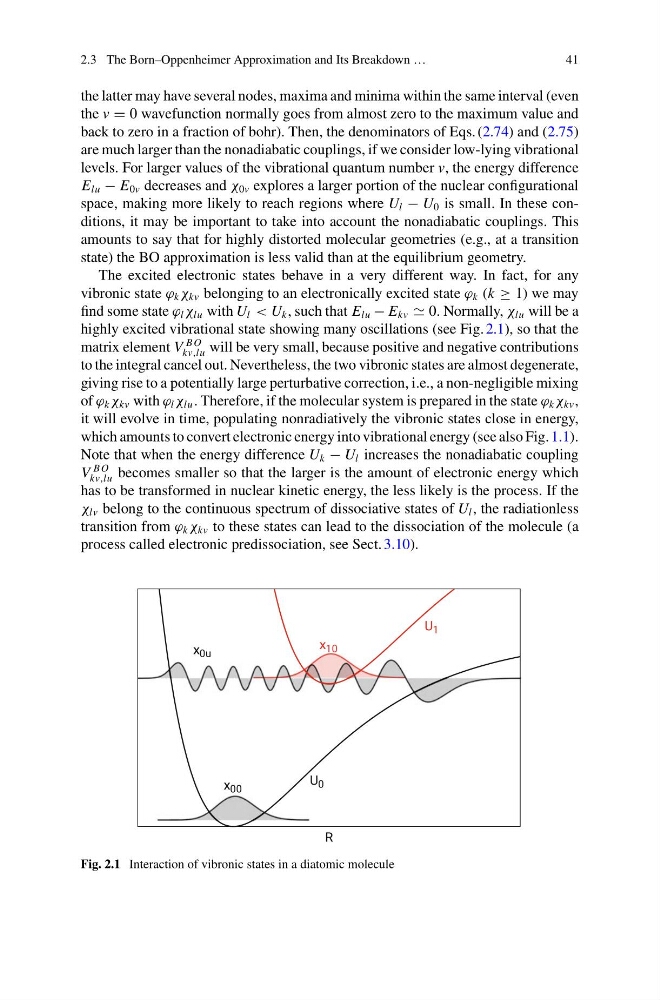
vibronic state ϕ k χ kv belonging to an electronically excited state ϕ k (k ≥ 1) we may
find some state ϕ l χ lu with U l < U k , such that E lu − E kv 0. Normally, χ lu will be a
highly excited vibrational state showing many oscillations (see Fig. 2.1), so that the
matrix element V
B O
kv,lu will be very small, because positive and negative contributions
to the integral cancel out. Nevertheless, the two vibronic states are almost degenerate,
giving rise to a potentially large perturbative correction, i.e., a non-negligible mixing
of ϕ k χ kv with ϕ l χ lu . Therefore, if the molecular system is prepared in the state ϕ k χ kv ,
it will evolve in time, populating nonradiatively the vibronic states close in energy,
which amounts to convert electronic energy into vibrational energy (see also Fig. 1.1).
Note that when the energy difference U k − U l increases the nonadiabatic coupling
V
B O
kv,lu becomes smaller so that the larger is the amount of electronic energy which
has to be transformed in nuclear kinetic energy, the less likely is the process. If the
χ lv belong to the continuous spectrum of dissociative states of U l , the radiationless
transition from ϕ k χ kv to these states can lead to the dissociation of the molecule (a
process called electronic predissociation, see Sect. 3.10).
x
x
x
Fig. 2.1 Interaction of vibronic states in a diatomic molecule
41
the latter may have several nodes, maxima and minima within the same interval (even
the v = 0 wavefunction normally goes from almost zero to the maximum value and
back to zero in a fraction of bohr). Then, the denominators of Eqs. (2.74) and (2.75)
are much larger than the nonadiabatic couplings, if we consider low-lying vibrational
levels. For larger values of the vibrational quantum number v, the energy difference
E lu − E 0v decreases and χ 0v explores a larger portion of the nuclear configurational
space, making more likely to reach regions where U l − U 0 is small. In these conditions, it may be important to take into account the nonadiabatic couplings. This
amounts to say that for highly distorted molecular geometries (e.g., at a transition
state) the BO approximation is less valid than at the equilibrium geometry.
The excited electronic states behave in a very different way. In fact, for any
vibronic state ϕ k χ kv belonging to an electronically excited state ϕ k (k ≥ 1) we may
find some state ϕ l χ lu with U l < U k , such that E lu − E kv 0. Normally, χ lu will be a
highly excited vibrational state showing many oscillations (see Fig. 2.1), so that the
matrix element V
B O
kv,lu will be very small, because positive and negative contributions
to the integral cancel out. Nevertheless, the two vibronic states are almost degenerate,
giving rise to a potentially large perturbative correction, i.e., a non-negligible mixing
of ϕ k χ kv with ϕ l χ lu . Therefore, if the molecular system is prepared in the state ϕ k χ kv ,
it will evolve in time, populating nonradiatively the vibronic states close in energy,
which amounts to convert electronic energy into vibrational energy (see also Fig. 1.1).
Note that when the energy difference U k − U l increases the nonadiabatic coupling
V
B O
kv,lu becomes smaller so that the larger is the amount of electronic energy which
has to be transformed in nuclear kinetic energy, the less likely is the process. If the
χ lv belong to the continuous spectrum of dissociative states of U l , the radiationless
transition from ϕ k χ kv to these states can lead to the dissociation of the molecule (a
process called electronic predissociation, see Sect. 3.10).
x
x
x
Fig. 2.1 Interaction of vibronic states in a diatomic molecule